INTERVIEW
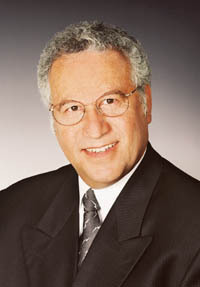
Irving Schneider
POSITION: President of Johnson & Wales University, Providence Campus
Background: After teaching at Johnson & Wales for 16 years, Schneider was promoted to dean of the business division in 1986. In 1997, he was promoted to vice president of academic affairs and, in 2000, to vice president of the Providence Campus. Schneider assumed the role of president of the Providence Campus in January 2004.
EDUCATION: B.S. in marketing from Husson College, Bangor, Maine, in 1968; M.A. technical and industrial education from the University of Connecticut, 1975; Ph.D. in technical and industrial education, University of Connecticut, 1982.
RESIDENCE: Warwick
AGE: 61
Irving Schneider calls it turning an “eyesore into an asset.” That’s how the Johnson & Wales University Providence Campus president describes the plans for Harborside Village, an apartment complex for students built on a rehabbed brownfield. PBN sat down with Schneider to talk about the project, the university’s curriculum, and its place in the community.
Seifert Systems Invests in Energy Efficiency to Strengthen Operations
For manufacturers, energy is more than just another operating expense. It plays a critical role…
Learn More
PBN: Why is there a need to build the Harborside Village, with about 575 apartments?
SCHNEIDER: The purpose of building more housing on campus is really not to increase our student enrollment, but to have better housing for the students that we have on campus. Also, we want to make our housing more centralized. We had housing out in Warwick at the Airport Center East residence hall. … We used to have to bus students to campus. We sold that property to the airport. We still have a lease, but had decided to close the residence hall. Now, we’re trying to bring more people on campus. There’s more housing planned besides the Harborside Village. That project will be completed in September. … This is what we call phase one. If the project is successful, there will be a phase two.
PBN: Johnson & Wales University is known for its culinary and hospitality programs, but what other programs attract students?
SCHNEIDER: The hotel college is well-known; the culinary college is well-known. But the business college is really what drives us here. The foundation of this institution has always been business. … There are people out there in the general public that haven’t gotten the message that we do have a graduate school and we do have majors other than culinary arts. We also have a school of technology and a school of education.
PBN: What educational experiences do you offer that will help students once they graduate?
SCHNEIDER: I think the key that intrigues people about Johnson & Wales programs in general is the experientially based curriculum. Even though not every program has that requirement, they will. … That’s what sells. And what industry likes about us – students that come out of our campus are willing to work hard and they graduate here with a portfolio that indicates that they have worked in some capacity while they were going to school. … We also recruit well and have a strong admissions group that markets the institution.
PBN: Do they focus mainly on attracting local students?
SCHNEIDER: We have students here from 50 states and close to 90 countries. … We aggressively recruit from there. We have an international admissions department, which is an entity under admissions that specifically deals with our marketing overseas.
PBN: What are you doing in the community?
SCHNEIDER: Our students spend hours doing volunteer work. Specifically regarding business, we have applied for a small-business development center grant. … If we get that, it will help the Larry Friedman Entrepreneurial Center, which reaches out to small businesses through the Small Business Administration and offers seminars and training for small businesses. Currently, we have the Progreso Latino program that we run through the center. Our students are working with minority startups, going over basics of developing business plans. Some of that training is done in English and some of it is done in Spanish.
PBN: Could you explain the situation with the Beacon Charter School?
SCHNEIDER: Beacon was in the process of losing its charter. … I was approached by some folks up there to do something. They wanted us to be a guarantor of a loan, which we could not do because of our nonprofit status. I told them that because they have programs in the arts – culinary is one of their programs – and in business, there was a possible synergy with Johnson & Wales. … I told them I would provide our human resources, but not capital. We helped with finding new leadership. Because Johnson & Wales got involved, I truly believe that [Gov. Donald L. Carcieri] and the R.I. Department of Education extended the school’s charter. They’re having some pains, but they’re surviving. A lot of it has to do with Johnson & Wales supporting that institution because we want to make sure that students that are interested in those arts are going to get the education they needed.
PBN: Any other initiatives the university is slated to launch?
SCHNEIDER: At Harborside, we’re working on an initiative called Exchange City. … It is a business and economics program offered to middle and high school students. They learn 25 hours of their business curriculum in a high school and the last five hours they actually come into a “city.” It’s in a building and the city has 14 to 16 businesses. They each have a role to play. They learn how to do banking, they learn how to write checks and they learn how to deposit checks. There’s a “City Hall,” so they learn about local government. There are so many different things. … It ties in to what we do here because it’s experientially based.
PBN: Any plans to expand the university’s presence downtown?
SCHNEIDER: There may be some opportunities, and I know Brown University is looking for those opportunities as well. When the Interstate 195 relocates, there may be some opportunities for us. We’d like to do some construction at some point in that area. There’s a master plan that we have some of the land that we own in the part of the city. Right now, the hospitality college and the college of business are in the same building. Our plans are to have the college of business stay where it’s at and have a separate facility for the hospitality.