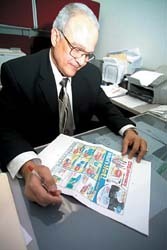
Marvin Abdalah, Horton Interpreting Services CFO, checks the translation of a bilingual CVS ad. He may alter the Spanish wording depending on which part of te country the ad will appear, allowing for regional variations in the Spanish that is spoken in different parts of the U.S.
Interpreters service all types of industries
Horton Interpreting Services Inc.
Beyond Cash Donations: How New Forms of Giving Are Transforming Not-for-Profit Accounting
Evolving Funding Landscape for Not-for-Profits Not-for-profit organizations are being asked to do more with less,…
Learn More
Owner:Juana I. Horton
Type of Business:Interpreting, translation and cultural diversity training
Location: 45 Royal Little Drive, Providence
Employees: 12, plus about 200 consultants
Year Founded: 1994
Annual Revenue: About $2 million
The calls come in all day, from hospitals, health care centers, law firms, businesses and social service agencies. They need someone who speaks Spanish, or maybe Portuguese, Cambodian, Polish or Farsi – and who can handle even specialized terminology and situations.
With 24 hours’ notice, Horton Interpreting Services can meet almost any need. On the fly, it might depend on the language, but Horton’s people work around the clock, 365 days a year. No agency in Rhode Island can handle so many languages, or so many clients at once.
Then there’s the translation department, with a roster of experts who don’t just speak the languages they work in, but have a formal education in them, and the skills to handle anything from a simple brochure to legal and scholarly texts.
Hundreds, if not thousands, of Rhode Islanders can do a basic English-to-Spanish translation, for example, but Marvin Abdalah, who oversees Horton’s team, is an exacting boss. It’s not good enough to get the meaning right; he won’t tolerate Anglicisms, poor grammar or slang.
“We see these barbarities that are out there, and we laugh,” president and CEO Juana I. Horton says. “What can we do?”
What Horton has done is focus on quality – hand-picking her staff and consultants so they not only master their languages, but understand the cultures of the people their clients serve, and can handle themselves as professionals in any environment.
Medical interpreters are trained in-house and given books to build up their knowledge of health care terminology. Court interpreters have formal training – and if Horton can’t find a Rhode Islander for a job, she’ll recruit from other areas. Translators are usually native speakers who were schooled in the language. For Spanish jobs, Horton will ask who the target audience is, so if it’s Chicanos, for example, the translation can be tailored to Mexican usage, whereas if it’s Dominicans, some of the wording might be a bit different.
Horton didn’t start out with these kinds of resources. In 1994, when she began working as an interpreter, she was a stay-at-home mom booking assignments from her dining room.
“I wanted to work part time, and interpreting was perfect, because it was flexible,” Horton says. “I could tailor it around my schedule.”
Horton grew up bilingual. The daughter of a Venezuelan lawyer who worked internationally, she was born in New Orleans, spent her early childhood in the Andean region of Venezuela, then came back to the United States when she was entering fourth grade.
It was the 1960s, and English as a Second Language programs had yet to be established. Horton was placed in second grade, and learned English by just listening and paying attention. She still considers Spanish her first language, but because her education was in English, she mastered that language, too, and she studied French for several years.
Before having her first daughter, Shelley Moniz, Horton had worked at Brown University, in human resources, but she seldom used her Spanish there. Her international upbringing “always stayed with me,” she says, and that drew her into her new career.
As Horton’s interpreting business grew, she realized she needed an office, so in 1997, she rented a small space on Broad Street. Then she started hiring consultants to take jobs she couldn’t take – “I couldn’t be in 10 places at once” – and handle other languages, and soon she had to take over a whole floor in her small building.
In the early years, money was tight, and banks refused to loan Horton working capital, so if a client was late in paying her, Horton would not pay herself to ensure her consultants got paid. Later, when the business was stronger, banks reached out to her.
Horton soon outgrew her Broad Street space, and moved into a section of the Manufacturing Jewelers and Suppliers of America building on Royal Little Drive. Her offices there are a far cry from where she started: spacious, corporate chic, suited to her clientele, which includes Lifespan, Citizens Bank, UnitedHealthcare of New England, and MetLife Auto & Home.
Two years ago, her daughter went to work for her; Moniz is chief operating officer. Abdalah, who started as an interpreter, is her chief financial officer. Their priority now is on building up the translation side of the business, which now produces only about one-third of revenues. But the interpreting side is going strong: The company has two full-time bookers to coordinate all the assignments. Horton herself stopped taking jobs about three years ago.
“I just don’t have the time,” she says. “I’m too involved. I sit on like 12 boards.”
Horton is particularly active with the Hispanic American Chamber of Commerce, a division of the Greater Providence Chamber of Commerce that she co-founded and chairs. She represents the group at the national level, and is often in Washington; she was on an extended visit for the last two weeks, and was interviewed by phone for this story.
As one of Rhode Island’s most successful (and award-winning) female and Hispanic entrepreneurs, Horton now sees herself as a potential role model for the next wave, and she’s worked with the Center for Women and Enterprise as a mentor and adviser. And as an interpreter who knows how few pros are available to work in the courts, she has been active in the state courts’ development of a certified court interpreter program.
“I want to make a difference,” Horton says. “And as you know, in Rhode Island, one person can make a difference.”