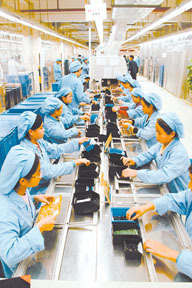
currency is making Chinese products
cheaper in the U.S.
U.S. Sen. Reed tells local manufacturers China’s trade tactics are not being ignored
black>
Beyond Cash Donations: How New Forms of Giving Are Transforming Not-for-Profit Accounting
Evolving Funding Landscape for Not-for-Profits Not-for-profit organizations are being asked to do more with less,…
Learn More
U.S. Sen. Jack Reed last week told a handful of Rhode Island manufacturing
executives that one of their most vexing problems is on Washington’s radar:
competition with Chinese manufacturers.
Gripes over an uneven playing field with China have been growing louder from
manufacturers in Rhode Island and nationally. Among their chief complaints:
China’s intentional devaluation of the yuan, the Chinese currency. Keeping its
value low makes Chinese products cheaper in the United States and more expensive
overseas, cutting into U.S. manufacturers’ sales.
In an Oct. 14 letter to President Bush, Reed and six other senators urged
Bush to formally investigate whether China or other countries are in violation
of trade agreements with the United States. The senators argue in the letter
that artificially low overseas currencies have contributed to the loss of some
2.5 million manufacturing jobs since 2001.
“We have to be as aggressive as we can be on China with regard to these currency
issues,” Reed told manufacturing executives during an Oct. 20 roundtable discussion
at Technical Materials Inc. in Lincoln. “But it’s going to be a multiyear process.”
Reed said China’s devaluation is impelling other Asian countries to keep their
currencies cheap. For example, Japan has been buying U.S. treasuries at a record
pace – reportedly as much as $120 billion – in an effort to nurse its economic
recovery by depressing the yen’s value.
Bob Nangle, chief operating officer of Meridian Printing in East Greenwich,
said Chinese printers benefit from a weak yuan and cheap labor, enabling them
to set prices 25 to 40 percent less than printers in the United States. Despite
higher travel and shipping expenses, the deep discount is enough to lure many
U.S. book publishers to print books overseas, he said.
“We’re able to retain the customers who recognize that our quality is better
and who can afford to pay,” Nangle said.
He said Meridian recently finished printing a book by photographer Annie Leibovitz,
whose publisher initially considered moving the job overseas. But Leibovitz
was insistent that the book be published stateside, he said.
Another big complaint from manufacturers is that Chinese companies flout intellectual
property laws. Reed said 15 to 20 percent of Chinese products are counterfeit
– many lifted from patented U.S. products, which cost U.S. companies an estimated
$1.85 billion in lost revenue during 2002, he said.
When China joined the World Trade Organization in 2001, there was an expectation
that it would begin playing by the rules. But that hasn’t happened, Reed said,
and the WTO has been slow to reign in the Chinese.
“We haven’t evoked the WTO on currency or intellectual property issues,” Reed
said. “Until we do that, we’re just going to let everybody cheat.”
The Bush administration has addressed currency intervention in recent weeks.
Treasury Secretary John Snow visited China specifically to discuss the issue
and Bush reportedly raised the issue in China and Japan last week.
But Reed says remedying trade problems with China has taken a back seat in
Washington to the war in Iraq. Also, the Bush administration has been forced
to tread softly with China on trade because it needs the country’s cooperation
on stanching North Korea’s nuclear proliferation, Reed said.
There are, however, at least three bills pending in Congress related to the
Chinese currency issues, Reed said. Snow is expected to give a report to Congress
next month on the foreign currency manipulation that is likely to spotlight
the extent of Chinese transgressions.
Also, Congress’ appropriations bill contains $3 million to create an office
of Chinese compliance within the Department of Commerce, which will more closely
track trade violations committed by Chinese companies.
For the complete current issue, visit our subscription Web site, or call (401) 273-2201, ext. 227 or 234.