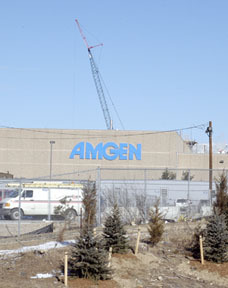
Amgen's plant in West Greenwich.
Things appear to be running smoothly at Amgen Inc.’s new, $500 million cell-culture manufacturing facility in West Greenwich.
Company officials recently said the 200,000-square-foot plant, which received its go-ahead from the U.S. Food and Drug Administration last month to produce Amgen’s rheumatoid arthritis drug Enbrel, is performing better than expected and has helped wipe out the waiting list for the popular medication.
“We’re getting much better yields per run and much higher success rates, so that plant is getting…substantially more efficient,” said Kevin Sharer, Amgen’s president and chief executive officer, during a Jan. 23 conference call announcing the company’s fourth quarter earnings. “It does give us a lot more confidence, the ability of that plant to supply the market.”
Seifert Systems Invests in Energy Efficiency to Strengthen Operations
For manufacturers, energy is more than just another operating expense. It plays a critical role…
Learn More
What’s more, the Enbrel now being produced at the plant could someday be prescribed to treat diseases beyond rheumatoid arthritis. In recent weeks, Amgen announced that Enbrel has shown positive results in clinical trials involving patients with psoriasis, a painful skin condition, and ankylosing spondylitis, an inflammatory disease of the spine that causes pain and swelling.
In particular, the psoriasis study results “have provided some of the strongest support for licensing application that we have ever seen,” said Roger Perlmutter, Amgen’s executive vice president of research and development. Company officials declined to say when Amgen would apply for FDA approval to market Enbrel for psoriasis.
For now, though, the focus is on Enbrel as a treatment for rheumatoid arthritis, an inflammatory disease that causes joint pain and stiffness and afflicts 5 million people worldwide.
Since receiving FDA approval for the West Greenwich facility in December, Amgen has notified the 40,000 patients on its waiting list that the injectible medication now is available. More than half of those patients have “responded favorably” to the new availability and 10,000 of them already have been prescribed the drug, officials said.
In total, roughly 80,000 patients now are taking the medication, Amgen says.
Still, the bottleneck in production capacity has kept a lid on the sales potential of Enbrel. Sales of the drug during the fourth quarter actually fell from a year earlier, from $216 million to $204 million, because of supply constraints, Amgen officials said.
Meanwhile, competitors have moved into the rheumatoid arthritis market, including Johnson & Johnson’s Remicade and a drug called Humira, for which Abbott Laboratories received earlier-than-expected FDA approval on Dec. 31. Abbott expects the product to approach $1 billion in annual sales.
But Amgen officials have assured investors that the West Greenwich facility will help quell what is expected to be big future demand for Enbrel. The company says sales of Enbrel should grow to $1.2 billion to $1.4 billion in fiscal year 2003, up 50 to 75 percent over last year’s $800 million.
“With … manufacturing shortfalls resolved, we believe Enbrel could realize its long-awaited breakout potential,” said analyst William Tanner of Leerink Swann & Co., in a Jan. 21 edition of BioWorld Today magazine.
Clinical trials of a once-weekly dose of Enbrel also have shown promise and could be approved by the end of the year, company officials said. Enbrel users now take injections twice a week. In contrast, Abbott’s new rheumatoid arthritis product is administered just twice a month.
In August 2001, Amgen (then Immunex) announced plans to make West Greenwich its worldwide Enbrel-manufacturing headquarters. More than 500 employees are at work in the retrofitted plant, which is producing much of the company’s Enbrel supply. (Before, most of the company’s supply had been produced at a plant in Germany).
Amgen expects to employ about 1,100 workers in West Greenwich by the end of the year. A second, $500 million facility of similar size, now under construction at the site, won’t be ready until 2005.
Amgen’s fourth-quarter profit more than doubled to $456.4 million, bolstered by strong sales of its two anemia drugs, Aranesp and Epogen. For the year, the company took in $5.5 billion in revenues, up from about $4 billion a year earlier. It also spent $1.1 billion on research and development last year, marking the first time in its history that Amgen exceeded $1 billion in R&D expenditures.
For the complete current issue, visit our subscription Web site, or call (401) 273-2201, ext. 227 or 234.