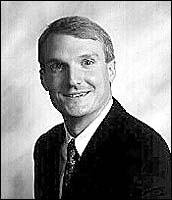
Rep. H. Norman Knickle, D-Warwick, plans to sponsor several bills this month aimed at preventing medical errors in the state’s hospitals, because the state Department of Health hasn’t done enough on its own, he said.
One measure would require public hearings and possible system-wide regulations to prevent wrong-site surgeries – an issue spotlighted by the case of a Rhode Island Hospital neurosurgeon operating in December on the wrong side of a patient’s head, which was made public last week.
Knickle said the DOH has failed to initiate any broad, system-wide changes to eliminate such medical mistakes, instead handling each incident on a case-by-case basis. Knickle points to the recent Rhode Island Hospital incident: He said the DOH directed the hospital in a December 2000 letter to take steps to avoid wrong-site surgeries, after a high-profile incident in which doctors mistakenly removed a young girl’s tonsils instead of performing corrective eye surgery.
Seifert Systems Invests in Energy Efficiency to Strengthen Operations
For manufacturers, energy is more than just another operating expense. It plays a critical role…
Learn More
“I have consistently brought to the department’s attention the system-wide regulations that New York (state) has to prevent wrong-site surgery,” Knickle said. “But (Rhode Island’s DOH) still hasn’t promulgated any regulations, and these mistakes keep happening.”
Hospital industry officials say they are taking their own steps to correct that problem. Cathy E. Boni, vice president of clinical affairs for the Hospital Association of Rhode Island, said risk managers from the state’s hospitals have met in recent months to discuss procedures each hospital uses to prevent wrong-site surgeries.
“We want to see what hospitals are doing to prevent wrong-site surgery and to see if we can move toward standardization,” Boni said.
Knickle also wants to force hospitals to implement internal “corrective-action” plans as soon as an incident occurs. Although a similar provision now exists in the state’s reporting regulations, he said hospitals wait for the DOH to order corrective action following medical mistakes, rather than taking action themselves.
Knickle has been an outspoken critic of the DOH, blasting a report it released in November on hospitals’ medical errors and ways to reduce them. The report – required by state legislation and funded with $300,000 – said hospitals often fail to report errors when they occur, possibly because the state’s reporting requirements are too vague, the report said.
He claims the department fell short of its mandate to outline a plan to reduce medical mistakes in Rhode Island’s hospitals.
“The report failed to address the most crucial directive – recommendations to curb medical errors in the future,” Knickle wrote in a Jan. 4 letter to Health Director Patricia A. Nolan.
DOH officials, meanwhile, say they have already taken action on most of the recommendations made in the November report – including tightening the reporting requirements for medical errors to eliminate what many hospitals considered to be a gray area.
“We think we’ve made tremendous progress as a result of this process,” said Robert J. Marshall Jr., the department’s spokesman.
The department says it clarified the definition of “incidents” or “events” that hospitals must report. For example, the definition of an incident had been “a serious, unforeseen complication resulting in an extended hospital stay.” But that wording left much to interpretation, according to Wayne Farrington, chief of the DOH’s office of facilities regulation.
“If it was dangerous surgery and a patient died, one could argue that the death not be reported, because it was foreseen that that might happen,” Farrington said. “You might have had one facility using the strictest interpretation of the definition and rationalizing away the need to report it.”
As a result of the November report, the definition was changed to say a complication “not expected nor probable” resulting in an extended hospital stay “or the death of the hospital patient.”
“We basically added meat to those definitions to make sure (hospitals) understand the intent of these reporting regulations,” Farrington said. “Sometimes they can be influenced by what their legal counsel says. Now we’re saying ‘If you think a (medical error) happened, you report it first, then you do your investigation.’”
Marshall said reporting of incidents has increased, from 132 reports in 1999 to a projected 295 reports in 2001 – largely because of increased dialogue between hospitals and the DOH. And the department in recent months issued 29 deficiency notices, requiring 12 hospitals to submit “plans of correction” detailing how they would correct specific problems.
DOH officials also say they have met regularly with hospital risk managers to discuss medical errors and completed a training session on controlling a type of hard-to-treat and potentially deadly staph infection.
The department was given another $300,000 this year to continue its stepped up oversight of hospitals. A survey of one hospital already has been completed this year and another is scheduled, Farrington said.
Knickle says his other bills will include a proposal to eliminate handwritten prescriptions by 2005 and a plan to create a link on the DOH Web site for hospital workers, patients or others to report medical errors anonymously.