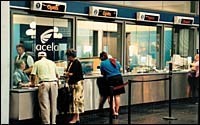
keep ticket agents busy.
(Brian McDonald)
Amtrak’s Acela service has taken a public relations beating in recent weeks.
On July 15th, an Acela Regional train traveling from Washington, D.C., to Boston reportedly got stuck on the tracks for two hours near Cranston after the train lost power.
Seifert Systems Invests in Energy Efficiency to Strengthen Operations
For manufacturers, energy is more than just another operating expense. It plays a critical role…
Learn More
That same day, a column in the Boston Globe recounted the author’s recent trip from Boston to New York on an Acela Express train, Amtrak’s new high-speed service geared toward business travelers. Although the train arrived on time, the columnist said the door-to-door trip took about two hours longer than a Boston-to-New York flight.
And a week earlier, the Globe ran a front-page story detailing Acela Express’s spotty on-time record. Just 26 percent of the Acela Express trains arriving in and departing from Boston were on time during the first week of July, according to the Globe’s analysis.
“A lot of things came together to create a very bad week for us,” said Amtrak spokeswoman Cecelia Cummings, who did not refute the Globe’s findings but said the train’s six-month on-time record is 86.5 percent for the New York-to-Boston trip.
Despite the string of troubles, the Acela Express service – launched last December – increasingly is seen as a viable alternative to flying for Providence-area business travelers. And as airline service continues to decline amid unprecedented passenger volume, some say the express train’s popularity will only grow.
“(The trains) are cheaper, they get down to New York pretty quick and there’s less chance of cancellations,” said Maryann Sasso, president of Providence-based Pearson Travel, which books corporate travel arrangements. “I think businesspeople are getting very frustrated with flying because of the cancellations and delays. The trains definitely are becoming more popular,” Sasso said.
Also, the express trains typically are less expensive than flying – about 25 percent cheaper than standard airline shuttle fares, according to Cummings. For business travelers who habitually travel on short notice, the savings can be much larger.
Sasso said the lowest-priced “walkup,” or same-day, round-trip ticket from Providence to New York last week was $613, vs. the Acela Express roundtrip, business-class fare of $208. An airline ticket for the same flight purchased a week in advance would run $477, Sasso said.
The majority of riders on the sleek Acela Express trains are business travelers, according to Amtrak. Every seat has a plug-in for laptop computers, with ample room to spread paperwork out. Companies can reserve conference tables and, unlike airplanes, riders in most cars are able to use cell phones and pagers.
“Many of our executives really like the Acela experience,” said Melissa Carden, public relations manager for Swarovski Ltd., the Cranston-based crystal manufacturer.
Carden said to her knowledge none of the Swarovski executives, who frequently travel to New York for trade shows, have had trouble with delays or other problems on the express service.
Still, there are drawbacks. Carden, who travels to New York several times a month, said she still prefers flying and only takes the train when bad weather delays or cancels flights.
“At first, the (Acela Express) seemed like it would be the way I would prefer to travel,” she said. “But I’ve found that there are definitely pros and cons.”
While the three-hour-and-twenty-minute trip is a big improvement over the older commuter trains, it still is a long trip – especially for shorter stays, Carden said. She added that cell-phone use is a problem: Service through Connecticut is spotty and other passengers don’t want to be held hostage to their fellow riders’ conversations.
Amtrak officials, however, say the express service already is a success. Acela Express revenue of $15.3 million between December and June eclipsed Amtrak’s original projections despite a sharp decline in business travel, according to Amtrak spokeswoman Cecelia Cummings.
“We didn’t incorporate a 26 percent drop in business travel when we did our projections, so we’re thrilled that we met expectations in this economic climate,” said Cummings. She added: “We’ve been pleased with what we’re seeing in Providence.”
Amtrak has been steadily adding to its New York-Boston frequencies since it began with one roundtrip in December. It now offers five daily roundtrips between Boston and New York and plans to offer 10 roundtrips by the end of the year.
Acela Express trains depart from Providence weekdays at 6:47 a.m., 7:47 a.m., 3:47 p.m., 5:47 p.m. and 7:17 p.m. Those trains, with the exception of the latest departure, continue on to Washington, D.C., for a roundtrip fare of $322.