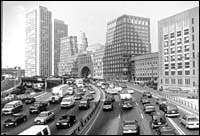
that is usually much heavier than this.
State officials say the best way to avoid what can be best termed as gridlock — that commute from Providence to Boston each morning — is to take the train.
In July the Rhode Island Department of Transportation instituted three more trips between the cities; one trip to take care of the mid-day commuters, another to improve the afternoon commute and the third, an evening train for workers staying late. Stephen Devine, supervising planner at RIDOT, said it was a small step, but an important one.
Seifert Systems Invests in Energy Efficiency to Strengthen Operations
For manufacturers, energy is more than just another operating expense. It plays a critical role…
Learn More
Although “taking off this number is not going to make that much of a difference,” Devine said, considering the number of cars flowing up and down Route 95 between the two cities each day, “taking any amount off will change things for the commute and for the environment.”
Prior to the addition of the three trains, there were approximately 525 people commuting by train from downtown Providence to Boston every day, and about 75 coming to Providence from Boston. Devine said current statistics are 796 from Providence to Boston, and nearly 100 coming to Providence daily.
Jeff Larson, general manager of SmartRoute Systems in Cambridge, Massachusetts said more people taking the trains obviously means fewer people on the roads. SmartRoute Systems is a company that provides information about commutes for over 40 cities in the country. Working with State Police, traffic aircrafts, in-road sensors, 70 cameras and numerous commuter contacts, the company reports its information on its Web site at www.smartraveler.com, on a telephone hotline, and on a local television show in Boston.
Larson said the information his company provides gives commuters more options.
“Traffic patterns have changed,” he said, “and that’s made these corridors much busier. I think people have choices they didn’t have years ago, but travel times are longer. That’s why I’m an advocate for using the train. It’s an under-utilized option.”
Larson thinks communication between Boston and Providence could be improved.
“I think it’s important that Massachusetts and Rhode Island try to coordinate information,” he said. “I don’t think there’s enough effort between states.”
Devine said he has not been in contact with anybody at SmartRoute, but his focus is more on the rails than the roads.
As far as the rails go, he said the ultimate goal is to have every train that ends in Attleboro go all the way to Providence. After that step is instituted, they can concentrate on having those trains go to Warwick, and eventually have rail service between Boston and South County.
“We’re getting there incrementally,” he said. “One station at a time.”
As far as the roads go, Doug Cope, director of public affairs with the Massachusetts Highway Department said his organization is currently studying a project dubbed, “The Route 128 Add-a-Lane Project,” which is in its preliminary design phases. The thirteen miles this project would benefit would begin at Route 24 in Randolph, Mass., and extend into Route 9 in Wellesley.
The estimated cost of the project would be $96 million, and it would be conducted in eight different phases of construction, beginning with the bridges.
“You can’t widen the roads and then the bridges,” said Cope.
He said traffic would just bottleneck at each bridge. The project, now under environmental review, would entail adding a shoulder lane and median on each direction of Route 128, and require widening existing bridges. But now, said Cope, it is only a plan.
Until that day comes, Larson said, there are other things people can do to shorten the time of their commute.
“People should try to get information as best as they can,” he said, “and they should know there are other options.”
A recent report by the Massachusetts Highway Department found only 1 percent of Massachusetts residents ride the commuter rail to get to work.
Devine is still optimistic.
“I think traffic congestion is only going to get better as we improve the rail system between the two cities,” he said.