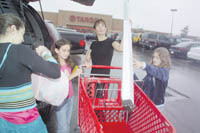
Perhaps the only people more excited than parents about kids going back to school are retailers.
Though school bells are just starting to ring, cash registers at various stores have been chiming for weeks in what is expected to be a record-setting back-to-school retail season.
Seifert Systems Invests in Energy Efficiency to Strengthen Operations
For manufacturers, energy is more than just another operating expense. It plays a critical role…
Learn More
According to the National Retail Federation, students and their parents will spend $47.8 billion getting ready to return to the classroom.
“That’s an 18 percent increase overall in spending for both college and kindergarten to 12th grade,” said Ellen Tolley Davis, a spokeswoman for the retail federation.
Back-to-college spending is expected to soar 33 percent to $34 billion this year, while spending for kindergarten through 12th-grade students is predicted to be down 8 percent to $13.3 billion.
And while demand for clothes, shoes, books and school supplies is expected to be strong for K-to-12 shoppers, analysts expect computer sales to slow.
“Though many consumers will be buying electronics this year, they may be taking a break from spending on high-end computers and other expensive gadgets,” said Tracy Mullin, president and CEO of retail federation, in a release. “It’s understandable that after several years of strong gains and record-breaking sales, demand may cool slightly for electronics merchandise this year.”
Those shoppers buying electronics for the K-to-12 set are expected to spend $2 billion.
They spent $3 billion last year.
Families who have purchased computers for their K-to-12 students seldom see a need to upgrade their home computer systems on an annual basis, and many schools have computer labs to meet students’ needs, Davis said.
College students, however, are expected to spend some $8.2 billion on electronics; that’s $700 million more than last year.
“Most college kids will tell you they need a digital camera, and a cell phone to keep in touch … and iPods are certainly popular with the college crowd,” Davis said.
Retailers are just beginning to realize the buying power the college crowd has, Davis said.
The average college freshman and their parents will spend $1,151 to prepare for college, nearly half of that on electronics. Sophomores are expected to spend $1,028 in total.
“The main destination this year will be the campus bookstore,” Davis said. “They buy their books, university apparel and school supplies there.” Some 59 percent of people are planning to buy their back-to-college gear at the campus store, but college students shop at all sorts of stores to prepare for school.
“College students don’t seem to favor any particular retailer, which means the opportunities are endless for just about every type of store,” Davis said. More than half (55 percent) of those who said they’ll shop at the campus bookstore said they’ll shop at discount stores, 41 percent at office supply stores, 36 percent at department stores and 32 percent will log online to shop.
Both college students and their parents will be doing the buying. Davis said students spend 40 percent of the total.
“Most of these college students aren’t paying rent or bills, and they have summer jobs and graduation money to spend,” Davis said. “Retailers have begun to realize the high spending frequency of college students.”
College students have been shopping for years, but have had difficulty finding what they want, Davis said. Retailers who are now marketing themselves as “back-to-college” headquarters are reaping the financial benefits.
College students and their parents are projected to spend $11.9 billion on textbooks, $3.6 billion on dorm and apartment furnishings, $3 billion on school supplies, $5.7 billion on clothing and $2 billion for shoes.
“Retailers have continued to market to this sector every year, and it’s snowballing,” Davis said.
Back-to-school shoppers looking to outfit the K-to-12 crowd will spend an average of $443 per child. Shoppers in the Northeast will spend more than in other parts of the country, spending $513 per child, which is up from $435 last year.