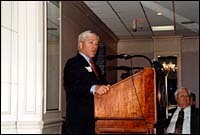
William V. Irons
(Brian McDonald)
Back in November 2000, newly elected Senate Majority Leader William V. Irons outlined his priorities to business leaders and state officials at a Greater Providence Chamber of Commerce breakfast meeting at the Providence Marriott.
A Democrat from East Providence, Irons used the opportunity to challenge small business owners to get to know their senators and representatives and to invite their legislators to their places of business.
Beyond Cash Donations: How New Forms of Giving Are Transforming Not-for-Profit Accounting
Evolving Funding Landscape for Not-for-Profits Not-for-profit organizations are being asked to do more with less,…
Learn More
“Many of my colleagues do not understand you,” said Irons. “It is rare for a business person to reach out to a pubic official. It is critical that each of you develops a relationship with your senator and representative.”
A Providence Business News Executive Poll conducted last week suggests that about half of those businesses and organizations that responded did in fact invite a legislator to their workplace.
At the same time, it has been a relatively quiet session with regard to small business issues.
Sen. Mark A. Cote, D-Woonsocket is chairperson of the Joint Committee on Small Business. It has not been the busiest of assignments.
As the 2001 legislative session approaches its closing weeks, the Joint Committee on Small Business had yet to sit to hear a bill – and there was no indication that it was going to. Cote suggest that at least in part, it has not been a case of there not being small business issues, but more that those particular issues have been taken up by other legislative committees.
“That’s one thing I need to do – to alert the chairmanthat there are bills that should be in this committee that end up in a corporations committee, either Senate or House,” said Cote.
Rep. Melvoid Benson, D-North Kingstown is also a member of the Joint Committee on Small Business. She agreed that it seems that several bills have been forwarded to the corporations and finance committees.
But Benson is not discouraged. She said legislators are well aware of the importance of small business issues.
“We know that small business is the backbone of the state,” said Benson. “I see it vividly in the different small businesses that operate in Quonset Point. It’s an important facet of government and it is our responsibility as representatives.”
Laurie White, senior vice president at the Greater Providence Chamber of Commerce, said much of the focus of the Chamber has been to lobby in favor of the elimination of the capital gains tax, a proposal supported by Gov. Lincoln Almond and approved by the Senate Finance Committee.
“Our primary issue is the capital gains tax,” said White. “The business community has really been aggressive in reaching out to the Senate and House leadership.”
White said the Chamber is also busy within the confines of the capital city, working with businesses to spread the word about what a detrimental impact the living wage would have if adopted in Providence. The Providence City Council has yet to take action on the living wage proposal.
Several pieces of legislation that would affect the business community remain in committee at the State House as of this week. They include:
Senate bill 341, which is pending in the House Finance Committee. It would establish a tax credit for personal income tax on long-term capital gains beginning in the tax year commencing Jan. 1, 2003. The credit would reduce a taxpayer’s state capital gains tax by 33.3 percent in the first year. The next year the reduction would be 66 and two-thirds percent and in tax year 2005 and thereafter the credit would be 100 percent of the personal income tax on capital gains.
House bill 5160 and Senate bill 70 are currently pending in the House and Senate Labor Committees respectively.
Both bills propose increasing the minimum wage 50 cents per hour to $6.65 per hour. The bills are being opposed by a business community which notes that the state’s minimum wage has increased by 50 cents in each of the past two years and is the sixth highest minimum wage in the country.