Farmers, food producers, lawmakers and community partners came together at Farm Fresh Rhode Island on Oct. 6 for the first annual RI Grown Day – a celebration of all the people who make our local food system thrive.
From inspiring talks to hands-on workshops on food safety, land succession and more, the day was full of learning, connection and collaboration. It also served as the kickoff to RI Grown Week, which was held from Oct. 4-11.
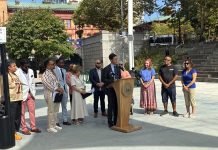
During the event, Ken Ayars, chief of agriculture and forestry for the R.I. Department of Environmental Management, announced more than $125,000 in Specialty Crop Block Grant Program grant awards to help Rhode Island farmers expand market access for local fruits, vegetables, tree nuts and nursery crops.
As part of the day’s events, local farmers and food producers connected with agricultural professionals, taking part in workshops about produce safety, land planning, grant applications and marketing, along with breakout sessions for the animal agriculture, produce, floriculture, fiber and external food organization sectors.
[caption id="attachment_508192" align="aligncenter" width="1024"]

GROWING INDUSTRY: Ken Ayars, chief of agriculture and forestry for the R.I. Department of Environmental Management, speaks during RI Grown Day at Farm Fresh Rhode Island on Oct. 6. Seated, from left, are Bryan Jones, president of the Future Farmers of America Rhode Island chapter; Melissa Cherney, CEO of the Rhode Island Community Food Bank; Farm Fresh R.I. Executive Director Jesse Rye; Georgina Sarpong, director of food strategy at R.I. Commerce Corp.; DEM Director Terry Gray; and state legislators Rep. Teresa Tanzi, D-Narragansett, and Sen. V. Susan Sosnowski, D-South Kingstown.
COURTESY R.I. DEPARTMENT OF ENVIRONMENTAL MANAGEMENT[/caption]
Since the event took place in the middle of apple season, Yesenia Barnier, director of community nutrition at the Rhode Island Community Food Bank, served some snacks made with Rhode Island-grown apples.
“We are serving a cheddar apple grilled cheese, which is a little bit of an upscaled grilled cheese with some caramelized onion and a honey Dijon mustard spread on there,” she said. “The apples are Portland apples, and they are grown here locally in Rhode Island, and they are from Scituate Nursery.”
The bread was from Seven Stars Bakery, with locations in Providence, East Providence and Cranston. The only import was the cheese, which was from Vermont.
Barnier outlined some programs her team has developed, including one called Healthy Habits.
“We go out right into the community. We do nutrition education classes for little kiddos all the way to senior citizens,” she said. “The classes can be found at our member agencies such as meal sites [and] pantries, but they can also be found in a lot of communal spots like libraries … where we know people are already gathering and they’re just trusted, welcoming spaces.”
Barnier says the programs make more than 450, sometimes 500, meals for kids in Rhode Island.
“They’re learning great habits,” she said. “They’re getting to, of course, enjoy wonderful food and everybody ends up happy.”
Ayars says the food education side is a very collaborative atmosphere in Rhode Island. DEM works with partners, such as Farm Fresh Rhode Island, Southside Community Land Trust and Hope & Main, among many others.
Over the past five to 10 years, the network has expanded, just as the number of food producers in the state has expanded, Ayars said, adding there are more than 1,000 farms in Rhode Island.
He says most of these farms are relatively small, and many are family-run, which puts them in the same lane as many of the restaurateurs and food retailers in the state.
“Rhode Island is one of the few states that actually grew [its] number of farmers in between the last two counts by the USDA [U.S. Department of Agriculture] and the Census of Agriculture, which is done every five years,” Ayars said.
Rhode Island had the highest percentage of new and beginning farmers in the U.S., according to the 2022 Census of Agriculture.
Ayars said that while many of these young farmers didn’t grow up on the family farm, “they’re interested in the food system.”
Those of us who are not thinking about starting a family farm can keep our farms and farmers strong by supporting local agriculture and markets.
“Dining Out With Bruce Newbury,” syndicated weekly on radio, is heard in Rhode Island, Connecticut, Massachusetts, Vermont and Indiana. Contact Bruce at bruce@brucenewbury.com.