of teamwork in transportation.
Despite a heavy mix of rain and sleet — they arrived on time.
A jack-knifed tractor-trailer shut down a section of Route 95, forcing Connecticut Gov. John G. Rowland to make his way to Providence via Route 6. Massachusetts Gov. Paul Cellucci made it from Boston, and Rhode Island’s Gov. Lincoln Almond had only that 10 minute drive from his home in Lincoln.
Rhode Island's Market Has Changed. Developers, Builders, Investors and Sellers Must Change With It.
By Emilio DiSpirito IV License Partner | Engel & Völkers Oceanside Leader | The DiSpirito…
Learn More
Fittingly, the governors of the three states met in Providence last Thursday morning (Dec. 14) to discuss transportation issues.
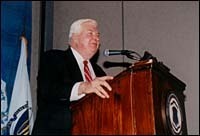
The stage for the meeting was the New England Regional Transportation Summit, held at The Westin. Joining the governors and other guest speakers were several Rhode Island officials, and U.S. Senators Jack Reed and Lincoln Chafee.
The governors found that they share common concerns with regard to issues such as congested highways, expanding airports and underutilized rail and waterways. All three agreed that transportation concerns must be solved on a regional basis — if they are to work for the long-term.
And they all agreed that states and the federal government share a responsibility to address transportation infrastructure issues as they relate to the business climate.
“We’ve all heard the expression ‘draw a line in the sand,'” said Almond. “When it comes to moving New England forward, that’s something we can’t afford to do. To maintain our competitive edge globally and keep our economies strong, we must have a region with no borders. Intermodalism plays an important role in our work.”
Regional airports shineOne transportation issue at the forefront is that of air
travel — where New England has seen a dramatic rise in traffic at regional airports,
but at the same time sees Boston’s Logan International as a key player still dictating
much of what happens throughout the region.
Since 1996, fares at T.F. Green Airport have decreased by 17 percent — the arrival of Southwest Airlines and other low-cost carriers playing a significant role in that decrease.
At Logan in Boston, fares have risen by 7 percent during the same time frame.
“The regional approach is good for the consumer,” said Amedeo Odoni, a professor at the Massachusetts Institute of Technology. “And regional airports are attracting a bigger share of what happens outside of 495.”
Odoni was among the speakers at summit, bringing along with him some telling statistics. Among them, the fact that 75 percent of air passenger growth in New England between 1996 and 1999 occurred at regional airports.
The MIT professor made it clear that the time is right for New England to develop a regional airport system. Odoni pointed directly to the dramatic growth in passenger flights at Rhode Island’s T.F. Green, and similar growth in Worcester, Mass., Hartford, Conn., and in Manchester, New Hampshire. And while Logan has had its troubles, said Odoni, it will remain an integral player in the development of any regional system.
“The market conditions today are favorable to develop a regional system,” he said.
Crowded highways — tough on business
As the focus of the summit switched from air to ground, Gov. Rowland pointed out that in the decade between 1982 and 1992, the number of trucks on American highways grew by 80 percent.
Studies from the most recent decade are expected to show additional growth. It is an issue, said Rowland, which officials in Connecticut have studied closely — finding the highways especially busy in the southeastern section of the state.
Chief among Rowland’s concerns, are finding ways to get more freight onto the railways – and more cars off the highways. And also, he said, opening up more avenues for travel.
“We need improved access across the Hudson River,” said Rowland. “It’s not a New York problem, but one we must all address.”
On that issue, he said, the federal government needs to step in to assist in creating a crossing.
As for getting cars off the highways, Rowland suggests some creative approaches. For example, he said, he has talked to some large manufacturers in his state about increasing flextime opportunities for employees.
“It makes sense to take advantage of technology to get people off the highway during rush hours,” he said.
Gov. Almond took the opportunity of the summit to share his views on several transportation related-subjects. They included:
Dredging — Our recent energy crunch underscores how crucial it is to ensure
that dredging begins ahead of schedule. Just think. Dredging the Providence River
will mean that tankers will be able to bring in heating oil to storage areas directly.
Gone will be the days of solely relying upon smaller capacity barges to replenish
our supply.
Port — I have long believed that a port at Quonset point will benefit
our regional economyQuonset would be the only fully serviced deep water port between
New York and Halifax. I have received the RK Johns Study which revealed that building
a port at Quonset is economically feasible, given projections for shipping trends
over the next 10 to 20 years.
Third Rail — We are working on the Freight Rail Improvement Project to
support the movement of goods to the North and South. That’s helping existing
companies at Quonset and it will assist us in our efforts to bring new business
there as well.
At the summit, Almond requested that the New England Governors Conference reactivate its Transportation Committee. The group agreed to do so.