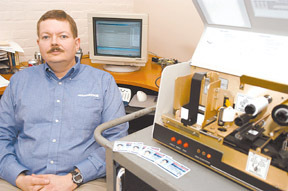
Atlantek's ID-card printer.
Atlantek Inc.
Location: 10 High St., Wakefield
Type of Business: Supplier of professional thermal printers, secure ID card solutions
Seifert Systems Invests in Energy Efficiency to Strengthen Operations
For manufacturers, energy is more than just another operating expense. It plays a critical role…
Learn More
Year Founded: 1986
Employees: 80
Annual Revenue: WND
Web: www.atlantek.com
Inside the shell of a former mill, Atlantek Inc. has cultivated the digital-printing
goods to back up its reputation as a leader in thermal-image printing.
First started as a small consulting firm by company President Harry Schofield,
Atlantek has come a long way since it became operational in the mid-1980s.
After doubling its work force to approximately 80 employees a little more
than a year ago, the company has found a niche market that includes providing
the printer technology for more than 20 states’ driver licenses and forming
a partnership with Eastman Kodak for professional-grade printers.
Schofield had been employed as an engineering manager at Gulton Printer in
East Greenwich when he and a few of his former co-workers decided to branch
out on their own.
Atlantek initially offered its services doing research and development and
soon developed an ID-card printer that used thermal technology. Within a few
years, Atlantek moved out of a smaller office in Peace Dale, into the Wakefield
mill building. Atlantek now takes up about two-thirds of the building’s 48,500
square feet and will move into even more space next year as it continues work
with Kodak.
More than half of the company’s employees work in operations and manufacturing,
another 20 are in engineering and about a dozen people work in sales and marketing.
By 1995, Atlantek was out pitching its printers to prospective clients for
everything from the printing of financial cards to an emerging driver license
market. Approximately 40 states use desktop digital printing technology (some
larger states like California, Texas and New York use larger factory-floor printers),
including Rhode Island, which signed a deal with Atlantek in 2002.
The printers are also used to manufacture ID cards for a couple of Canadian
provinces (Schofield expects to be in a couple more by the end of the year),
Panama, the Bahamas, Sri Lanka, Tasmania and Guatemala among other places in
Mexico and countries in South America.
“We were able to provide the technology early on to print pictures on cards,”
Schofield said. “When driver licenses started to move toward digital imaging
and wanting to store pictures in databases for demographic information, we could
provide that technology.”
While the printers themselves are the only product Atlantek manufactures,
the cards, laminates and ribbons the company orders are made to strict specifications
from other suppliers.
Project Engineer Gary Field, one of the first to join the company, said card
stock alone is subjected to a wide-ranging round of tests. Besides being placed
in a variety of solutions – everything from dry-cleaning fluid to salt water
(Field noted that soapy water is the toughest on cards) – cards and their images
must withstand the extremes of hot and cold, ultraviolet rays and “flex” tests
where a card is required to last 100,000 bends in an hour.
Field, who said there’s no cutting corners when one of the more common uses
for a license is scraping ice off a windshield, said the product needs to be
top rate because a faulty line of cards could result in significant material
and labor costs for a government to replace.
Field said the company’s printers usually have a life of five to seven years,
when more often than not, the machines are replaced because of an expired technology
life.
Atlantek is now focusing on supplying security cards for government buildings,
airport security and for college campuses – all of which have a need for serious
mass production. And even with the discussion of increased security needs in
the wake of Sept. 11, Schofield said he has yet to see more interest in Atlantek’s
products, which include an array of security features mostly developed by the
company.
“In this country, there’s been a lot of discussion about security,” he said.
“But no one is spending a lot of money on it.”
More recently, Atlantek has been working on its multi-head printers developed
for professional digital photography and detailed plotters used by the oil logging
business; (Atlantek acquired Gulton in 1987 and revitalized that segment of
the company).
The company is also developing wristbands complete with photo IDs for use
in correctional facilities and for hospital patients as part of federally mandated
privacy standards. A new generation of ID printers is also being fine-tuned
and will be capable of spitting out 120 cards an hour as opposed to 75, weigh
32 pounds instead of 47 and be about a half-foot thinner at 10 inches deep.
“The work we’ve done in the last five years, working from an objective to
make cards that couldn’t be tampered or altered without the traces of that being
evident,” Schofield said, “We’ve achieved that.”
The company’s printing focus has now been moved to battling counterfeit cards,
an increasing difficult task as the access to technology grows. Schofield, who
noted that while his company has the technology to produce the printers, it
doesn’t make consumer product, said partnerships would continue to be critical
for the company to maintain its leadership position.
Although he declined to disclose Atlantek’s exact revenues, Schofield said
the company has achieved double-digit growth in the last five years and is getting
a lot of attention from larger companies now. And he said he wouldn’t dismiss
the possibility of a merger.
“We’re always looking to expand and form new partnerships in one form or another,”
Schofield said. “That’s what the business world is about these days.”