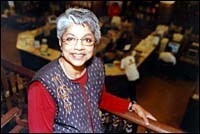
Freitas Johnson.
(Brian McDonald)
Just as art is often in the eye of the beholder, the title of “artist in residence” can take on different meanings and functions.
Indira Freitas Johnson and Stephen Pennell are two artists in residence working with the community – both the scholastic community and the community at large – with their mission to highlight various issues or concepts through art.
Beyond Cash Donations: How New Forms of Giving Are Transforming Not-for-Profit Accounting
Evolving Funding Landscape for Not-for-Profits Not-for-profit organizations are being asked to do more with less,…
Learn More
According to David Henry, head of education at the Rhode Island School of Design (RISD) Museum, Art ConText (a collaboration of the RISD and the Providence Public Library) has among its primary goals to bring new art to the museum and to bring creativity to the library and expand its programming.
Each artist identifies a group they are interested in working with, for example diabetics or high school girls, and is placed in one of the library’s neighborhood branches. The artist is expected to conduct programs and produce art that is reflective of the library’s community.
During the artist selection process (there are three artists each year), “I’m very clear that this is not just an art commission – there is a community element that is very important here,” said Henry. “Art ConText would not be right for every artist.”
The eighth artist to participate in the program is Indira Freitas Johnson, who has been splitting her weeks between Providence and her home in Evanston, Illinois since February.
Johnson is working with the literacy program at the Knight Memorial Library in South Providence to create the exhibition FREENOTFREE, which will open at the RISD Museum in June and run throughout the summer.
“I’m collecting stories – this notion of free and what the market has defined as free,” she said.
The stories from Knight Memorial’s literacy group will be written on raku bowls (“sort of the idea of the spiritual container,” said Johnson), and Johnson also has boxes for story contributions at each of the library’s 10 branches throughout the city. Patrons are given a “free” gift – a pebble, rose petal or like item – and are asked to give a story for the exhibit in return.
The bowls will be arranged on the floor in a pattern loosely based on a rengoli, a traditional Indian floor painting that blesses the family.
Other stories will be written on the “free” compact discs sent through the mail to advertise products and services and displayed in the exhibit’s entranceway in a manner reminiscent of the Indian toran, a hanging that welcomes people into the home. Some stories will be written on the walls of the museum itself.
The idea for the exhibition has its origins in Johnson’s own story: After Johnson fell ill on a trip to India, her sister and their friends stayed by her side day and night.
The care of the doctors “you could pay for, that service, but it wasn’t as valuable as someone who was there because of love,” said Johnson. “You can never pay them back.”
Steven Pennell is the artist in residence at the University of Rhode Island’s Alan Shawn Feinstein School of Continuing Education, located in downtown Providence.
Pennell has an extensive background in theatre, but his job has allowed him to address urban issues such as hunger, domestic violence and family diversity through art, music and dance.
With the school’s urban setting, “I thought there was a great opportunity to educate people about issues,” he said. “It suits this particular campus.”
In addition to addressing various issues through a variety of art forms, Pennell works with a myriad of community groups and university departments to accomplish his work.
A recent exhibition on hunger featured a unique combination of artists displayed together: professional artists, professors, students and children.
Pennell has also honored the campus’s earlier incarnation as a department store – Shepard’s – with the live Christmastime window display “Meet Me at the Shepard’s Clock,” which featured oral histories of former store patrons, live performance in the recreated store departments in the building’s display windows and carolers. The “audience” watched from the street.
The most important thing, Pennell said, is the way his job allows him to reach out.
“It touches people’s lives from the very old to the very young, from street people — Traveler’s Aid is just around the corner — to the business people who are here It has an incredible impact — that’s very exciting.”