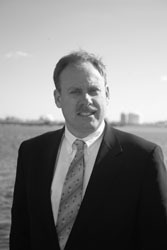
Executive director of Save The Bay, Curtis Spalding, said his group's mission is tied closely to business.
H. Curtis Spalding
Position: Executive director of Save The Bay
Rhode Island's Market Has Changed. Developers, Builders, Investors and Sellers Must Change With It.
By Emilio DiSpirito IV License Partner | Engel & Völkers Oceanside Leader | The DiSpirito…
Learn More
Background: Spalding has been executive director of Save The Bay for 15 years. Prior to becoming executive director, he served as assistant director of policy for the organization. Spalding also worked on the U.S. Environmental Protection Agency’s (Region 1) estuary program for two years.
Education: Bachelor’s degree in political science from Hobart College in New York and a master’s degree in public administration from SUNY Albany
Residence: Cranston
Age: 45
PBN: Has Narragansett Bay and the environmental community recovered from the fish and clam kills of two summers ago?
SPALDING: The fish kill and clam kill in August 2003 really just dramatized what was wrong with Narragansett Bay with dissolved oxygen levels. For several years before that, dissolved oxygen monitoring data had shown there was a problem in Narragansett Bay and the fish kill brought that message home that bay life can’t live without oxygen in the water. Because of the fish kill, the Legislature, governor and policy-makers have responded very well to addressing the dissolved oxygen problem. In two years, we’ve seen new policy, new organizational structures and a commitment to invest with the land and water bond that passed in November. There’s been a rigorous and forthright policy and leadership response to the problem and we’ve very satisfied with that. The question now is keeping the momentum going, and so far so good. The risk for it happening will be there until we start reducing the nitrogen loading to Narragansett Bay. New permits have been issued that require nitrogen loading be reduced. Plans now have to be made … that will take, we hope, less than 36 months, but you don’t fix these problems instantly.
PBN: Ballot question 8 provided $19 million in funding for the watershed restoration project, among others. What’s the status of that effort?
SPALDING: Question 8 will have an immediate impact on our communities. There is a backlog of open space land that needs to be purchased, so they will immediately start buying more land. There is a backlog of recreational infrastructural improvements so parks and ball fields and other community resources will be improved, and the state revolving loan fund for wastewater improvements had exhausted its loan capacity, so loans for improving wastewater treatment and storm water treatment will go out immediately. The other important thing about Question 8 is that in every city in the state, it was overwhelmingly passed. There was no difference between our urban communities and our bay communities and our rural communities. Providence was one of the highest voted-in areas, with 77.4 percent. We are very pleased that the goals of the bond were supported by all parts of Rhode Island. Reducing nitrogen loading is the No. 1 priority. The legislation passed calls for it to be done by 2008. There is new technology, some of which is built here in Rhode Island, new nitrogen-removal technology that is affordable and does not require tremendous amounts of new infrastructure at these facilities. If this new technology works, we see that 2008 deadline as doable.
PBN: What is your position on the proposed LNG terminal?
SPALDING: Save The Bay is opposed to the proposal to build a dock at the LNG terminal in Providence. Our rationale for that opposition is that to bring that facility up to standards of safety will require buffers, buffer areas and security measures that could well diminish the opportunity to redevelop the waterfront in Providence. As far as we’re concerned, the redevelopment of the Providence waterfront is our best hope to clean up those brownfields, reduce storm water pollution from those sites and restore bay habitat in the upper bay. Anything that puts that private investment at risk for the Providence waterfront is something we think we need to oppose.
PBN: Save The Bay will be moving into new headquarters on a brownfield site at Fields Point in a month or so. What is the significance of an environmental group developing on a brownfield?
SPALDING: Explaining that our best hope to clean up and restore the upper bay is private investment, the significance of having us moving or having invested in it ourselves is important. We have gone through it; we know it can be done. We know that you can restore bay habitat in an urban area and build a nice facility. I think our experience will be a great lesson for the community on how we can restore the upper bay and gain some important commercial and public use of those properties. We will use the facility as a case study. We will show people how we managed the storm water and put a buffer in and how we built marsh area. We will endeavor to show designers how these things can get done for reasonable amounts of money, or just as importantly, where the resources can be garnered to do that. One of the reasons we went forward with a brownfield project in an urban area was that we wanted to lead the way.
PBN: There’s a U.S. report out, “The Death of Environmentalism,” which suggests environmental groups focus too much on the negatives, and that they need to reassess their efficiency. Are environmental groups becoming ineffective?
SPALDING: No. There’s a healthy process of rethinking or thinking about how critical environmental issues like global warming or climate change get addressed in the next couple of years. The key thing that makes us successful is that we have always talked about values and how restoring Narragansett Bay fits in our community values system here in Rhode Island. That is the message of the Death of Environmentalism report – that a bay that is clean and restored is part of our values system. The report says that we have to paint a picture for Americans that shows we can have a healthy community, high quality of life and sustain our environment. A major critique is that we talk an awful lot about the problems and the negatives and not about the positives that we can build. I think where Save The Bay has been successful is that we’ve always laid out a future of a healthy bay and a healthy community. These things go together, and I think that’s why we’ve made progress in an era of frustration at the national level.