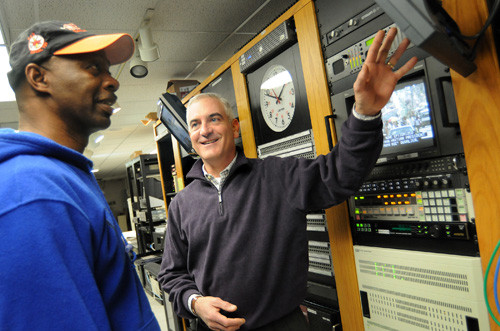
Sen. William A. Walaska is trying to help Rhode Island PBS by giving them Capitol Television, a consolidation that would require the General Assembly to relinquish control of its broadcasting arm.
The Warwick Democrat has introduced a bill that would remove Capitol TV from the General Assembly’s control and allow R.I. Public Telecommunications Authority, which oversees the PBS station, to take it over.
“They’re struggling like every other business,” Walaska said last week of Rhode Island PBS. “I look at our Capitol TV and they’re very competent, they do a nice job. But essentially the bulk of their work year is from January to the end of June and in the summer months their workload is not as heavy.”
Walaska said there is fear of federal budget cuts for public broadcasting and that fundraising numbers are down for PBS. According to 2009 financial reports, Rhode Island PBS heavily relies on fundraising, accounting for 22 percent of its revenue in 2009.
Gov. Lincoln D. Chafee’s 2012 budget proposal recommends nearly $1.8 million for Rhode Island PBS. That’s slightly more than this year but down from the $1.9 million the station received from the state in 2009.
Capitol TV has a total budget of just under $1.4 million, under revised figures for this fiscal year. Chafee’s budget recommends a slight increase to $1.44 million. The legislation does not specify how much of that money would be shifted to PBS, if approved.
“I thought that Capitol TV could assist PBS in their programming, help them do more local programming,” Walaska said. “Also, those are full-time jobs at Capitol TV, if we could utilize them also at PBS that would not only add to local programming, but it would save money for PBS because they would have the availability of the expertise of Capitol TV.”
The station, which broadcasts as WSBE-TV Channel 36, provides in-school, instructional programming, along with other education programs focused on science, nature, arts, music and documentaries. It also offers a variety of how-to programs for adult viewers.
There has “always been criticism of a lack of local programming” at PBS, Walaska said. He added his proposal could help PBS add more local programming by utilizing the equipment, staff and resources of Capitol TV.
“We’ve been talking [in the legislature] about consolidation for years … this is one that can be done without hurting anyone,” he said.
The senator introduced a similar bill a few years ago that failed to pass and faces an uphill climb again.
“Any bill that requires consolidation of agencies requires quite a bit of negotiation,” he conceded. “People are fearful that it could cost job cuts or cuts in pay.”
Neither PBS nor Capitol TV approached Walaska about the bill. He said that he discussed the bill with Piccerelli before introducing the legislation and that he was open to the idea.
“I wasn’t [totally] surprised because it’s legislation that has been submitted at least once or twice before in prior sessions,” Piccerelli said. The legislature “has to see where money can be saved or where new revenue streams can be created.”
Piccerelli said he was not sure how this new responsibility would help with the projected budget cuts. “I don’t see any surplus money being transferred over if that happened,” he said. “I think that all they have is personnel and it would be a transfer of personnel … to us.”
“In terms of [Capitol TV’s] programming, it would not change at all,” Piccerelli said. He brought up the proposed bill in a staff meeting recently and the staff raised the possibility of opening a third channel for Capitol TV programming.
“I’m sure there would be some overlap of responsibilities, so I suspect there would be some reassignment of employees,” Piccerelli said.
“From our perspective, it’s not something we’re asking for and if the legislature charges us with the responsibility…we will do our best with covering the needs for their coverage requirement,” Piccerelli said.
Steven Tymon, general manager of Capitol TV, sees a compatibility issue with the potential change.
“We’re not really compatible,” he said. “I know we’re two state-funded programs, but that’s where it ends.”
“We do live, unedited [broadcasts] showing how the government works and their programming is of a different nature. …There’s not a lot of overlap in programming and responsibilities,” Tymon said.
On an average day between January and July, Tymon’s staff can easily work for 14 hours. The hours are not as long when the legislature is out of session, but Tymon said that there is still work to do.
During the off-season, Capitol TV still covers special sessions and occasional committee meetings. Tymon said that last summer they were on the road recording special-commission meetings regarding pensions.
“They’ve almost become a full-time legislature,” he said. •