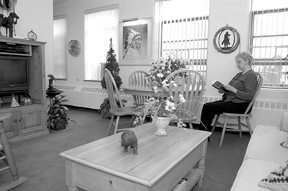
Center which offers assisted-living services.
There’s good news for long-term care facilities.
The aging baby boomer generation is healthier and living longer,
which means there is no immediate crisis to open beds for this largest generation
in the United States.
“When they have to go to a nursing home it will be later rather
than sooner,” said Kathleen Connell, state director of AARP.
Seifert Systems Invests in Energy Efficiency to Strengthen Operations
For manufacturers, energy is more than just another operating expense. It plays a critical role…
Learn More
A recent AARP report shows that the long-term health care industry,
which includes nursing homes and newer services like assisted and independent
living options, will likely not see an influx of baby boomer patients until
as late as 2020 when the oldest of the generation turns 75.
The organization predicts that the number of baby boomers in these facilities
will reach 2.1 million by 2034 if current health trends continue. This finding
is in opposition to a study put out by the Senate Aging Committee back in 1990,
which concluded that the 2.1 million mark would be reached in 2005.
In Rhode Island, these numbers may be pushed ahead a few years. The state
has the eighth largest segment of people 65 years old or older. However, there
is considered to be enough time for nursing homes and other long-term care facilities
to get conditions right before the inevitable glut of baby boomers is expected
to enter nursing homes and other similar facilities.
One of the main changes to the industry is the growing desire for independence
sought by the elderly.
A 2002 Rhode Island survey by the AARP cites that 90 percent of the participants
want to stay at home longer.
“We, and many other organizations, are trying to develop a system for staying
at home,” Connell said. “We’re moving as quickly as possible to ready the state
for the changes that are coming.”
Also, a growing number of traditional nursing homes have added assisted and
independent options; both have nurses on site, but for the most part the elderly
live on their own.
“We’ve seen members branch out to offer multiple levels of care in the last
15 years and I think this is a preview of what’s to come as the baby boomers
start looking for long-term care services,” said Hugh Hall, administrator at
Westview Health Care Center in West Warwick and president of the Rhode Island
Health Care Association.
According to Diane Evans, administrator at the not-for-profit St. Joseph Living
Center in Providence, there are about 60 assisted-living facilities in the state
including St. Joseph. She said customer demand for such a service is growing
as the elderly live longer and healthier.
She points to a 98-year-old resident at St. Joseph’s who gets by fine with
just a “little” help. It’s a situation that is becoming more commonplace.
“Assisted living is a more desirable option for the elderly nowadays,” she
said.
Alfred Santos, executive vice president of the Rhode Island Health Care Association,
said he expects there could be a need for as many as 3,000 more beds at long-term
outfits as baby boomers age. The state occupancy rate at nursing homes now is
about 91 percent, which equates to about 1,000 beds.
Although he acknowledges that nursing homes will have to eventually deal with
the baby boomers and their culture, there is a more pressing issue to deal with
right now.
“The problem continues to be reimbursement,” said Santos, whose organization
includes 70 percent of the 103 nursing homes in Rhode Island. “Nursing homes
are not getting the money they need to pay expenses. Adding more people will
add more losses.”
He cites a federal report on Medicaid that says Rhode Island is missing out
on $29 million a year from Medicaid, the main source of funding for nursing
homes. This fact has resulted in the closing of 15 nursing homes that have gone
under in the last two to three years.
Legislation has been passed in the state that Santos said will hopefully close
the gap. It calls for payment to be made based on inflation adjustments from
year to year. The current system, according to Santos, measures inflation from
a starting point of 1991.
The end result is that inflation is fixed at between 2 percent to 4 percent
rather than the “actual” 4 percent to 6 percent.
Another issue he says will affect care will be nursing availability. Nursing
homes are experiencing a 22 percent vacancy when it comes to nurses, and there
is a need for more teachers to handle a growing number of students going into
the profession.
“All these issues have to be addressed before the baby boomers come of age,”
he said.
Jim Flanagan, vice president of Horizon Bay Manors, said baby boomers have
an advantage when it comes to addressing such concerns. They are numerous, at
76 million, and by nature politically active, which he says will lead future
government to focus on their agenda; this includes changes to the long-term
care industry.
“Issues of payment, and type of services, will be driven by this voting block,”
he said. “Their size, clout and education will help them.”
One service that likely will be addressed by the government is paying for
assisted-living and independent-living services.
Medicaid does not subsidize the costs to the individual. Most residents pay
on their own or, as Evans points out, can receive help through SSI and state
waivers. But, she says, these funding sources are limited.
“Assisted living is often cost prohibitive,” Evans says. “We are always looking
for ways to expand programs to make this service available for the average resident.
A lot of people who are not yet ready for a nursing home would benefit from
assisted living.”
The demands that baby boomers will put on the long-term care market are already
being seen today, particularly in Rhode Island.
The state has the largest 85-plus demographic in the nation. Like baby boomers,
they are benefiting from advances in medicine, living longer and showing a tendency
toward independent living.
According to AARP spokeswoman Barbara Peters, longevity means the elderly
don’t always need the nursing capabilities of a traditional nursing home.
“The Greatest Generation, as Tom Brokaw called them, is better off today with
new drugs now available for blood pressure, cholesterol and such,” she said.
Flanagan adds that this has turned long-term care facilities away from a medical
model and more toward a social model.
“There are apartments rather than rooms with four patients,” he said.
He adds that nursing homes are feeling the effects of alternative offerings.
Partially in response to this trend, they have added rehabilitation care to
its list of offerings.
This has come about as hospitals are releasing patients earlier after medical
intervention, he says.
“Now, there is a greater need for more educated nurses in these settings,”
he said.