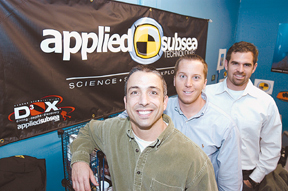
Michael R. Lombardi of applied subsea technologies
applied subsea technologies
Owner: Michael R. Lombardi, president
Location: 95 Hathaway Center, Suite 5, Providence
Rhode Island's Market Has Changed. Developers, Builders, Investors and Sellers Must Change With It.
By Emilio DiSpirito IV License Partner | Engel & Völkers Oceanside Leader | The DiSpirito…
Learn More
Type of Business: Marine science and technology company; bioexploration
Employees: 6
Annual Revenue: $800,000
Imagine planning and training for months to travel thousands of miles to explore under the ice of Antarctica. Imagine, too, that after all the preparation, because of limitations in technology, a half-hour is all the time there was to explore one of the last uncharted regions on Earth.
In actuality, Michael Lombardi, president of applied subsea technologies, spent a total of six weeks on Antarctica’s ice and was able to dive under it for a half-hour a couple dozen times. But still, completing possible life-saving research in half-hour intervals hardly seems worth it.
What if divers had the equipment to explore under the ice for two to three hours at a time? Even still, in warmer waters, what if they were capable of staying under for an entire eight-hour workday, floating, swimming, capturing and discovering new marine life?
And perhaps the most important question of all for AST to answer: Could the extra time under the sea allow someone to find the cure for cancer?
The possibilities are chilling, but as Lombardi well knows, pursuing such ideas is often left to the uncertainty of grant funding. He needed to find a steady funding source capable of sustaining his exploration curiosities.
“I refused to write another grant,” said Lombardi.
He wanted to figure out a way to support his research with steady capital.
The ticket to those adventures seems to hinge on the manufacturing and selling of a closed-circuit re-breather – the CCR2000. AST recently acquired the rights and development of the CCR2000 and formed an alliance with Dan Wible, its inventor. The CCR2000 is a computerized underwater breathing apparatus.
Along with its manufacturing partner VR Industries of Warwick, AST will produce the unit and market it to the commercial/offshore industry and military and scientific community.
According to AST, the CCR2000 is a significant improvement over traditional scuba, where excursions are limited to about one hour at limited depths. The CCR2000 is capable of dives approaching 2,000 feet up to eight hours in duration. According to an AST information sheet, CCRs recycle a diver’s exhalations and recover valuable gas that is lost as bubbles in open-circuit techniques.
On a recent eight-minute dive at 308 feet with CCR technology, 29 different marine species were collected in a space equivalent to a door frame. Of the 29, 12 were new and seven were “hot” or showing useful biological activity.
“Imagine what we could have found in the ninth minute,” said Don Goulart, vice president of marketing and dive support.
“It is about access,” he added. “(Diving) deeper means greater, more significant access to unknown environments.”
Lombardi, 24, a native of Seekonk, started AST in November 2001 as a service provider for researchers who needed logistical help setting up dives and extra underwater manpower.
He graduated in three-and-a-half years from the University of New Hampshire with a degree in marine biology. During that time, he began contract dive work and publishing his underwater research.
Goulart was a marketing director for a microbrew launching a national campaign. The two, with a mutual love of diving, began to talk about the possibilities of “diving deep with the coolest toys and saving the world while doing it.”
“The company was founded on exploration first,” said Goulart.
Ninety-seven percent of the ocean is still unexplored. AST’s idea is not just to build and sell the CCR2000 but to continue research as well, according to Goulart.
Earlier this year, Lombardi and Goulart took their concept to the Boston Sea Rover, an annual marine trade show. It was there that the two met Jim Jaworski.
“Within two minutes of meeting them and seeing their vision, I was there,” said Jaworski. He has combined his international business expertise with a love of diving to become AST’s vice president of operations.
“I started the monster,” said Lombardi about AST. “Don helped paint the picture and Jim was the missing element that we needed to ground us.”
In addition, the three consult with a seven-member advisory board that consists of people from the scientific community, the Slater Center for Marine and Environmental Technologies and the Rhode Island Manufacturing Extension Services. AST also has a diving control board through its membership in the American Academy of Underwater Sciences, which advises on operations, procedures and technology development.
When asked if their concept of for-profit science is shunned in the scientific community, Lombardi answers that there will always be skeptics.
“I will take it to the grave that the business of exploration is commercially viable science that can and should be done,” he said.
Goulart added, “We are proving that science doesn’t have to be academically driven or funded. It can be independent with business development.”