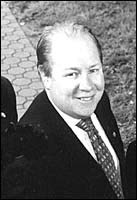
Name: J. Christian Bollwage
Position: Mayor of Elizabeth, N.J., and co-chairman of the United States
Conference of Mayors Brownfields Task Force.
Background: A native of Elizabeth, Bollwage was elected in 1992 and reelected
in 1996. While serving as mayor he has overseen the redevelopment of the historic
Midtown section of Elizabeth while also spearheading the effort to redevelop many
of the state’s brownfield sites. His efforts have resulted in Elizabeth being
chosen for a Federal Brownfields Pilot Program. Appointed last year co-chair of
Conference of Mayors Brownfields Task Force. His work with brownfields both in
his city and across the country earned him the “Brownfield News Award for Excellence
in Brownfields Redevelopment” from Brownfield Magazine. Boll-wage visited Rhode
Island recently where he was the keynote speaker at a brownfields conference.
Education: Kean College (Union, New Jersey)
Residence: Elizabeth
PBN: Tell us about Elizabeth.
BOLLWAGE: Elizabeth is the fourth largest city in New Jersey. It has a
history dating back to 1644 and like many Rhode Island cities, has an industrial
past dating back to the early 1800s. We are a population of about 110,000.
Seifert Systems Invests in Energy Efficiency to Strengthen Operations
For manufacturers, energy is more than just another operating expense. It plays a critical role…
Learn More
What are some of the brownfield success stories in Elizabeth?
One of our earliest projects was developing a site near the New Jersey Turnpike into the best performing IKEA store in North America. The Elizabeth IKEA store, which opened in 1990, generates over $1 million in tax revenue for the city and another $2 million in Urban Enterprise Zone Revenue. We also opened a brand new $9 million, 56,000-square- foot supermarket in a five-acre former handbag manufacturing plant. This site, located at a key intersection in Elizabeth had fallen into disrepair and become an eyesore. In another scenario, which is repeated 1,000 times across the country, a plastics manufacturer closed down and left behind an abandoned property. The property became a magnet for illegal activity, an eyesore and had a tremendous negative effect on the surrounding neighborhood. The city acquired the site and with community input, redeveloped it into Little League, t-ball fields, and a clubhouse.
What would you consider your greatest success story?
The mall. We took a municipal landfill that had been closed for 25 years and turned
it into the largest new retail development on the East Coast. Many people have
called this the biggest brownfields success story in the country. Jersey Gardens
Mall opened just over a year ago. It’s over 1.7 million square feet of space and
home to 200 stores and restaurants. Over 150,000 shoppers a week visit our outlet
mall. Aside from the 1,700 construction jobs, the mall has created almost 4,000
permanent jobs. During the first eight months of operation it generated $2.5 million
in revenue for the city.
What made the project so successful?
There were a few key factors. The city assisted the developer with the cost of remediation by making low-interest loans available to them and helping them secure another loan from the state. We created a working group of all involved agencies and private interests so that we could expedite the process. We turned to our state legislature for help and they responded by creating an important brownfields redevelopment financing tool, which allowed certain municipalities to designate “landfill reclamation districts.” It allowed the city to assess a 3 percent franchise fee on all taxable items sold within this area.
Was there opposition?
There was political opposition. People started campaigns saying the mall was going nowhere, and people were going to “shop and glow.” I had to overcome that through education by saying there were going to be jobs, revenue and I would clean up a blighted area. Now it’s the future, it’s the catalyst for hotels, 750,000 square feet of office space, ferry terminals, and much more.
Why develop brownfields, as opposed to other open space?
Every year this country tears up the equivalent of New Jersey, Delaware, Rhode Island, and part of Pennsylvania in greenfield space. We need to start to reuse our land and recycle it because it’s the only way we are going to be able to increase investment in our urban areas. Frankly, we just can’t keep tearing up the farm space and the green space.
What is the economic benefit to developers in working to develop brownfields?
There is a profit in this if it’s structured properly. That’s the balance of the
negotiations. The developer has to make money. We can’t think the developer is
going to come in and do a project for nothing – they have to make money. The way
a developer makes money is that many of the up-front starter costs are paid for
by the government. If we, as a government, can come in and remediate the land
and pay for the remediation costs, the developer is treating that as a greenspace
application and doesn’t have all of these soft costs in the start-up of the project.
Sometimes the remediation and these costs are what drive developers away from
brownfield development and that’s the number one issue people in government need
to see.
How do you get developers to see past the contamination?
Sometimes there isn’t a political will to help the developer get past that. I mean there needs to be an incentive whether it be a tax credit, whether it be the cost of remediation. Keep in mind when we were building the mall, and we were remediating on this property, even if the developer stopped we would still have gone so far on the remediation, that we would have made it viable for the next developer.
How do you get the public to support these ideas?
You tell them there will be jobs.
How do you balance brownfield development with protecting the environment?
The public buys into brownfield redevelopment very quickly if you are going to create jobs and reduce the tax rate. The extra benefit is the health issue. Redeveloping brownfields, converting a landfill, removing a hazardous condition benefits the quality of life in the neighborhood, so that’s important as well. When you ask that question, the health issue isn’t the thing that jumps out at residents but it’s the greatest benefit of all, because when we redevelop a brownfield site, you take away the blight for the urban decay.
What do you think the key elements are to making programs like yours a success
in other cities?
One key is to have resources. I mean, the brownfield program in New Jersey puts $15 million a year into remediation costs, into initial assessment costs. There are no grants involved but there are loans involved to address these situations. One of the things we are lobbying for, and (U.S. Sen. [Lincoln] Chafee has been very supportive of it) is a national brownfields policy. National brownfield legislation would provide funding for the entire nation in order to start redeveloping brownfields. You see Rhode Island is a smaller state and they don’t have a lot of the resources that a larger state would have, so therefore it would be a very helpful bill.
How did these developments change the economics and even character of your
city?
Our total budget is $127 million. When we built the mall and we generated another
$6 million in revenue that’s 6 percent of the budget that is now coming in as
new revenue – that’s a major economic impact on the municipal tax situation. It
also takes away the blight. Some of the buildings we developed we had to deal
with illegal drug activity, squatters, and when you remove that from the community
that’s a benefit.
How does Rhode Island work on projects like these despite its size and the
apparent difficulty infunding?
Legislation. You can look at current state legislation and try and find ways to tighten it up. You can also look at legislation from other states, and pick the best of that legislation for what will work in Rhode Island.
In Rhode Island, we categorize our brownfields into three different areas.
Does New Jersey have a similar process?
I have never seen classification like this, but I believe the mall that we developed would be considered a tier three — there was real or perceived contamination, we had very poor access, no infrastructure, and little economic potential as a mall.
Does a project need to be as big as a mall?
No, if I tried to build that somewhere else in New Jersey it wouldn’t have worked. The reason the mall worked is because it was on a landfill and there isn’t much you can do with a landfill except cement it over and create a parking garage. Projects can be any size.
Has the image of brownfields changed as a result of projects like the mall?
There was a debate in the beginning on brownfields, whether we should actually call this brownfields or not because it leads people to the connotation that there is contaminated land, and people are scared of that. Brownfields kind of stuck in comparison to greenfield. I think the more that we do in education, and the more that people get out and talk about the reconversion, the more society is going to embrace this. Keep in mind brownfield isn’t an old term. It’s clearly changing among political leaders because political leaders recognize the value of removing blight and creating economic benefit.