When Brown University turned on its new supercomputer last November at a ribbon-cutting attended by Gov. Donald L. Carcieri and other dignitaries, officials said their goal was nothing less than the transformation of Rhode Island’s research landscape.
Four months later, Brown is already seeing the benefits of the powerful, multimillion-dollar machine, which can perform more than 14 trillion calculations per second at its peak speed of 14 teraflops – 50 times faster than what was previously possible at Brown. To take one example, a group of researchers mapping Mars can now process images from NASA in one day instead of three months.
“On campus the excitement about having this kind of supercomputer available is really palpable, and we really are seeing a lot of people getting involved with it,” said Clyde L. Briant, the university’s vice president for research, “I’m very, very pleased with the whole thing.”
Nor are the benefits limited to Brown. The supercomputer is envisioned as a statewide tool that will allow other schools, government agencies, hospitals, nonprofits and businesses to access the technology at a competitive cost (currently, about $100 per account). Researchers at the University of Rhode Island and the Marine Biological Laboratory in Woods Hole, Mass., helped design the machine and are taking advantage of it.
The supercomputer’s lofty mission, as set out by Brown and IBM Corp., which shared the cost and provided the technology, is to give researchers in Rhode Island the means to tackle – and, hopefully, solve – “grand challenges” and “pressing societal problems,” in areas ranging from climate change and biology to education and health.
That may sound like hyperbole, but supercomputing’s local boosters are far from alone in their hopes. A 2005 White House report declared: “The most scientifically important and economically promising research frontiers in the 21st century will be conquered by those most skilled with advanced computing technologies and computational science applications.”
That view is shared by Briant, who is also co-chair of the R.I. Science & Technology Advisory Council, which Carcieri created in 2005. “Research is the catalyst, the underpinning, the foundation for a lot of economic development, and I think we want to build research in this state to make that happen,” he said.
In recent years, high-performance computing has become critical to advanced research – and not just for scientists. It powers sophisticated modeling and simulation tools and also makes it possible to sift through the vast amounts of data generated in the digital age.
“As computing systems have progressed from the megaflops era of the 1970s to the petaflops era of today, our ability to accurately simulate a broad range of biological, chemical, physical and even social phenomena has grown dramatically,” Thom H. Dunning Jr., director of the supercomputing center at the University of Illinois at Urbana-Champaign, said in congressional testimony in February.
“Computing today penetrates all disciplines,” said Jan Hesthaven, director of Brown’s Center for Computation and Visualization, where the supercomputer is housed, and a professor of applied mathematics. “It allows researchers and students to do things across the university they probably couldn’t do 10 or 15 years ago.”
Hesthaven said colleagues tell him they are exploring new avenues of research made possible by the machine. A group in the engineering department is doing detailed modeling to test when and how material cracks when it gets bent, with an eye on increasing sustainability and durability. Biologists are comparing genetic sequences in different organisms across multiple generations to find clues about what causes different traits.
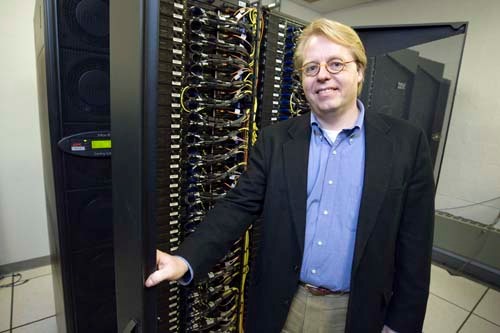
Brown’s supercomputer is made up of a trio of IBM rack systems roughly the size of three refrigerators and housed in a server room at the Center for Computation and Visualization, which is located at the corner of Brook and George streets. Its storage capacity is 390 terabytes – the equivalent of 1,599 MacBooks – and its memory totals 4.5 terabytes.
You don’t sit down at a monitor to use the machine – it doesn’t have one. Instead, you visit a Web site and plug in an order for the information you need computed, then download the results when the supercomputer finishes processing the request.
(“We’re not fortunate enough that we own a third of the world’s oil,” Hesthaven quipped, “so that puts us in a slightly different position when we write checks.”)
Closer to home, New Mexico’s government spent $11 million to build Encanto (Spanish for “Enchanted”), which can perform 172 trillion calculations per second. But its experience also shows how fast new technology gets eclipsed these days: Encanto was the world’s third-fastest supercomputer when it was unveiled in 2007, but has slipped to 25th in the latest rankings.
Hesthaven said he expects the use of Brown’s supercomputer to grow from an average of about 75 percent of capacity currently to nearly 100 percent this spring. “It certainly justifies that there was a need for it,” he said. Brown is also finding it to be helpful in attracting and retaining faculty members.
Hesthaven has been spreading the word about the supercomputer to researchers at other organizations and is also fielding calls from outsiders looking to use the machine. There have been discussions about finding ways of letting Rhode Island high school students try it, as well. Brown and IBM also plan to host a series of symposia in the coming months at which experts will discuss various ways the supercomputer can be used.
And despite a fiscal crunch that has forced Brown to reduce next year’s budget by $30 million, the university’s leaders voted in February to hire two more people at the computation center, including an executive director who will be charged with oversight and outreach. Eventually, the staff is expected to total 10.
IBM, meanwhile, is already working on the next generation of supercomputers. The company has founded a lab in Dublin where researchers are trying to “break the exaflop barrier” by building a computer capable of a million trillion calculations per second. •