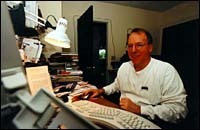
Bryant College accounting professor.
(Tom Croke)
When friends and family gathered to watch Bryant College’s 554 undergraduates receive their diplomas on May 18, they weren’t all on the Smithfield campus.
In fact, when accounting professor Neal Hannon handed a diploma to his son Mark, family in New York, Florida, California, and even Nova Scotia were watching it happen via the World Wide Web
Beyond Cash Donations: How New Forms of Giving Are Transforming Not-for-Profit Accounting
Evolving Funding Landscape for Not-for-Profits Not-for-profit organizations are being asked to do more with less,…
Learn More
I think this is pretty cool,” said the elder Hannon. “The possibilities of all of them watching are nil if it weren’t for the Web.”
Hannon and his Rhode Island-based family tried the technology out a week earlier when he watched his oldest sister receive her graduate degree from National University School of Education in San Diego.
“She did a little jig after she got her diploma,” Hannon said. “My two other sisters and I were instant messaging one another as we watched her dance across the stage. It was terrific.”
Both events were made possible through what is known as streaming technology — a way of enhancing World Wide Web sites by integrating video and audio with a site’s text-based content. Unlike downloading a video or audio file separately and then playing it back later, stream media plays when a Web page downloads onto a user’s browser.
“A couple of years ago the technology wasn’t efficient enough to handle this type of broadcast,” said Thomas M. Aldous, president of the East Providence-based Streamedinfo.com. “Technology has changed and the you can now get quality video.”
This is the second time in three years Bryant College has broadcast its commencement ceremonies over the World Wide Web — the first time being in 1999.
“When we first did it, we had an international student from China whose parents weren’t going to be able to make it to the ceremony,” said Joyce G. O’Neill, director of marketing and communications. “It was a way for his relatives to see what was happening.”
This year, college officials decided once again to broadcast not only the undergraduate ceremony, but also the graduate ceremony held May 17.
“It has become part of our strategic plan to make the technology available and then use it,” O’Neill said. “This year we have a new Web producer, and the technology has really come to the forefront.”
According to college officials both broadcasts were successful — with more than 167 people logging on to watch the graduate ceremony, and 270 people logging on to view the undergraduate ceremony. In addition, O’Neill said nine people had accessed the graduate ceremony in the three days following its initial broadcast, and more than 250 people accessed the undergraduate ceremony in the two days since it was initially broadcast live.
“I think that a lot of these hits are students and family members who go back and decide that they want to see what it was like on their own time frame,” O’Neill said. “In addition they can save for themselves on the home computer.”
O’Neill said the technology came with a relatively small price tag as the college already had many of the things needed for a successful transmission.
“We had to buy a server which cost us about $1,200, and we are running that through the cable television channel we have on campus,” O’Neill said. “It’s definitely a learning curve. Next time will probably include a mixing board because the sound wasn’t as good as we would have liked, but it was still a success.”
Aldous said what makes this type of broadcast so exciting is that three years ago these capabilities were only available to large corporations with a huge amount of bandwidth, whereas today anyone with a modem can enjoy streamline video.
“Previously people using the video needed a corporate connection,” he said. “But today the technology is freely accessible, and you are starting to see the same kind of technology in places like a day care center where a parent can log on and visit their children. It’s being used in a lot of innovative ways.”
O’Neill said the college plans to continue using the technology in the fall when they broadcast football games and other college activities over the Web.
“We didn’t start out with great expectations for this,” she said. “But it has been a huge success.”
As for the Hammons, Neal said his son Mark accepted his diploma “with a really big grin.”
A grin the whole family could see.