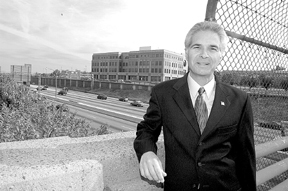
RIDOT director juggles funding for construction
Seifert Systems Invests in Energy Efficiency to Strengthen Operations
For manufacturers, energy is more than just another operating expense. It plays a critical role…
Learn More
James R. Capaldi
Age: 57
Position: Director of Rhode Island Department of Transportation
Background: Capaldi has held several positions at the DOT, starting
as an engineer. In 1987, while he was chief design engineer, he left for the
private industry for two years, then returned to the DOT as chief of construction.
He was promoted to chief engineer in 1994 and held that position until Gov.
Don Carcieri tapped him as director in January.
Education: University of Rhode Island
Residence: North Providence
Q. What is your budget this year?
A. The budget is a unique tool. We came out equal to last year’s budget.
The dollars are difficult to explain because you will see our budget as $86
million, I think, and we have a pass through to RIPTA. A massive part of our
program is our capital program, the federal funds, which last year we got $190
million matched by $30 million of bond and additional gas tax. Our budget is
rather small for the 800 employees we have. Usually the majority you’ll see
is the $7, $8, $9 million this year for snow removal, which if we have a bad
year we wipe out by February or March, which means we’re running on deficit
right off the bat. So it’s a unique budget to try to explain, but we get about
20 cents of the gas tax, each penny is $4.7 million so there’s where the $80-or-so
million comes in and from that RIPTA gets a part. Then, with those dollars,
a percentage pays debt service. Our debt service this year is, I think, $33
million.
Q. One of the measures the governor has talked about in relation to your
budget is GARVEE financing. Can you explain what GARVEE is and why a state might
go after that type of funding?
A. It’s called a Grant Anticipation Revenue Vehicle. The ‘E’s were
added to make it sound Garvey because Jane Garvey was the deputy federal highway
administrator in 1995-96 when ISTEA (Intermodal Surface Transportation Efficiency
Act of 1991), which is really TEA-21 (Transportation Equity Act for the 21st
century) allowed the use of grant anticipation revenue vehicle. Now what is
that? When Eisenhower signed the bill for the interstates and he did (proposed
funding it) by a gas tax. In signing that bill the states could go ahead and
do interstates, if they wanted. But there was no cash. There was the authority
to do it, but there was no money. So the states were told, ‘If you want to start
the interstate you can go out and get bonds for engineering, right-of-way and
construction costs and we’ll pay you back. We’ll give you all the money.’ We
were one of the first states to take advantage of that.
Q. Is that a guarantee that you (RIDOT) will get 100 percent back or is
that a risk every year?
A. Well, you have to understand we’re trust babies. I hate to say
it that way, but we don’t wait for grants. It’s not like we’re sitting here
applying for a grant. Fast forward now to 2003, because the gas tax is collected
and when they did TEA-21 they did something else too. They put a firewall because
before all the gas tax went into all one pot even though it was still gas tax
and then it could be technically raided to shore up Social Security or to go
to a war or whatever. In 1995-96 when TEA-21 was passed that firewall was created
and you couldn’t touch the gas tax money. So, that money is a big trust fund,
the highway trust fund. It gets distributed through a number of different formulas,
depending how many roads you have, people who drive and size of state. There
was about $31.8 billion shared last year among all the states. And Rhode Island’s
share of that last year was $191 million. So it’s about an 80-20 (federal-state
match) ratio. So, you say, am I guaranteed? The bond counsels look to see is
there even a chance you’re not going to get any federal money. If they didn’t
give us any federal highway money we pay 18 cents on each gallon of gas that
goes to the federal highway trust fund. So if they gave us back the 18 cents,
which is unheard of, you multiply that by 4.7 cents per million and that’s what
would generate for Rhode Island. I think it’s about $87 million. So we are at
least going to get that if there is no program. Let me bring you right to the
point. So the money comes every year. I call it a guarantee. All the federal
requirements and laws – they would have to give all that up – if they ever said
there was no program. There is no bond counsel or person in this business that
believes that is going to happen.
Q. Is this the first round of GARVEE bonds?
A. I think there are going to be three series. We’re working on this
now. We made presentations and had three public hearings. We did worst-case
scenario all at once. And they’re saying we have more than one series. What
that does is eliminate negative arbitrage. Let me tell you what I’m faced with
as director when I took over. I was faced with five projects, two of which were
funded in the existing transportation improvement plan (TIP) at approximately
$60.5 million a year for the next four years, so that’s about $242 million.
But that was only going to build the Washington Bridge, which is an $80 million
project and it was going to build part of the relocation of I-195. The freight
rail improvement project (FRIP) had a shortfall of some $50 million, with no
money in the TIP for that. The second phase of Route 403 had no money in the
TIP for it and that was about $100 million. Then, as you may know, there was
a lot of concern about maybe we should put a toll on the new Sakonnet Bridge.
What was somewhat unknown is to build the bridge with tolls was going to cost
$20 million more and it was going to fill wetlands. Governor Carcieri was faced
with a public and Legislature that didn’t want tolls and really no other way
to pay for this bridge. So he asked is there any other alternative.
Q. Are these projects necessary and is construction going the way you want?
Let’s start with the Washington Bridge.
A. The Washington Bridge which carries over 200,000 cars a day, I
would like to think is a critical bridge or the whole east-west connection on
the interstate is gone. So that has got to be done. It is already an advertised
project and I think the bids will be open sometime in November. So that one
is all done, and we are anticipating this money to be coming in. We will be
out to construction very soon.
Q. What about the relocation of 195?
A. There are 17 bridges in serious disrepair. There are wood and shorings
holding them up. We’ll probably get six or seven more years out of them as we
watch them every six months. So they’ve got to be replaced. There is nothing
we cannot do 195. There are 15 contracts. We’ve finished all the way to five,
and put out seven. They are already out to construction and part of this GARVEE
program. Seven was the last contract I could put out, without GARVEE that would
be the last one and we would have to stop there and wait for more money to become
available in later years. So we would be spreading out the construction. Contracts
13, 14, 15 are really to take down the old bridge. So we’re planning to put
the traffic on this (new extension) in 2008. So this is very active. We are
heavily into the construction.
Q. The freight rail improvement project?
A. We’ve already invested some $150 million and when the agreement
was made in 1996 then-Governor Almond made an agreement that said we would pick
up the tab with federal highway money if we couldn’t finish it. So, I’ve got
to use federal highway money. It’s 22 miles. We’ll replace 17 miles of track
–12 miles new, 5 miles (repair). We’ll try and get it in service by the end
of 2005, worst case 2006. We’ve already invested and have under construction
the eight of the nine construction contracts with Amtrak support. We’re about
to sign an agreement as soon as we get the GARVEE to do all of track 7 which
is a five-mile piece from Providence to Central Falls and we’re preparing to
do a two-mile piece out of Quonset.
Q. Route 403 in Quonset?
A. We’re building only half the project to the largest track of land
we have for development – half a road. So when the developers come in and say
when are you going to finish the second half … what would the answer be, ‘I
don’t know’? Which is what the answer has been up until this point in time.
‘I don’t know’ is not good. Now we have to make a commitment to build the second
piece of it, the link we’ve been planning for 15 years or not. The governor
has to make that decision and so do I. If we don’t get the GARVEE we stop at
School Street. With the GARVEE we’re able to finally finish it and take it Route
4 the access highway. Now we can actually tell the developers we’ll be done
in 2008.
Q. And what about the Sakonnet River Bridge?
A. We’re going to replace it sometime … And if we don’t start replacing
it now, the repairs we did about two-and-a-half years ago are good for eight
years. I have about six years left of it. Are we going to keep doing major repairs?
We’ve got to replace it some day and costs don’t get cheaper to build large
bridges.