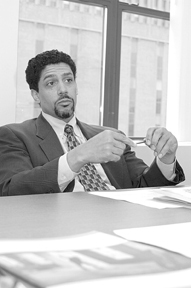
Economic developer shares visions for downtown, neighborhood growth
Donald C. Eversley
Beyond Cash Donations: How New Forms of Giving Are Transforming Not-for-Profit Accounting
Evolving Funding Landscape for Not-for-Profits Not-for-profit organizations are being asked to do more with less,…
Learn More
Position:
President, Providence Economic Development Partnership
Background:
Prior to his current position, Eversley was director of work force and business development for the Bronx Overall Economic Development Corporation for two years; before that he was director of operations, strategic planning and governance for the Board of Education of the city of New York, Office of Charter Schools. He is also a former president and CEO of South Atlantic Communications and his own law office.
Education:
Bachelor’s from Brown University in psychology and Afro-American studies; JD from the University of Pennsylvania School of Law
Residence:
Providence
Age:
45
Q. What exactly does your job entail?
A.
We’re not a city department or agency; our operations are funded through revenue generated from our revolving loan fund and we were created with federal (Housing and Urban Development) dollars. We are continuing the commercial loan program (the old corporation had), sharpening up our criteria and focus, we plan on being more inclusive in terms of the types of customers that we target, and the range of activities and neighborhoods that those customers will represent. We’re looking to get involved in a whole range of commercial and industrial activities. We’re economic development lenders – while we are a commercial loan program like a bank, a bank makes its decisions based on a financial return. Like a bank we need to be repaid and generate those dollars, (but) we also have a social return. While we need to generate money, it’s also part of our core mission to generate jobs, to serve low- and moderate-income neighborhoods, to recover blighted properties. These are not city of Providence loans. Moving forward, we’ll be engaging in a variety of activities that are not loan-related. It’s important that we have the capacity to do economic development strategy – acting as a resource for the mayor in helping him shape his economic vision. Going forward, old days – loan program. New days – it’s loans, economic development strategy, small-business assistance, we’re going to get involved with work force development.
Q. How closely do you work with the state Economic Development Corporation?
A.
The PEDP and RIEDC have a great working relationship, and I personally have a tremendous working relationship with Mike McMahon. They have a bigger picture to work with, however, here in Rhode Island, we have a city-state concept. You can get everywhere so quickly and so easily, with Providence at the heart of the whole thing. I think everybody gets that, and we need to have a capital city that is strong and vibrant and makes an impact from Westerly to Newport. So many of the people in the rest of the state work, play, shop, entertain, get educated in Providence, that it’s not like other cities, where what’s going on in Albany has little to do with what’s going on in New York City. Here, it’s all connected. And although they have to be responsive and engaged in Quonset and northern Rhode Island as well, it’s clear that they realize that Providence is a very large part of their agenda.
Q. There are at least three bills in the General Assembly that could be seen as negative for business in the city – the split tax rate, garage tax and continuation of the tangible tax. How do these hinder your job of attracting business?
A.
Having been here three months, I’m only now starting to catch up on legislative implications of economic development. It’s a long, Byzantine process, and I don’t have a lot of details on those. Without specific reference to the details, I think we have to look at tax policy very carefully to make sure we’re not hindering the entrepreneurial zeal that’s here. However, tax is one small piece of what makes a business successful and what makes a company decide to be in any particular location. I think sometime folks focus on taxes perhaps more than they should – there are so many other things that are equally – if not more – relevant. There are great businesses in very high tax locations because they get something extra from being there. We have to make sure that we have a tax structure that is fair – I think it’s more important to have a fair tax rather than low tax.
Q. Do rapidly increasing home prices make it harder to land businesses that would move here?
A.
You’d probably have to ask individual businesses, and it would depend on where they’re moving from. A lot of the businesses that may be looking to relocate are often coming from even higher prices – certainly New York, Boston, southern Connecticut, Philadelphia are all higher priced than here. Many of them are actually coming here because of the average lower (cost of living) which would include home prices, restaurant bills, cost of just living and doing business. Here in Rhode Island some people are expressing sticker shock, particularly in the more upscale neighborhoods. On a statewide basis we’re still certainly lower than some of our neighbors in the Northeast. Someone buying a house is expressing disappointment over the increasing costs of homes – the people selling the houses are very happy. It’s a double-edged sword. What we can do is encourage more inventory and a broader range of housing.
Q. What do you think is the biggest detriment to creating vibrant residential neighborhoods around Downcity?
A.
I left Providence in 1981 and returned just recently. When I first came (back) about a year ago, I was amazed at how different the city looked, but then I realized virtually all of that development that I saw at that time was between South Main Street and City Hall. Just walking one more block was like seeing the back of an old Western set on a movie lot. One more block puts you on Washington or Westminster streets circa January 2003 – empty storefronts, folks walking around with expressions of despair. Even downtown the Providence renaissance was very uneven. The projects that were done were done very well, but I think they were all project-based, without sort of a comprehensive strategy. So what we’re looking to do is fill in behind it – to go block by block and create a kind of dynamic city we need. People are living here … but they’re living here with no grocery store, no pharmacy, no gift or card shop, or the other things you need in normal residential communities. We’re aggressively trying to build those things and encourage those types of services. The criticism of the other viable neighborhoods – sometimes I wonder if folks have been in those neighborhoods lately. In upper and lower South Providence and the thousands of new and rehabilitated units that have been developed in the past few years have created tremendously viable housing stock. You can look at the work that the West Elmwood organization is doing, the Olneyville Development Corporation. There is a lot to do but I think we have a good combination of public and private sector players that are well on their way. Having a strong downtown is a key to having stronger neighborhoods.
Q. How would you like to see the city and state work together to develop the property along the water opened up by the Interstate-195 relocation?
A.
One of the ways I can be most helpful is to bring my own skills, knowledge and perspective to the discussion because you have many talented people that have been working here on the city for years. I’m here to work with them and build on the momentum that they’ve built, but I also want to add my own perspective because it’s not helpful if everyone is singing the same song. If there are folks focusing on historic preservation, neighborhood improvement, high-tech industry and financial services, I want to not negate those things but focus on work force development, adult education, old-economy industries – your manufacturing distribution, building trades.
Q. What are you hearing about filling the void left at the former American Express building?
A.
I know that Rhode Island Economic Development (Corporation) has been working on that. My own opinion is that it will be filled the instant Boston Financial goes back to Boston. There’s a tremendous demand for first-class office space in the city and I have every expectation, based upon what I know about the market, that that will be filled.
Q. Do you see an opportunity for Providence to really build on the influx of medical research operations in the Jewelry District?
A.
I think the medical industries – it’s really multifaceted – medical service and delivery, the hospitals, the clinics; you have the medical financial services like Blue Cross and Perot Systems – both of those are growing industries as our population increases and ages. The medical research/manufacturing sector – the Amgens, the bioengineering folks (show) tremendous opportunities. It’s an area we can really be competitive in. We’ve got world-class doctors and hospitals; we have world-class engineering faculties. The Brown biotech center is a tremendous opportunity because not only does it represent an important step but it’s a good symbol of the momentum I’m feeling is going forth …