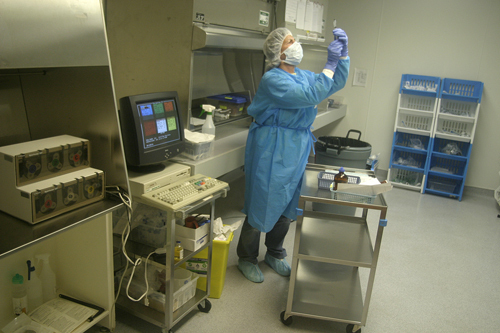
Like most pharmacies, Pawtuxet Valley Prescription has come to rely quite a bit on its pharmacy technicians.
The technicians play key roles in assisting the pharmacists with prescription orders, preparing doses for patients and filling out complicated insurance paperwork. At Pawtuxet Valley Prescription, those skills could be needed at any time, since the business offers 24-hour service.
But a recent change in state regulations governing pharmacies now requires technicians performing advanced duties to be nationally certified and licensed.
And that has created a shortage of properly trained technicians in Rhode Island.
While Leo Blais, president of Pawtuxet Valley Prescription and a Coventry state senator, said recently that the technician jobs at his business are filled, that is not the case elsewhere.
“There are lots of openings,” Blais said. “And there are new stores opening up all the time; they all need qualified people to work at those places.”
That is why the Community College of Rhode Island’s Center for Workforce and Community Education (formerly the Division of Lifelong Learning) will offer a 155-hour pharmacy technician program starting in October that will cover skills ranging from calculating dosages to handling the details of insurance billing.
It is not a degree program. Suzanne D’Onofrio, CCRI’s director of work force training, said those who complete the program will receive a certificate and will be prepared to take the national certification exam.
Students will also receive help looking for a job, including assistance in writing a resume. “When the students finish the training, we don’t just say ‘Good luck.’ We want to be able to place them too,” D’Onofrio said.
Most technicians earn between $10.10 and $14.92 an hour, according to a May 2006 survey by the U.S. Bureau of Labor Statistics.
The launching of the CCRI program was praised by Blais, who has also been recruited as an instructor. “It’ll be a boon for the industry,” he said.
The idea to create the program actually came from Mayur Shah, a Chicago pharmacist and CEO of MRxI Corp., which provides education services to health professionals.
Shah said his company contacted CCRI about establishing a program after learning that the R.I. Department of Health pharmacy technician regulations had been revised to require certification and licensing.
MRxI offered the curriculum and materials and recruited local pharmacists to act as instructors. CCRI had to provide classroom space and lend its reputation as an accredited school.
D’Onofrio said she researched some of the 20 other pharmacy technician programs MRxI operates nationally, including one at Massachusetts Bay Community College in Wellesley Hills, Mass.
The reviews were positive, so CCRI moved forward with MRxI. Shah said MRxI charges the school a flat fee. In turn, tuition is set at $3,000 per student. D’Onofrio said the program has received approval for a federal grant from the Work Force Investment Act, which will pay the fees for qualified students.
The program, which will run from October to January, will include “modules” on drug interactions, basic pharmacy operations, dosage calculations and insurance billing training. Some of it can be completed online.
While the maximum class size has been set at 25, about 10 people have signed on so far. D’Onofrio said others initially wanted to take the course, but students are required to have a diploma and will have to undergo a background check before getting hired.
During her research on the need for a pharmacy technician program, D’Onofrio said she learned that there were plenty of job openings at retail pharmacies, hospitals and nursing homes because of a change last year in the Department of Health regulations.
Those new rules created two levels of licensed technician:
• Technician I, who can be trained by the employer but whose duties are limited;
• Technician II, who must receive training from a program accredited by the American Society of Health-System Pharmacists, a program approved by the R.I. Board of Regents, or a program that requires the technician to pass the Pharmacy Technician Certification Examination or the Institute for Certification of Pharmacy Technicians exam.
By regulation, a Technician II can be given greater responsibilities, including being allowed in the pharmacy to prepare medications without a pharmacist.
Shah said those technicians are also paid higher wages, adding that Woonsocket-based CVS Caremark Corp., which has worked with MRxI, has expressed an interest in hiring students from the technician program.
Blais said the local health care industry will certainly benefit.
While some pharmacy businesses have no in-house training programs, some pharmacy companies “invest a lot of time and training and documentation for new people coming in,” Blais said. “If there were a pool of candidates [with] the same basic competencies – that makes the learning curve a lot shorter.”
And despite the tough economy, pharmacy-technician students shouldn’t have any trouble getting a job, he said. •