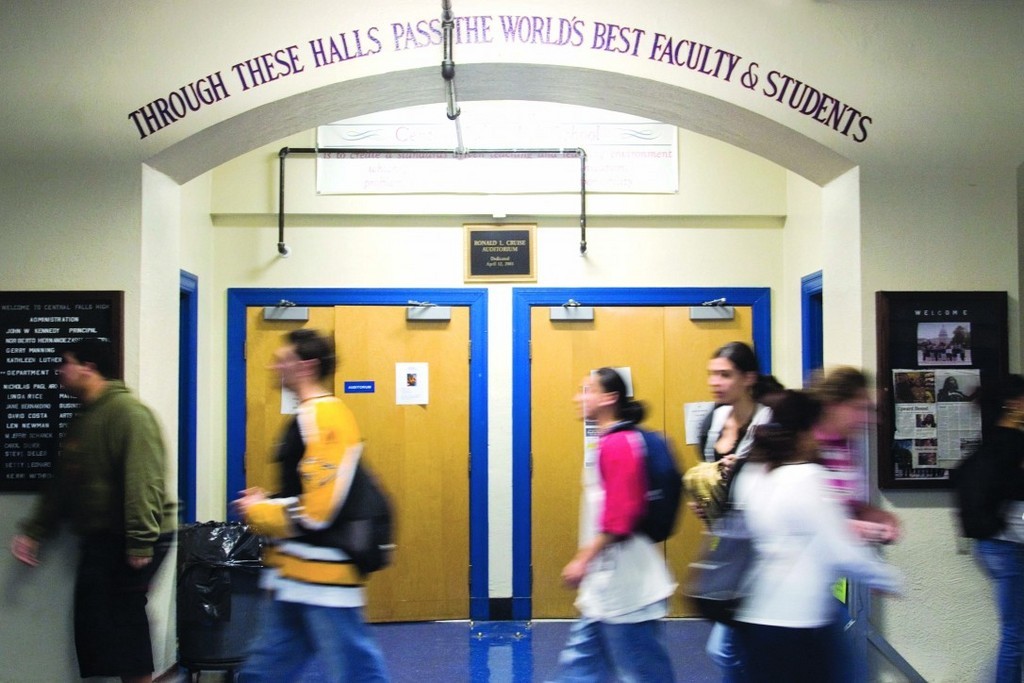
At Central Falls High School, most students are well-behaved and respectful of their peers and teachers, and the teachers care deeply about the students and want them to succeed, according to a recent report from the R.I. Department of Education.
But the majority of students at the school can’t read or write well, the report also says, and can’t do even the simplest math without a calculator.
The report is based on the observations of 15 department staffers and 15 urban educators who visited the school on Dec. 12 and 13 and observed more than 128 hours’ worth of classes. The team was brought in by interim Superintendent William Holland to provide input as Central Falls High School prepares to be reconstituted, as required under federal law.
The No Child Left Behind Act of 2001 imposes a range of sanctions on public schools that do not make “adequate yearly progress” in their students’ academic performance; the sanctions culminate, after several years of missed targets, in reconstitution. The law applies only to schools that receive federal Title I funds, which support programs for low-income students.
Central Falls High School, with more than 80 percent of its students in poverty, has been missing its targets since 2002 and will have to be reconstituted next fall. It will be the second Rhode Island school to be reconstituted, after Hope High School in Providence, which was turned into three smaller schools at the East Side campus in 2003, well before any federal sanctions kicked in.
The state has given Central Falls several options: reopen the high school as a charter school, replace all or most of the staff, place the school under private management, place the school under state management, and/or restructure the school’s staffing or governance.
“Essentially what will happen is [Holland] will need to prepare his recommendation for what should happen here. That’s why he wanted the report,” said Rick Richards, policy and school improvement specialist for the state Education Department. “Reconstitution is a serious move, and he wanted to know what the health of the school is.”
Since receiving the report last month, Holland has submitted a plan to Gov. Donald L. Carcieri and the state’s Board of Regents for Elementary and Secondary Education. The details have not been released, however, and Holland wouldn’t offer a preview.
But the state’s report did offer hope.
“It was a little better than we expected,” Richards said. “I think the school has some strengths that we knew about but didn’t understand as well as we do now.”
This is not the first time the high school will have to make special efforts to address its problems. As required by the state, it has already offered supplemental services after school, and last school year, it implemented a corrective action plan. A block schedule has been implemented, and a “Jump Start Academy” has been set up for academically at-risk students.
But test scores for 2005-2006 show that only 26.5 percent of students were proficient in English and 19.4 percent were proficient in math, compared with the state averages of 54 percent and 42.8 percent, respectively.
The report attributes the problem in part to low expectations and poor teaching practices.
Only “some” teachers “structure their classrooms, design their lesson, or teach in ways that assure all students are interested and engaged in learning,” the report says. The teachers “often micromanage student learning by giving them detailed notes to copy from the board, stressing answers over questions.” Moreover, “too often, teachers say that students are not capable and cannot be expected to do challenging work.”
Anna Cano-Morales, chairwoman of the Central Falls School District’s board of trustees, offered a similar view. “The teachers have low expectations for the students and in their ability to learn,” she said, “and there are low expectations from the community and even from the students.”
Jose Lebron, a senior at the high school, said the students want to be challenged more. “I think if there were more hands-on activities and debates in class, the test scores would go up,” he said.
But Principal John Kennedy countered that “I’m not sure that these kids come here for an education. Some of them have to come because it’s either they come to school or they go to the [R.I.] Training School.”
Demographics do pose a challenge. Along with the high poverty rate, 25 percent of the students are learning English as a second language and 25 percent are in special education. Mobility is also a major problem: This year alone, 192 students have left and 150 have entered.
“It’s a different culture here. We’re never going to be Barrington,” said Jane Bernardino, chairwoman of the business department. “All the kids here can learn, but they are at different levels.”
Cano-Morales agreed. “There is a question of whether or not some kids are literate even in their own language,” she said. “It’s just a different animal here.”
Colleen Callahan, director of professional issues for the Rhode Island Federation of Teachers and Health Professionals, a member of the Board of Regents and an expert in school reform, said that’s why the teachers should not be blamed too quickly.
“We don’t want to make the leap to accusing the faculty of being incompetent,” she said. “The situation at Central Falls is one where the demands on the high school and the demands on the students have been ratcheted up,” she said “and they have significant needs in order to catch up.”
Callahan also noted that both the district and the school have gone through substantial leadership changes, with three superintendents in the last few years – and a fourth expected in the fall – and three high school principals.
Holland said he is hopeful that things will improve soon.
“My feeling is that it’s very doable, in terms of turning things around and making the sort of progress that is needed,” he said. “There’s momentum within the school, but my general feeling is that something more dramatic needs to happen in terms of changing teacher practices in the classrooms.”
While it’s not easy to teach such a diverse population, Holland added, “we’re small enough, just over 1,050 students, that we can accelerate change easier than a high school of 2,500 or more.”
The students are also hopeful.
“It’s a good school,” said senior Brian Silva. “We have a lot of goals to accomplish, but everyone here has the potential.”