Bank Newport executive Julie Mott doesn’t deny that overdraft fees provide a useful revenue stream for her bank and other financial institutions.
But Mott, assistant vice president and deposit servicing manager, says those fees have been getting a bad rap from consumer advocates lately.
Despite penalties for withdrawing too much from checking accounts – either through checks or debits cards or ATM withdrawals – Mott and other bankers say overdraft protection programs are saving customers in others ways, helping them avoid fees for insufficient funds, penalties from merchants and damage to their credit history.
“I’d like to see how much it has saved customers,” Mott said. “It’s a safety net, and our customers want that.”
Safety net or not, the fees banks and credit unions charge to cover overdrawn checking accounts have drawn fire in recent weeks as two studies have highlighted the rising collection of those fees.
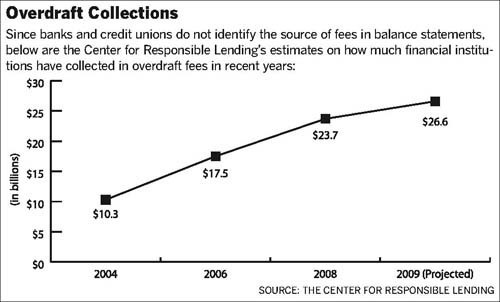
One of those studies, from the Center for Responsible Lending, estimated that banks and credit unions collected $23.7 billion in overdraft fees in 2008, an increase of 35 percent from just two years earlier. “These fees are likely to be even higher in 2009,” the report said, forecasting that they would top $27 billion by year’s end.
In response, U.S. Sen. Jack Reed, D-R.I., was one of a group of senators last week to sponsor legislation that they said would protect consumers from “abusive checking account overdraft fees” by restricting what banks can charge.
At the state level, Sen. Frank A. Ciccone III, D-Providence, introduced a bill last spring that would have limited overdraft fees at $5 for each transaction. The bill died in the Senate Corporations Committee.
A Woonsocket college student has even filed a federal class action lawsuit against Citizens Bank and its parent Citizens Financial Group, claiming that the “astronomically high” overdraft fees from his debit card are a violation of the Truth in Lending Act. The bank has asked that the lawsuit be dismissed.
Consumer advocates argue that some banks enroll checking account holders in overdraft protection programs without their consent, and then institute practices such as approving debit card transactions that overdraw accounts they could have denied for no fee. In some cases, banks reorder transactions from the same accountholder so that the largest are processed first, increasing the number of overdraws.
A Bankrate.com report last month said bank fees such as those for overdrawing checking accounts are at an all-time high.
Greg McBride, a senior financial analyst with industry tracker Bankrate.com, said the fees aren’t exactly making banks wealthy, but in a tough economic environment during which loan portfolios are taking a beating, every bit helps.
“The financial institutions are taking a page from the playbook of the airlines and the government,” McBride said. “They’re looking for ways to fill in the gaps.”
With lawmakers looking to add regulations, some of the nation’s largest banks – including Bank of America Corp., J.P. Morgan Chase & Co. and Wells Fargo & Co. – have eased their stance on overdraft fees.
Beginning last week, Bank of America will allow accountholders to opt out of overdraft protection, will charge fees on a maximum of four items a day, and will waive fees when an account is overdrawn by less than $10. A further rollback by BofA is expected in June 2010.
Bank spokesman T.J. Crawford said he could not say how much revenue is generated from overdraft fees.
“We acknowledge that the changes we make will have an effect on revenue, but we’ll make adjustments,” he said.
Many observers say overdraft fees are on the rise, in part because of consumers’ increasing reliance on debit cards, making it easier to withdraw too much from a checking account without being aware of it.
Accounts vary on the scope of the problem.
The Center for Responsible Lending says it estimates more than 50 million U.S. residents overdrew their checking accounts at least once over a 12-month period, with 27 million accountholders incurring five or more overdraft or insufficient-funds fees.
At the same time, the American Bankers Association said 82 percent of banking customers surveyed in August had not paid an overdraft fee in the previous 12 months.
In a statement on the survey, Nessa Feddis, ABA senior federal counsel, equated the fees to getting a parking ticket. “They’re meant to be a deterrent,” Feddis said.
But Rauh said most customers he’s talked with would rather have overdraft protection, than have bills or other charges go unpaid because of insufficient funds.
“The angriest customers I’ve seen in my 18 years in the business are the ones where we didn’t pay,” Rauh said.
And while much is being made of the overdraft fees, Rauh said they are assessed relatively infrequently at Washington Trust, and depending on the circumstances, the fees are often waived.
Of the 15 million checking account transactions Washington Trust handled last year, 0.05 percent incurred an overdraft charge, Rauh said.
Yet it is a good source of cash. For Washington Trust, about 2 percent of the bank’s total revenue – $43.69 million for the third quarter – is derived from overdraft fees, which are $32.50 per overdrawn transaction.
In an e-mailed response to questions from Providence Business News, Citizens Financial Group spokeswoman Amie Kershaw did not outline overdraft-revenue numbers for the company, but said that fee income has declined since 2008. She did not give a reason.
Citizens Bank, a subsidiary of Providence-based Citizens Financial, automatically provides overdraft protection for its checking accountholders, Kershaw said.
Under the Senate bill, banks would be prohibited from automatically enrolling customers into an overdraft protection program.
Other features of the legislation include: requiring banks to charge fees more in line with the cost of processing overdraft transactions; preventing banks from changing the order in which transactions are processed; limiting the number of times per month and year a customer can be charged an overdraft fee; and requiring a warning if an ATM transaction will overdraw an account.
The legislation doesn’t sit well with bankers such as Rauh.
“Anytime politicians start deciding how much a business can charge for its services, you’re going into dangerous territory,” he said.
McBride, the analyst from Bankrate.com, said taking simple steps such as keeping better track of transactions and monitoring account balances online can go a long way in keeping the overdraft charges down.
“That’s the good news: These fees are completely avoidable,” he said. •