A special tax incentive proposal designed to encourage the rehabilitation of vacant downtown buildings– and increase the number of people living downtown — appears to be moving closer to a Providence City Council vote.
And if city council members have any questions regarding whether the demand for such a measure exists, they need only take a break during their next meeting — and walk around the block.
Beyond Cash Donations: How New Forms of Giving Are Transforming Not-for-Profit Accounting
Evolving Funding Landscape for Not-for-Profits Not-for-profit organizations are being asked to do more with less,…
Learn More
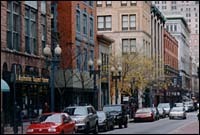
The city’s old core — just a short walk from Providence Place, the Westin Hotel and the hustle and bustle of the financial district — is dominated not by street vendors hawking goods or signs of sales, but by vacant storefronts, broken glass and dingy alleyways.
The wait for an influx of artists, yuppies and businesspeople into what are supposed to be newly renovated lofts continues. The idea – to get people to live downtown — remains a priority among city planners.
But now, officials will consider extending a tastier carrot in an effort to spur development.
The tax abatement proposal would allow for owners of vacant downtown buildings to have property taxes frozen at their current rate and would make them eligible for a tax stabilization plan over a ten-year period.
It targets downtown’s old core — bordered roughly by Dorrance, Pine, Empire and Fountain Streets.
Prospective rehabilitation projects would have to get off the drawing boards and into action quickly to take advantage of the plan. The proposal comes with a three-year window; meaning interested parties would have to apply within three years of its being enacted.
In the first year of the stabilization plan, property owners who have rehabbed their property would get 90 percent of their taxes abated, 80 percent in the second year and so on. After ten years, the buildings would go back on the city’s tax rolls and be fully taxed.
The proposal was made possible after the General Assembly passed enabling legislation for the capital city in 2000.
It currently sits with the city council’s finance committee and may be forwarded to the full city council within weeks.
Patricia McLaughlin is the city’s deputy solicitor and point person on the tax abatement proposal. She sees the proposal as a critical piece of a puzzle that is being completed in the city– albeit slowly.
Never was it expected, she said, that the old core would be developed with the rapidity of Capital Center, where the Rhode Island Convention Center, Westin Hotel, Providence Place and Courtyard Marriott have all risen in recent years.
But McLaughlin quarrels with the suggestion that the old core of the city has been neglected – that little or nothing has changed. That just isn’t so, she said.
“We always knew that this would be a long run,” she said. “It is an area that has been resistant to development. Taking commercial buildings and making them residential is a challenge.”
But it is a challenge that McLaughlin is convinced will be met. She cites ongoing work at several buildings and the fact that a Sundance Film Center is expected to make a home on Union Street replacing the Travelers Aid Society, which will move most of its operations to the Broad Street YMCA on the outskirts of downtown.
It is all part of a big picture, according to McLaughlin, one that includes making sure there are people in the city 24 hours a day, seven days a week.
In fact, there is at least some evidence that — providing apartments and lofts are made available – people will be willing to live in the city.
Downtown’s largest apartment complex, Regency Plaza, for example, has 444 apartments – and 98 percent of them occupied. Those that are not, said Donna Coccia, director of marketing, are being renovated. Coccia has no trouble finding tenants for the apartments, which range from $890 to $2,600 per month. About 1,000 people live and work at Regency Plaza, she said.
“It’s become a community,” said Coccia, referring to downtown residents. “Years ago we were the only show in town.”
But there is an apartment complex overlooking the train station, plans for another nearby and now, she said, there is talk about a new apartment complex across the highway from Providence Place. The number of lofts throughout the city presumably would rise if the tax abatement proposal in question is passed.
State Rep. Paul Moura, a Providence Democrat, who sponsored the enabling legislation
at the General Assembly, called it “one of the most important bills” of the last
few years.
“We need to encourage development– and this is how we do it,” said Moura. “We have a residential neighborhood in the city now– people don’t realize that, but we do. This is how we make it grow.”
City Councilman Terrence Hassett has supported legislation of his own that provides tax credits for property owners who fix up residential properties. It’s an important approach, he said, to improving city neighborhoods.
Drive around Hassett’s Smith Hill district and it is obvious that such an approach works– as several three-tenement properties have undergone significant renovations. He suspects that a similar approach– some kind of tax benefit– will work downtown.
Daniel Baudoin, executive director of the Providence Foundation, sees a tax break approach as a fiscal reality. No one is going to invest in a building unless it makes sound business sense.
“You need programs to help with the equation,” said Baudoin. “You don’t want these buildings to sit empty.”
Baudoin said tax breaks such as the one being proposed are becoming relatively common throughout the country. “Pure market forces,” he said, make it difficult to rehabilitate buildings in such areas.
“The money you have to put in does not necessarily come back in what you can charge for rent,” said Baudoin.
Stanley Weiss agrees.
Weiss is a downtown property owner with several projects in the offing, including one to bring a bed and breakfast into the city’s old core. Weiss has long championed the city’s older core, where he has an office. Old buildings, he said, cost money to renovate. And that money isn’t so readily available. It is a recipe that begs for special circumstances.
“You can finance something across from Providence Place very easily,” said Weiss. “But try getting financing for something across from Mathewson Street. It’s a different story.”