How and when to jump into social media are questions that your business may still be grappling with: How much time to invest, how to go about it, how much of your budget should be set aside for it or even whether the company should get involved at all?
But whether or not you decide to use social media as marketing tools, your business – big or small, in whatever field – should have a social media policy in place for employees, industry experts say.
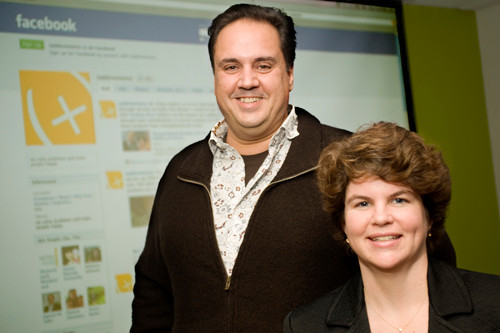
“It’s a fine line of enabling people to be free but appropriate; a lot of it is couching it around common sense,” said Mary Sadlier, executive vice president and chief strategy officer of (add)ventures. The Providence-based, brand-management firm put their social media policy in place about two and half years ago.
“We were at the forefront of helping our clients with their social media initiatives, and we felt it was important to have our own,” Sadlier said. She observed that (add)ventures often shares the policy with clients, not only to help them with their respective policies but also to reassure them that (add)venture employees will not divulge confidential information – even accidentally – through social media.
Sadlier admits that as a brand-management firm, (add)ventures staff may be savvier than the average employee on the use of social media, which are online tools that people use to connect with one another, including social networks.
“Everybody here is quite familiar with the concept of a brand, so we never want to put anything out there that will negatively affect our brand or, more importantly, our partner brand. So we tell them to use common sense: think before you post,” she said. “Once you put it out there on the Web … it can live forever.”
Even (add)ventures, a small company that deals regularly with social media and brand-management issues and thinks of its employees as “family,” felt the need to establish a social media policy because “we didn’t want to leave it to chance,” said Sadlier, noting that the policy becomes particularly crucial when working with interns or freelancers.
“For us the key thing is, don’t do harm to the company, and these guidelines are built around that,” said Jamie J. Pachomski, senior public relations consultant.
FM Global also relies on common sense as the backbone of its social media policy, outlining advice such as “pause twice before posting,” “keep internal discussions internal,” “identify yourself,” and “be mindful of perception.”
Alicia Collins, social media architect for insurance-marketing firm Astonish Results, says the Warwick firm’s social media policy covers not only company-related social media updates but also employees’ personal accounts.
As for whether or not employees can use social media for personal use during company time, opinions vary from complete prohibition to a suggestion from (add)ventures President and CEO Stephen Rosa: “Think of it as a cell phone. If you’re using it for personal reasons, don’t abuse it.”
“If you have a personal profile on Facebook, you do work for a company, so technically you still represent the company,” said Collins. “So even [on a personal page] you shouldn’t be [insulting] your co-workers, saying something bad about your boss … it can get back to them. Make sure everything you’re posting is professional and goes along with what the company’s mission is.”
So, nothing is personal?
“Well … yes,” Collins said, noting that social media may once have been places to post personal pictures [and] keep up with family and friends, but since its popularity with businesses has exploded, it is no longer an exclusively private arena.
“A good, general rule of thumb is if you wouldn’t put a picture in a frame on your desk at work, don’t put it up on a social networking site,” said Michelle Riggen-Ransom and Adam Darowski of Providence-based BatchBlue, in a “blue paper” on social media for small business.
As to how to create your own social media policy, “there is no one size fits all,” but there are a few decisions a company needs to make before establishing one, Astonish Results said.
• First, decide whether the business is going to participate in social media; if so, what are your goals and what tools will you use?
• Second, which employees have an appropriate business use for social media? Can only certain employees use these tools? Can they be used by other employees only after business•hours?
n Third, to what extent will you monitor employee use•and how?
n Fourth, when, where and in what manner will you require, allow or not allow employees to reference the agency and their agency affiliation on their personal sites?
Astonish Results also recommends that companies consult with human resources, legal, security and technology departments.
“Beginning from a position of trust is a key concept in gaining employee acceptance,” Astonish Results said, while noting that once a policy is in place, it should be strictly enforced. “A policy which is not enforced (or worse, inconsistently enforced) in many instances may be worse than no policy at all.”
Some of the resonating themes throughout social media policies include: always have permission from clients before posting about them, write in the first person and identify yourself, avoid topics beyond your area of expertise, and keep messages positive.
“Social media is a nice way of keeping up with employees’ personal lives. You can see photos of their child’s recital on Facebook and say ‘Hey, that picture was cute,’ ” Rosa said.
But unless you are good friends with your boss or other co-workers, it may not be in your best interest to “friend” them.
“Don’t feel obligated to friend your boss,” said Sadlier.
Social media policies also play an important role by warning employees of the consequences of violating the policies, which can range from disciplinary action to termination.
In order to monitor social media use, FM Global relies on automatic feeds for both traditional and social media so its public relations department would be alerted to any company-related posts. Smaller companies may rely on a personal network in order to keep tabs on potential problems.
“My experience is that if things are happening in social media, they’re probably happening elsewhere in the organization, too,” said Sadlier. “If there’s some sort of rift, my guess is that it will not only manifest itself in social media but in other ways as well.”
According to Pachomski, “Social media is like working with a bottomless toolbox and the trick is to find which tool – or which combination of tools – accomplish your business objectives.” •