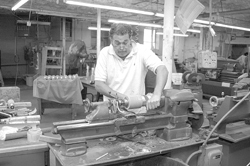
Custom Molded Products, a manufacturer of rubber moldings for copy machines
and truck hitches, wanted to diversify its client base and increase revenue.
For that, the Providence company turned to a local manufacturing partnership
and the Department of Defense.
“There are just so many questions that come up” when getting into the defense industry, said Gus Campopiano, president and CEO of Custom Molded Products.
Seifert Systems Invests in Energy Efficiency to Strengthen Operations
For manufacturers, energy is more than just another operating expense. It plays a critical role…
Learn More
Campopiano is a war veteran, the company’s vice president of sales and marketing was also in the military, and the company has a retired brigadier general on staff, so defense seemed like a good fit, he said.
“Before, we were looking at smaller clients. Now we’re looking at Raytheon, Hamilton Standard. We’re really playing in the big leagues.”
There are 35 to 40 Rhode Island companies that have turned to the R.I. Manufacturers Extension Services for help in obtaining defense contracts since the program, the New England Manufacturers Supply Chain Initiative, launched last November, according to Larry Meadows, defense contract specialist for RIMES.
Twelve Rhode Island manufacturers have submitted and/or received bids, and more than 270 companies have expressed interest in the program, Meadows said. All of the New England states are running similar initiatives.
“Our goal is to get small businesses (manufacturers) into the Department of Defense business,” he said. “RIMES holds the companies’ hands through the entire process. We help them write grants. We take companies with no experience and teach them how to be competitive and to get defense contracts.”
James Commo, president of Commo Sealing Products in Warwick, said he’s working on submitting 14 bids. The company manufactures rubber seals and gaskets for traffic lights and magnets. He hopes once he submits bids and is accustomed to the process, that defense contracts will comprise 10 percent of his business, with the possibility for expansion.
As to why his small company decided to diversify (his company consists of three employees, including himself), Commo said, “It’s probably one of the largest untapped markets out there right now for small guys like me, and I know the military would use a ton of this product.”
According to Meadows, there are 3,500 to 4,000 requests for quotes from the government’s Defense Logistic Agency coming in every week, ranging in size from $2,500 to $100,000. Approximately six requests for proposals, $100,000 and up, come in each week, he said.
Normally, a manufacturer doesn’t get any contracts for the first six months, Meadows said, but Custom Molded Products obtained two contracts within its first two months of submitting bids. As a result, the company, which over the years had downsized to a staff of three, is now growing.
According to Dennis Scavone, Custom Molded’s CIO, the company wants to make defense contracts 10 percent to 20 percent of its business, with hopes to grow that percentage. Both contracts are for producing molded gaskets for military tank or equipment applications, he said.
RIMES offers a course, Making $ense of Defense, on the ins and outs of the defense industry, debunking myths and “calming fears” of manufacturers. It offers a step-by-step how-to on getting into the industry, sifting through procedures and writing bids. RIMES works with the R.I. Procurement Technical Assistance Center on this effort. The center has a bid-searching service that will send bid requests from the government directly by e-mail to suitable companies.
“If you’ve ever had any dealings with the government as a private individual, you’d find it’s very difficult,” said Joseph Cannon, president of CAS America, which has been involved with the initiative since its inception.
“The biggest problem facing these companies is the number of upfront resources needed to get these contracts. Most small manufacturers don’t have the resources. They have all the needs of a big business, but without the funds and resources.”
CAS America has been working with RIMES to expand into defense, and currently manufactures furniture for command and control divisions of the military, Cannon said. CAS is unique from other small companies in that it deals directly with a local prime contractor, which obtains Air Force and Army contracts. In the last two years, Cannon said the company has worked on five or six contracts representing $400,000 to $500,000 in sales.
Pilgrim Screw Corp., based in Providence, has received $860,000 to date for design, development and fabrication of a composite fastener for the military’s Osprey Aircraft through this program. The company is in Phase II of development, Meadows said.
“Without RIMES, we would have been totally lost,” Campopiano said. “They explained what the process is. We’ve never done it before, so they told us the (Internet) sites to go to, the process of placing a bid.”
Commo said the bid process seemed easier with RIMES and the technical assistance center helping with Internet searching; and the course, he said, took away “30 to 40 percent of the confusion.
“Without RIMES, it would have been a bloody nightmare and I wouldn’t be doing it,” he said. “My biggest problem is having the time to do these bids.”
Cannon agreed that for many of these companies, manpower is a problem. Many are so small, company presidents and owners are sending the bids out themselves, instead of hiring someone to do it.
Many of these companies are looking to grow, but do they get contracts first,
or hire people to handle the bids? Cannon said he hopes to work with RIMES to
find a way to provide manufacturers with personnel who would solely handle the
bids.