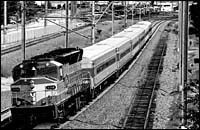
and Boston to Fall River and New
Bedford by 2005.
Recent reports predict the Massachusetts Bay Transportation Authority (MBTA) will not have enough money to both maintain existing services and expand its reach into new communities that have long been candidates for commuter rail service.
But Fall River and New Bedford commuters may rejoice with the news that the agency’s money woes won’t affect commuter rail plans in their cities. MBTA officials say that the New Bedford/Fall River Commuter Rail Extension project is still on schedule — and on budget.
A report released last month by the Massachusetts Taxpayers Foundation said that the MBTA "cannot afford to build proposed expansion projects without sacrificing critical maintenance and modernization of the existing system or incurring an even higher mountain of debt and undermining its still-fragile finances."
Seifert Systems Invests in Energy Efficiency to Strengthen Operations
For manufacturers, energy is more than just another operating expense. It plays a critical role…
Learn More
Jon Carlisle, spokesman for the State Transportation Department, which oversees the MBTA, said the organization has simply balanced its priorities, and that approximately 70 percent of its capital budget goes into maintenance of the existing system and 30 percent into expansion.
"We think the 70/30 breakup is a balanced one and equitable toward new construction," he said. "We’ve got a number of expansion priorities under the fixed budget we now find ourselves under." He said Fall River and New Bedford are priorities.
Carlisle anticipates working with state legislators to obtain more funding.
The New Bedford/Fall River Commuter Rail Extension, which is also called the Stoughton Alternative, will extend existing Stoughton Line service from South Station and Back Bay Station to New Bedford and Fall River. The project will include new construction of track, bridges, grade crossings, intersection improvements, eight new commuter rail stations and two train layover facilities.
The extended line, which the MBTA plans to have in service by February of 2005, is projected to cost in excess of $600 million. Carlisle said about $11 million has been spent so far, and includes the cost of elevating bridges in Fall River and New Bedford.
"I think that shows that the project is continuing to move along," said Carlisle.
Massachusetts Senator Mark C. Montigny (D-New Bedford) has been involved with the project since the beginning, putting in language that allowed the first phase of design and construction to begin in 1994. He said the commuter rail traditionally serves middle and upper class communities, and that bringing it to New Bedford would greatly improve the area’s infrastructure.
"(Southeastern Massachusetts) is a historically underserved region of the Commonwealth," he said. "The commuter rail will provide an essential economic lifeline to the people of New Bedford."
Senator Montigny is not daunted by the Massachusetts Taxpayers Foundation report. He said keeping on track with each deadline, the commuter rail extension is moving a few stops closer to reality.
"I am fully committed to seeing this project through to completion," said Montigny. "The final environmental certification will be submitted at the end of this month, three New Bedford bridges will be demolished and rebuilt this spring and the MBTA is continuing the design and engineering process. This project is moving forward."