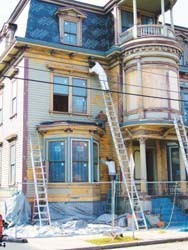
NONPROFIT DEVELOPERS are increasingly trying to use workers and contractors from the neighborhoods they serve. Above, workers at a Greater Elmwood Neighborhood Services project on Parkis Avenue in Providence.
When a blighted spot is redeveloped into affordable housing, the neighborhood looks nicer and the people have better places to live. But increasingly, nonprofit developers are looking to bring one more benefit to the community: good jobs.
In Providence, a “first source” ordinance promotes the use of local workers by requiring that for any contract in the city that is paid for with city or federal money, Providence residents must be considered first for the jobs.
Beyond Cash Donations: How New Forms of Giving Are Transforming Not-for-Profit Accounting
Evolving Funding Landscape for Not-for-Profits Not-for-profit organizations are being asked to do more with less,…
Learn More
“It’s been on the books for a number of years, but implementation started fairly recently,” said Brenda J. Clement, executive director of the Rhode Island Housing Network.
“We know that providing housing and good-paying jobs are integral,” she said, “so we want to keep the wealth in the community.”
But for the community development corporations working in Rhode Island’s poorest neighborhoods, the effort to hire local workers isn’t just a rule, it’s a part of their mission.
“They’re not just trying to build housing – they’re responding to community needs,” said Barbara Fields, director of the Rhode Island office of Local Initiatives Support Corporation (LISC), which provides loans to many of these developers.
“When you’re mission-driven,” she added, “you take a holistic approach, and you have other things that factor into what makes the project a success. It’s about people and places as well as profit.”
Greater Elmwood Neighborhood Services is taking that approach with a $4.5 million project on Parkis Avenue that will convert three Victorian houses into 16 condos, of which 12 will be affordable and aimed at first-time homebuyers, and four will be sold at market rates.
“With this project, we made a specific effort to hire people from Providence and the immediate neighborhoods, because economic development is one of the core missions of the organization,” said Michael Lozano, the group’s director of real estate development.
“We have a general contractor, and they are mandated by our contract with them to do outreach to local minority- and women-owned subcontractors,” he said. “And any of the workers who work for them, we also encourage to use minorities as much as possible.”
As a result, many people from the neighborhood have been hired for the project.
“Several of the subcontractors are from Elmwood,” Lozano said. “One of the painting subcontractors, Rafael Perdermo Painting, is actually based on Parkis Avenue, and we made a specific effort to get him involved.”
In addition to hiring people from the area, Clement said, many of the organizations are taking things a step further, by actually teaching people in the neighborhood how to run a construction business.
“One of the challenges to hire those from the community is that they may not have the skill sets needed,” she said. “Because of that, many of our members have felt that mentoring and training programs are critical and have been in the forefront of that, with lead-abatement training and programs about how to run a business.”
Stop Wasting Abandoned Properties, for example, has a contractor mentoring program that grooms people from the community to become contractors. “It’s for the father-son or father-daughter kind of business that is just starting out and needs some help,” Clement said.
Rose Kolawola, senior development associate of SWAP, said the group always tries to use neighborhood contractors, “but sometimes they don’t know how to do some things. So we did a focus group and asked them what they really needed, and most of them said that they could build, but didn’t know how to grow their business and how to make a profit.”
“That’s something that is lacking with some of the small contractors,” she added, “and it’s very important, so they can be out there and compete with other contractors.”
Through the SWAP program, they learn those other skills and have someone to ask questions.
“We help them improve their business with skills like bookkeeping, how to read a blueprint, how to maintain their schedule so they can do two jobs at the same time, how to bid, marketing and cost control,” Kolawola said. “We also invite speakers from the building department to talk to them about building permits, and we have a lawyer talk to them about how to protect themselves.”
Since 1991, the SWAP program has trained more than 42 contractors.
Joseph Garlick Jr., executive director of the Woonsocket Neighborhood Development Corporation, said it all goes back to the goal of improving neighborhoods, not just buildings.
“Job training and skills development is clearly something we need to work on,” he said. “It’s an important connection to keeping wealth in the communities.
“To have jobs and resources hits a lot of bells and whistles, for all the right reasons.”