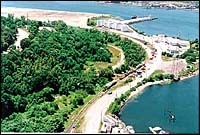
East Providence waterfront
that city hopes
to revive.
Valued at more than $1 billion, the 150-acres along East Providence’s waterfront is the focus of a development plan that could literally “change the face” of the city.
East Providence City Manager Paul Lemont said appraisals show development of the total property, formerly the home to a variety of large industries, could mean more than $1 million in annual tax revenues for the city, produce more than 600,000 square feet of office space, and bring an additional 3,000 jobs.
Rhode Island's Market Has Changed. Developers, Builders, Investors and Sellers Must Change With It.
By Emilio DiSpirito IV License Partner | Engel & Völkers Oceanside Leader | The DiSpirito…
Learn More
“Years ago we were a city with large manufacturing plants and oil storage facilities in that area,” he said. “Those days are long gone. The character of this city has been changing for the last 30 or 40 years and we can’t become complacent. We have got to look to the future to what kind of economy this city is going to have, to the type of people we will be serving and what kinds of jobs they will want. Then we must try and find the best ways to meet those needs.”
The property is split into several parcels including the Chevron site, adjacent to the winding Veteran’s Memorial Parkway and the Metacomet Country Club, Kettle Point and Bold Point.
According to Jeanne Boyle, the city’s director of planning, the proposed plan calls for a “mixed use” that would include both residential and commercial. According to city officials, development potential includes hotels, large-scale office space, research space, assisted living facilities, and multi and single family residential development.
“We are getting away from the heavy industrial uses,” she said. “We do have some specific types of uses in mind – there will be a retail component, an office component and residential development but just what the mixture will be remains to be seen.”
At the heart of the proposed plan, is the development of a campus-like headquarters for a large corporation, similar to the Connecticut-based based Pfizer, officials said. And while the city has yet to secure a company to occupy the space, both Lemont and Boyle are confident it will.
“It’s definitely going to take a large player,” Lemont said. “We say Pfizer because we are looking for these kind of high-paying technical jobs. We are in the process of dealing with professionals, meeting with developers that are connected to the larger companies and advertising in the trade journals.”
The recruitment process is complicated by the fact that many large companies want parcels that are ready for construction, and much of the East Providence waterfront is considered a brownfield — or an area with real or perceived contamination.
“Some of the parcels have already been cleaned,” Boyle said. “And the others are going through the process right now. What’s important is that we have the end use in mind when we go through this process so we can know what we are preparing for.”
What’s also complicating the process, said Brian Clark of MG Commercial Real Estate Service Inc., is that total property is owned by a number of different companies. For example, Chevron, one of Clark’s clients, owns one 30-acre parcel, while other companies like Arco, Amoco, Unocal and Getty own the other parcels.
“Somehow you have to gain control of the entire parcel,” he said. “And right now no one group has a handle on it.”
Lemont doesn’t see the lack of unison in ownership as a problem
“The land is owned by various companies, but we plan to bring those owners on board and make sure their interests are best served in the process of getting from where we were to where we want to end up,” he said. “If the city owned the property it would be more convenient for the developer. We just need to keep in mind that when you have numerous people with different backgrounds and interests that it’s important to get them to recognize the overall plan the city is adopting and understand that the plan is in their best interest.”
Already the city has begun to prepare for the transformation of its waterfront by changing some of the zoning laws that apply to the parcels from industrial to commercial. In addition, the city plans to create a Redevelopment Authority.
“This board will contain people from the community with a background in business and development,” Boyle said. “They will be in charge of marketing the development, handling proposal for condemnation and other activities like that.”
Other changes include a plan for a roadway along the southerly border of the property. Boyle said the city is currently working with the Rhode Island Department of Transportation on the plan.
And while the plans all look good on paper, both Lemont and Boyle agree one of the city’s greatest challenges is going to be keeping residents interested and patient. It’s expected the entire transformation of the waterfront could take as long as a decade.
“I think that people are excited about this project,” Boyle said. “At the same time, they understand that it will take a while.”
Clark said for the property owners, time isn’t a concern as the property’s potential makes it worth the wait.