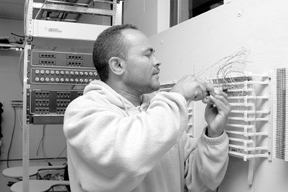
the R.I. chapeter of IBEW.
With the world becoming increasingly wired, the Rhode Island chapter of the
International Brotherhood of Electrical Workers, Local 99, has seen its three-year
teledata apprenticeship program solidify its roots as demand for high-tech services
rises.
George Ouellette, a member of Local 99 has been teaching the class since the local union started offering the program seven years ago. As time has gone by, he’s seen the demand for workers trained in teledata installation increase as more and more businesses, schools and banks look to network their workstations and create easier ways to share information.
Ouellette said work also picked up as the phone companies deregulated the installation of cablings and certified workers were allowed to do line installations.
Seifert Systems Invests in Energy Efficiency to Strengthen Operations
For manufacturers, energy is more than just another operating expense. It plays a critical role…
Learn More
“Over the years, there’s certainly been a lot more work,” Ouellette said. “When people first left the program a few years back, they’d be able to find work, but not enough for a full-time, year-round job. That’s changed. The work is a lot more constant now.”
Ouellette always teaches the final year of the apprenticeship program and attends annual training sessions at the University of Tennessee to keep him up-to-date on any changes or additions to the national curriculum in place for teledata certification. When Ouellette first began teaching, there were no national standards in place. He said the standardization hasn’t so much changed what he’s been teaching all these years, so much as it allows graduates and students to move easily between states without worrying about losing their certification or the training they’ve already completed. While electricians can do teledata work, teledata workers cannot necessarily automatically do electrician work – completing the national curriculum results in a limited license.
This year, there are a half dozen students in Local 99’s graduating class, though Ouellette said the number is usually double that, accounting for some attrition in typical first-year numbers between 15 and 18 students.
Between September and May, enrollees in the program spend about five hours a week in the classroom, which counts as part of the 2,000 training hours they’re required to complete each year. Ouellette said the hardest part of getting the local program off the ground was finding the journeymen for the apprentices to work with.
“The toughest part those early years was finding people who were qualified to do the work,” he said. “The students are only as good as the people they’re learning from.”
Several of Ouellette’s students over the years have stayed on to work with him on all sizes of operations from 10 workstations to buildings housing 1,000 workers. And he’s seen more than a half dozen women graduate from the program over the years and has another two women in his current class of six.
He said the teledata field – which is without heavy construction-type work that involves lugging around pipes or heavy conduits – is highly skilled work and offers pay to go along with the intensive training.
Ouellette expects teledata to be a viable field for some time, especially as management in the public and private sectors starts spending a little more in anticipation of whatever technology is next. Traditional copper phone lines are not going to be able to handle the bandwidth available through fiber optic cable, which Ouellette reasoned is necessary for voice-over IP or the integration of systems necessary for specialized building security or the automated “SMART House.”
“It’s all about integration,” Ouellette said. “The days of analog equipment are gone. Everything is becoming more and more specialized and the way I see it, as time goes on, the electrical industry is going to reflect that as time goes on. … It’s a self-perpetuating thing.”