In looking to the past and the preservation of the first water-powered snuff
mill in the American colonies, two local nonprofit groups hope to find the spirit
and the funds needed to fuel the state’s economic future.
On Dec. 3, the Gilbert Stuart Museum and the Rhode Island Youth Entrepreneurship Program launched a campaign with the goal of raising $1 million to benefit the groups.
An announcement at the State House coincided with the 248th anniversary of Stuart’s birth. By the time the 250th anniversary rolls around, the youth program hopes to be a fixture in all of the state’s high schools and the museum hopes to have completed its restoration of the portrait painter’s birthplace along with establishing a permanent endowment.
Seifert Systems Invests in Energy Efficiency to Strengthen Operations
For manufacturers, energy is more than just another operating expense. It plays a critical role…
Learn More
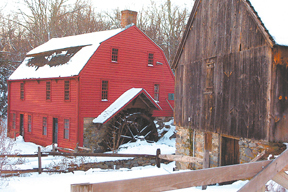
Stuart, who painted more than 1,000 portraits throughout his lifetime, including those of six U.S. presidents and the familiar likeness of George Washington that appears on the one-dollar bill, was born in South County in 1755. His birthplace has been preserved alongside the remnants of his father’s mill, where the Scottish immigrant built a business using 18th-century technology to efficiently pulverize tobacco leaves into the snuff that was commonly inhaled by the masses at the time.
Gov. Don Carcieri, standing in front of Stuart’s full-length portrait of George Washington in the State Room, said the day was a synthesis of two things that define Rhode Island – history and entrepreneurship.
From the state’s pre-Revolutionary past, through the Industrial Revolution and its corresponding wealth displayed in Newport’s mansions, Carcieri also touched on the state’s more recent entrepreneurial legacy, including CVS/pharmacy’s national growth out of its neighborhood Woonsocket storefront and Textron’s early concepts of a conglomerate.
“As a lifelong resident, it’s sometimes easy to take for granted,” the governor said. “But there’s an incredible depth and breadth and length of history here that’s pretty well-concentrated. … Entrepreneurship is our past and I also happen to think it’s our future. What we have to do is gear ourselves and our education to find the next thing.”
Kenneth Proudfoot, development director for the Rhode Island MicroEnterprise Association Inc. which runs the youth program, said his goal has long been to equip every Rhode Islander with a “portable set of entrepreneurial skills,” chief among them the ability to think, observe, write, plan, market and be financially literate. He says those are all skills people need to run their lives and their households while finding a way to “thrive and survive” in any situation.
For now, Proudfoot is juggling the teaching duties for the program, which is embedded as a component of business courses ranging from cost accounting to college-prep business at eight schools, including Warwick Area Career and Technical Center, Riverview Center in North Kingstown and the West Warwick, Feinstein, Warwick Veteran’s Memorial, Toll Gate, Central Falls and Cumberland high schools. A pilot version of the program was installed at several schools last year, but Proudfoot wasn’t happy with the results and completely overhauled the curriculum over the summer in order to get kids to “think like an entrepreneur.”
Along with standards such as class presentations, business case studies and project planning, the early stages of the program consists of thinking exercises – such as one where students are asked to consider what word in the English language is the most powerful (loyalty, freedom, hate, faith and life all kicked off discussions around the state). Another exercise asks students to sit down and write a list of 50 problems that need solving.
“Their lists start with these problems in a student’s own little world,” Proudfoot said. “From the first dozen or so, you see the problems naturally grow beyond themselves and their comfort zone and start looking at the larger world. The kids say they’ve never heard or thought about anything like this before.”
Proudfoot said plans call for the program’s availability to be increased to 30 or 40 high schools next year and reach 60 to 70 schools for the 2005-06 academic year. And at some point, he wants to take the program to the middle school level, but that requires more teachers and the creation of materials to accompany lessons.
“People in this state can’t wait for a better future to come along,” Proudfoot said. “They have to develop it for themselves. I don’t think the Independent Man should be a dependent man. Rhode Island’s history and heritage is better than that.”
Part of raising future entrepreneurs is fostering the need to dream of young people, said Proudfoot, who said people encounter too many negatives from rules and regulations in modern life. He added that he was surprised at how small student dreams in high school are, summing up the replies of teenagers as a three-step recitation of graduates, go to college and get a good-paying job.
“That’s not a dream,” he said. “It’s a list. When Roger Williams stepped into Rhode Island, he was a traitor and a radical and a religious leader. That mindset, that way of thinking should never have ended, been watered down, or been forgotten.”
The ceremony closed with the governor presenting the first dollar bill to the museum, which is advertising the fund-raising effort under the tag line, “Send George Washington home to Rhode Island.” The dollar bill, of course, features an engraving of Washington that is derived from an original portrait painted by Stuart.
In 2005, at the close of what the groups hope will have been a successful
national campaign, a complete list of contributors along with Rhode Island products
and artifacts will be buried in a time capsule to be opened in 2105. Donations
can be mailed to: Gilbert Stuart 2005, P.O. Box 625, Saunderstown, R.I. 02874.