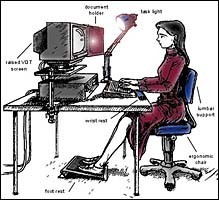
Businesses across the country may be breathing a sigh of relief after the repeal of a federal ergonomics regulation, but that doesn’t mean they can abandon the principles of ergonomics.
The federal Bureau of Labor and Statistics estimates that more than 300,000 workers nationwide suffer from work-related repetitive strain injuries such as carpal tunnel, and musculoskeletal disorders including back problems as a direct result of overuse and poor workplace design.
Seifert Systems Invests in Energy Efficiency to Strengthen Operations
For manufacturers, energy is more than just another operating expense. It plays a critical role…
Learn More
A survey conducted by the Bureau of Labor and Statistics found the reported incidence of repetitive strain injuries has skyrocketed from only 18 percent of occupational illnesses reported in 1981 to almost 70 percent today — costing more than $100 billion a year in workers’ compensation claims and lost wages. These injuries fall under the study of ergonomics — or the science of designing equipment to reduce fatigue and discomfort.
And while the federal Occupational Safety and Health Administration (OSHA) proposed regulations to reduce these injuries last year, the plan was adamantly opposed by business and trade organizations who called it “too costly, rushed and extremely vague.” Both the U.S. House of Representatives and the U.S. Senate repealed the standard, adopted in November, last week.
“There was no question that this got rushed through and that was of great concern to a large majority of businesses,” said Terrence Martiesian, state director of the National Federation of Independent Business Owners. “There was a large dispute about the cost — OSHA estimated it at about $4.2 million, which is a big number for small business, while the Federal Small Business Administration estimated it could cost as much as 15 times that, an even bigger burden for small businesses.”
The regulations, set to take effect this fall, would have covered disorders in the following areas of the body: neck, shoulder, elbow, forearm, wrist, hand, abdomen, back, neck, knee, ankle and foot. The standard also included a “Basic Screening tool” — a two- page checklist that identified the five risk patterns, repetition, force, awkward posture, contact stress, and vibration.
“Basically any kind of injury would have come back to the business owner,” Martiesian said. “And many of these companies don’t have the human resources staff to handle the paperwork.”
But many agree that the passage and then repeal of these regulations has done one thing – raised awareness among business owners both small and large.
“I think that everyone is on the same page when it comes to this,” Martiesian said. “A lot of people have already done things like selecting appropriate chairs. They don’t need anyone to tell them. I don’t know too many businesses that don’t want to have a safe workplace.”
According to Frances Pisano, owner of Pisano & Associates, a consulting firm that works with companies to achieve safety in the workplace, many businesses are starting to realize that “ergonomics equals good economics.”
Chris Daft, ergonomic team unit leader for The Beacon Mutual Insurance Company, agreed.
“What we have observed is that for businesses large and small, this is becoming part of a business strategy,” he said. “They see good ergonomics as a source of cost containment. By preventing injuries, they keep people at work, increase productivity and avoid having to lose money over time, training new employees.”
Daft said while many large companies are creating new positions for “safety manager” in charge of developing measures to prevent workplace injuries and monitor the implementation of those measures, he notes that smaller business are often limited by their resources.
“Not all businesses can handle this in-house, but that doesn’t mean something can’t be done,” he said. “It’s really about employee empowerment. Unlike traditional safety, ergonomics requires the involvement of all employees. They need to have protective information that allows them to identify hazards.”
Daft said Beacon provides smaller companies with the knowledge needed to establish ergonomic policies, and at a lower cost.
“We assist in implementing control measures, and train the employees,” he said. “It’s a combination of making people aware of the proper work style and giving them the proper tools to implement that style. We can’t eliminate physical stress, but what we want to do is minimize because minimization can be enough to prevent injury.”