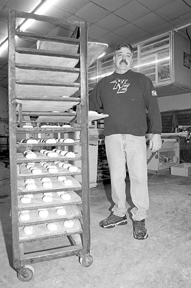
Sons Bakery in Fall River.
Jose Vasquez has seen the aisles at Stop & Shop change.
He bought a house next to the chain’s Branch Avenue supermarket five years ago and at that time couldn’t find Hispanic produce or products.
“But now, the store has adapted to a growing (Hispanic) population,” he said. “There’s a whole aisle of Goya products. And they carry a lot of (Hispanic) produce.”
Beyond Cash Donations: How New Forms of Giving Are Transforming Not-for-Profit Accounting
Evolving Funding Landscape for Not-for-Profits Not-for-profit organizations are being asked to do more with less,…
Learn More
Chain supermarkets like Stop & Shop and Shaw’s are keeping pace with demographics as they are finding profits fueled by populations that increasingly spend more and eat at home.
It’s a move that has led to the creation of whole departments that target communities of ethnic minorities. For instance, Stop & Shop has come out with its private label Mi Casa line to compete with Goya.
According to Providence-based MultiCultural Foodservice & Hospitality Alliance, in 2001 the Hispanic population in the United States spent 15 percent more on food consumed inside the house than the overall population.
And, the group found that Hispanic populations are the most brand-loyal in the United States.
Bertha Medeiros, owner of Medeiros & Sons Bakery in Fall River, has been riding a similar trend since the mid-1970s. She has been catering to the Portuguese population in southeastern Massachusetts with sweet breads, buns and muffins for years.
She has seen how population shifts have created a greater demand for goods as Brazilians and people from other backgrounds with a proclivity for sweet breads have populated the state.
“We get calls all the time to deliver our goods out of this region. At one point we had vans going beyond Boston,” she said. “But now, we are trying to keep the business small. We don’t need the headache.”
Although the Portuguese have been and are still a target for supermarket chains locally, the growing emphasis has been on the Hispanic markets.
According to the U.S. Census, the number of Hispanics grew from about 9 percent in 1990 to 12.5 percent in 2000. In Providence, Hispanics are the fastest-growing sector of the city.
The Food Marketing Institute adds that the purchasing power of the Hispanic population nationally has increased by 160 percent over the past decade to $542 billion in 2001.
“It’s not rocket science,” said Kenneth C. Herbst, a professor of food marketing at St. Joseph’s University in Philadelphia. “If you can begin a positive relationship between your store and the Hispanic population, you are apt to have a loyal customer base.”
Rick Stockwood, spokesman at Stop & Shop, said his company has been expanding its offering of ethnic foods exponentially over the years as such statistics have become more commonplace.
“The (demographics) are changing so rapidly,” he said. “We always look to a community to make sure our stores meet the needs of the customers there. The company has been doing this for a while.”
Stockwood adds that about 50 of the 342 Stop & Shop stores have aisles devoted to Hispanic products.
At Shaw’s, spokesman Terry Donilon said the chain is opening what they call Neighborhood Format Stores in ethnic communities. He points to a store in Providence on Atwells Avenue where Federal Hill, Mount Pleasant and Olneyville converge.
There, the store has devoted an entire aisle to imported sauces, salsas, pastas and other goods common to the two cultures.
“The shopping needs of these two populations are vastly different,” he said. “We’ve recognized this at the Atwells location and are refining it even further.”
Michael Levy, a professor of marketing at Babson College in Wellesley, Mass., said attempting to cater to minority markets has been expanding for the past 20 years.
“The secret of success for supermarket chains has been to do everything for the front end of business locally and the back end globally. That’s the opposite of how other businesses have viewed this,” he said.
He says there have been two intertwining forces at play that have led to more ethnic choices at supermarkets – a less homogeneous society and better technology to track buying habits and demographic trends.
“Marketers have become more sophisticated in that they realize the ethnic community can be very profitable,” Levy said.
Medeiros said the increasing number of ethnic foods on the market has played a part in decreasing the space available in stores for her products.
“They have brought in far more vendors,” she said. “Stores have changed their setups and our products are now at knee level near the meat section. We used to have racks on the floor and we did very well with that.”
Vasquez has seen changes at his local supermarket a little different than other Hispanic customers. He owns Providence Wholesale Produce, which specializes in tropical Hispanic vegetables and fruits like casabas, batatas and okra.
His clientele is mom-and-pop grocers who target the Hispanic population in Providence, particularly the Dominican population. He doesn’t supply the larger supermarkets, mostly because they buy produce from the same place he does at cheaper rates.
Vasquez says his business has been hurt by supermarkets selling more Hispanic foods, but not enough so that he must shut the doors of his business.
“The Spanish population is growing and as more people come in, there is more business for everyone, including the smaller (grocers),” he said. “There are still people who don’t want to go to the big stores.”
Brian Chicoine, owner of International Importing located next to Providence Wholesale Produce, doesn’t feel the same way. His company stopped carrying ethnic foods for his mom-and-pop clientele since the supermarkets started branching out.
“People used to go to the small stores to get the goods we provided, but they no longer have to,” he said. “Now, we specialize in mostly American items like canned Del Monte, paper goods and other non-perishables.”