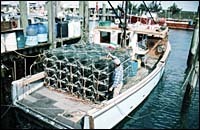
pots in Galilee.
Michael Marchetti says he’s a good example of how many commercial fishermen make their living by being flexible enough to go where the fish go.
In the spring, he fishes for squid, striped bass, mackerel, blue fish and other fin fish off the Newport coast. During summer months, Marchetti – president of the Rhode Island Lobstermen’s Association – spends his time a few dozen miles southeast of Point Judith, trapping lobsters and harvesting some scallops. And then, if it’s a tough winter, he might go dig quahogs.
But commercial fishermen in Rhode Island are concerned that a bill in the state legislature would force fishermen to declare a primary fishery at the beginning of the season, – such as lobster, shellfish or fin fish – leaving them to face potentially strict catch limits on the other species.
Beyond Cash Donations: How New Forms of Giving Are Transforming Not-for-Profit Accounting
Evolving Funding Landscape for Not-for-Profits Not-for-profit organizations are being asked to do more with less,…
Learn More
"You just can’t tell a guy ‘You’re a lobsterman, so now you can’t go scalloping or quahoging,’" Marchetti said. "The small-boat fisherman has the ability to be diverse. That’s how those of us with multi-purpose licenses survive."
For nearly two months, various Rhode Island commercial-fishing groups have been crafting their own version of the legislation, which is a monumental effort to change the way Rhode Island issues commercial fishing licenses. The state has had a moratorium on new commercial licenses in place for the last two years to allow policy makers to devise a better licensing system that would protect fishermen and fish populations alike.
The bill was drafted by the Senate policy office, with the input of the Department of Environmental Management, and has been praised by fishing groups as a comprehensive effort to introduce a new license system. But most fishermen say there are a few glaring problems – chief among them the issue of open access to all fisheries for those fishermen who already have multi-purpose licenses.
"You’d have to use a crystal ball in order to declare a fishery at the beginning of the year," said Ralph Boragine, president of the Rhode Island Seafood Council. "What if a guy declares fin fish, and we have really weird weather, and 90 percent of what that person would have caught doesn’t show up?"
Kenneth Payne, the state Senate policy adviser, who has drafted the bill, said the legislation is the result of several meetings of fishermen, regulators and biologists last year at the University of Rhode Island Coastal Institute.
Payne said a major issue during the meetings seemed to be reciprocity – concerns among some fishermen that it’s easier for others to shift into their area of expertise than vice versa. He said the part of the bill that would require fishermen to choose a primary fishery was meant to quell those concerns.
"If they say ‘flexibility is our highest value, not reciprocity,’ then I can draft legislation around that," Payne said. "It’s not for me to choose their balance point. (The commercial fishermen) have had to decide that for themselves, and I think that’s what they’ve been doing in a constructive fashion."
Another problem cited by fishermen: Licenses for newcomers would be available only for species that aren’t under some form of quota system or other regulatory restriction. Only a few species – such as eel, crabs and conchs – fall into that category, and commercial fishermen say it wouldn’t be fair to cut off access to most other species entirely.
"We believe there has to be access to all fisheries, even if it’s on a limited basis," said Russell Wallis, president of the Ocean State Fishermen’s Association. "I don’t think the state wants to tell people ‘You can have an open-access license, but you can’t catch anything.’
"We’re hoping we come up with something between wide-open access and slammed shut," Wallis said.
To remedy the bill’s perceived shortcomings, commercial fishermen are polishing details for a three-tiered licensing system, which they hope will be included in a substitute bill.
One tier would allow newcomers to get a license for any fishery as long as they adhere to whatever system of regulations is in place at the time. For example, someone with a new shellfish license might be allowed to harvest only two bushels of oysters, instead of the 12-bushel daily limit.
Fishing groups say they hope the legislation will serve as a framework for granting fishing licenses, while the state later issues quotas for fishermen with only partial access to certain fisheries.
"We want newcomers to come in because it’s vital to our industry," Marchetti said. "But it’s got to be at a reduced level for a time, and we want the Marine Fisheries Council and DEM to manage those nit-picky details."
A second class of license would allow commercial fishermen who already have a license for one fishery – lobster, shellfish or fin fish – to remain "whole" in that species, meaning they could catch 100 percent of the daily limit. But if they wanted to obtain a license for a second fishery, it would be subject to restrictions.
The third class of license would maintain the status quo for fishers who already have a multi-purpose license, allowing them to maintain full access to all fisheries.
There is, however, a group of commercial fishermen who say that all Rhode Islanders – newcomers and veterans alike – should have open access to all fisheries, and if quotas are needed, everyone should be subject to those.
"I think that’s a legitimately valid perspective," Payne said. "The difficulty with that is you might have an allocation that causes a lot of people to go broke."
Drafting the legislation has resulted in what commercial fishermen agree is a rarity in the industry: cooperation among their various groups and praise for regulators.
"I’m really impressed, because we’re doing this as an industry, instead of the lobster guys fighting with the shellfish guys, or the shellfish guys fighting with the fin fishermen," Wallis said.
And fishing groups say Payne and DEM Director Jan Reitsma have been diligent in hearing fishermen’s concerns and suggestions. They say they’re hopeful that much of their input will be worked into the bill’s final version.
Related Story: Industry anxiously awaits court ruling