Place contributed to RI's
growth in 2000.
Rhode Island has long been derided for its lackluster economic development. But detractors take note: For at least one year, the Ocean State’s economy far outpaced all others.
In 2000, Rhode Island’s economy, anchored by strong growth in financial services and real estate, grew faster than any other state economy, according to a federal report released last week.
Its gross state product – the total value of all goods and services produced within the state – grew 10.7 percent between 1999 and 2000, to $36.4 billion (in 1996 dollars), according to the study from the U.S. Department of Commerce’s Bureau of Economic Analysis. Rhode Island significantly outpaced the state with the second-largest gain, Idaho, which had 8.3 percent growth.
Beyond Cash Donations: How New Forms of Giving Are Transforming Not-for-Profit Accounting
Evolving Funding Landscape for Not-for-Profits Not-for-profit organizations are being asked to do more with less,…
Learn More
The federal analysis shows that a 29 percent surge in financial-services (including insurance) and real-estate activity – the largest increase of any state in the nation – accounted for more than two-thirds of Rhode Island’s growth during 2000. The jump likely reflects the state’s hot housing market that year and an influx of jobs and capital investment by companies such as Fidelity Investments, FleetBoston Financial Corp. and Citizens Bank.
By the end of 2000, mutual fund giant Fidelity had brought the number of employees at its Smithfield campus to about 1,500. Fleet also added hundreds of jobs in the late 1990s, pushing its Rhode Island employment above 4,000 workers by mid-2000, and Citizens added hundreds of jobs in Cranston that year.
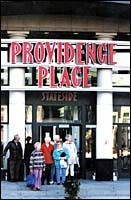
Other sectors underpinning the economic growth in 2000 were retail trade (13.1 percent growth) and wholesale trade (up 6.1 percent). Retail activity likely gained momentum from the Providence Place mall, which opened in August 1999.
Also, Rhode Island’s government sector grew by 4.3 percent in 2000, which was among the top-five growth rates in the country, and accounted for about 5 percent of economic growth that year.
Tom Schumpert, executive director of the Rhode Island Economic Development Corp., said the recent federal statistics reflect the success of the diversification strategy the state embarked on during the early 1990s. For instance, a package of financial and tax incentives led to Fidelity’s investment in Rhode Island.
“We will continue to work with our business community to grow our diversified economy for job creation and to generate new revenue,” Schumpert said in a written statement.
A close look at the Commerce Department figures through most of the 1990s shows that 2000 was an exceptionally solid year for economic activity in the Ocean State. The year before, the state’s economy grew just 2.4 percent.
In fact, the report, which includes data going back to 1993, shows that Rhode Island’s economy during those years never approached the 10.7 percent spurt it experienced between 1999 and 2000. The next-biggest gain was 7.9 percent growth in 1997, but the state was unable to muster better than 3 percent growth in any other year.
Because Rhode Island had been coming off two weak years of economic growth, the 10.7 percent spike in 2000 was “nothing necessarily to write home about,” said University of Rhode Island economics professor Leonard Lardaro.
“But I think the message to be gotten from (the report) is that it shows how receptive Rhode Island’s economy is to meaningful fiscal and economic policy,” Lardaro said. “The one economic-development policy we’ve done right in the last 10 years is with financial services, and it shows.”
After Idaho, the other fastest-growing state economies in 2000 were Oregon (8.1 percent growth), New Hampshire (7.8 percent) and California (7.3 percent). Massachusetts ranked 7th, with a 7.1 percent gain in gross state product. The bottom states in terms of economic activity were Alaska and Louisiana, both of whose economies shrank in 2000.