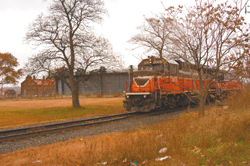
Providence Worcester Railroad: significant container volume growth
International trade, rising fuel costs main reasons for acceleration
Rail freight delivery is picking up steam as international trade increases demand to move product and the trucking industry struggles with fuel costs and new regulations.
In October, U.S. railroads reported the top three highest-volume intermodal weeks in history. Intermodal shipments increased 10 percent over last year, and the 20 busiest weeks over the last two years occurred this year, with 9,074,137 trailers and containers being moved, up 798,218 units over 2003, the Association of American Railroads reported.
Providence Worcester Railroad, a regional freight railroad operation serving Southern New England, reports a 2004 volume at approximately 70,000 containers, more than double that of a decade earlier. The publicly traded company also expects to handle about 35,000 carloads, compared to 28,000 a decade ago.
“The growth in international trade has had a profound impact on our container business,” said Providence Worcester Railroad Company spokesman Frank Rogers, reporting a 2004 volume close to 70,000 containers. “This (growth) involves steamship containers, primarily from the Far East, Asia and Europe which enter the United States through West Coast ports and the Port of New York/New Jersey with a subsequent move by rail to the Providence Worcester Intermodal facility in Worcester.”
Seifert Systems Invests in Energy Efficiency to Strengthen Operations
For manufacturers, energy is more than just another operating expense. It plays a critical role…
Learn More
Tonnage and carloads are up about 6 percent in Rhode Island with a projected tonnage of 1.1 million tons for the year – approximately 12,000 railcar loads. The 12,000 carloads translate into a 4-to-1 truck-to-rail ratio; 48,000 truckloads, or 96,000 truck trips as each loaded move results in an empty move as well, said Rogers.
Volume at Providence Worcester Railroad has been up across the system and commodity lines in traditionally shorter haul truck lanes, not only because of fuel prices but “hours on duty” regulations have impacted trucking labor, said Rogers.
Providence Worcester Railroad has already added some train and engine crew personnel in the past year. The company replaced older locomotives with 14 additional high-horsepower, fuel-efficient locomotives. Total fleet is 31 locomotives.
“We have met the demand and are positioned for further growth,” Rogers said.
The trucking industry – always a customer of railroads – have relied more heavily on railroads this year because of a driver shortage and there are fewer trucking companies due to insurance costs, competition and the high cost of fuel, said Rhode Island Trucking Association Director of Safety Paul Kennedy.
“Rail is three times more fuel efficient than trucks. The cost of fuel affects us, but it affects trucking more, so the trucking industry is sending more trailers long haul via rail and using the trucks short haul,” said Tom White, spokesman for the American Association of Railroads. The U.S. Department of Commerce International Trade Administration reported Nov. 10 that U.S. exports have increased 13.1 percent from a year ago and imports gained 15.3 percent.
One of the biggest growth areas for railroads is coal.
Rising costs of natural gas and oil have encouraged the use of coal – which accounts for more than 20 percent of the rail industry’s business and more than 40 percent of the tonnage shipped by rail.
As a result of the increase in business and retirees leaving the industry,
railroads plan to hire 80,000 employees over the next five years. The industry
currently employs 220,000 people, White said.