Initiatives help health care community make
progress in retaining, attracting nurses
The state’s health care community is making strides in remedying
a lingering nursing shortage with the help of improved recruitment and professional
retention programs.
Seifert Systems Invests in Energy Efficiency to Strengthen Operations
For manufacturers, energy is more than just another operating expense. It plays a critical role…
Learn More
This year, the number of available full-time and part-time nursing positions
in Rhode Island is approximately 20 percent lower than last year – dropping
from about 500 to 400 openings – the Hospital Association of Rhode Island reported.
There are about 4,500 nursing positions in the state health care system, which
represents the largest employer in the state.
“There are a couple of signs that show the success of our efforts,” said Cathy
E. Duquette, senior vice president at HARI. “We’re headed in the right direction,
but there is definitely more work to do.”
Freshmen enrollment at the College of Nursing at the University of Rhode Island,
for example, has jumped by more than 100 percent to 129 students from 55 students.
It’s the highest number of students in the program since 1998 and 1999 when
65 freshmen enrolled in each of those years.
New retention programs at area hospitals have been geared to make it easier
for existing staff to get training to eventually take over tasks of an aging
population of nurses.
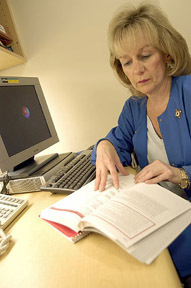
Ellen Cerullo, a registered nurse at Miriam Hospital for the past 26 years,
is taking classes on-site to earn her bachelor’s degree in nursing.
“It’s a springboard to a managerial position, teaching or getting my master’s
degree,” she said. “I’ve been wanting to do it for a very long time, but it’s
been difficult. But, going to classes at the hospital makes it much easier.”
Treating the shortage
Spotlighting the nursing industry has been a focus of several institutions
in Rhode Island. Colleagues in Caring, a group created through a partnership
between the hospital association and the URI College of Nursing, has created
externships for high school educators who in turn serve as vehicles for passing
along information about the health care field and the variety of opportunities
awaiting people with nursing degrees.
Educators are pointed to subject areas like algebra and biology, which students
need to take to become a nurse.
“You have to be more than just a nice person,” said Dayle Joseph, dean at
the College of Nursing. Joseph, who co-chairs Colleagues for Care, has used
this venue and other programs to attract high school graduates to the nursing
school.
Undergraduate enrollment in the nursing school totals 450.
Area hospitals have started their own in-house education programs to attract
and retain nurses, among other reasons. At Miriam Hospital in Providence, registered
nurses with two-year degrees like Cerrulo may take classes on-site to attain
a bachelor’s degree.
Rebecca Burke, chief nursing officer at Miriam, said the hospital teamed up
with URI to offer courses back in September. Currently 60 students are enrolled,
much more than the 15 she was expecting.
“So many nurses took advantage of this,” Burke said. “They are in a new learning
paradigm, opening themselves to a new awareness of the possibilities of nursing.”
A similar in-house program at Rhode Island Hospital allows nurses to earn
a master’s degree in nursing administration.
Donna Huntley-Newby, who oversees staff and patient education at Rhode Island
Hospital, said the program was created out of conversations about the nursing
shortage. Nursing administration was seen as an area that needed more attention.
“The job is very different than what it used to be,” she said. “They manage
millions of dollars. They need the skills to handle this.”
With the exception of books and application fees, both programs cost nurses
nothing. The fees are paid up front by the hospitals through existing reimbursement
programs.
These programs may be in place for a while as the nursing shortage is expected
to linger. According to some analysts, the shortage could last anywhere from
seven to 20 years.
“The average nurse is between 45 and 47 years old,” says Duquette. “We are
at a point where we need constant work to catch up with this trend. Currently,
the situation has stabilized a little.”
The average salary for a nurse is hovering around $50,000 including pay for
extra shifts, according to Joseph.
More nurses, less money
These initiatives are in competition with another reality facing hospitals
– declining revenues.
The Southcoast Hospitals Group in southeastern Massachusetts had a spike in
the number of uninsured patients coming through its doors last year. This was
the biggest factor in a recent $5.1 million loss on operations at its three
hospitals.
According to Barbara Weatherford, vice president of patient care for the hospital
group in Wareham and New Bedford, Southcoast had to do some creative budget
cutting in order to keep finances in line.
But slashing funds for caregivers, which includes nurses, is not among the
cuts. She said more patients mean more nurses and money needs to be diverted
from other areas. At her hospitals, paramedic services and cafeteria hours were
reduced.
She said about 56 percent of her budget, or $117 million, is allocated to
primary inpatient staff.
There are situations at hand that make paying these costs difficult in Rhode
Island. According to a 2001 study by the federal Medicare Payment Advisory Commission,
the state is at the bottom of the list of states receiving Medicare reimbursements.
According to Linda McDonald, president of the union United Nurses and Allied
Professionals, declining revenues have slowed income increases for nurses; this
has led to difficulties in nurse recruitment and retention in Rhode Island compared
to Massachusetts.
“Hospitals have to spend $75 an hour on a traveler (contract nurse) and this
costs money,” she said.
Freeing funds to train and recruit nurses will help cut back on the dependency
on contractors, thus making more money available to raise the pay scale for
all nurses.
In creating the hospital programs, providing simplicity has been a key factor
in its success. Cerullo has described the bachelor’s degree classes as “a golden
opportunity” in that the costs for tuition are paid up front by the hospital.
This allows her to forgo paying for classes on her own and later submit for
a reimbursement.
“I have two kids in college my husband and I are already paying for,” she
said. “We couldn’t afford a third.”
She says her fellow nurses have reacted positively to the program, adding
that the ease has made hitting the books again more of a reality.
Before, the general feeling was that nurses were expected to be responsible
for their own education as it pertains to getting advanced degrees. Now, she
says that notion has shifted. There is one less barrier for nurses to advancing
their knowledge and many are looking to take advantage of what’s available before
the door closes.