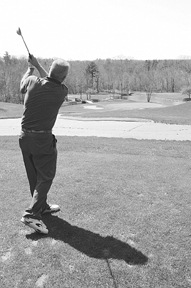
Chemawa Golf Course
Owner: Glen Bourque
Beyond Cash Donations: How New Forms of Giving Are Transforming Not-for-Profit Accounting
Evolving Funding Landscape for Not-for-Profits Not-for-profit organizations are being asked to do more with less,…
Learn More
Location: 350 Cushman Road, North Attleboro
Type of Business: Golf Course
Year Founded: 1994
Employees: Peak season: 32, including part-timers; off-season: four.
Annual Revenue: WND
It’s mid-July, and four thirsty golfers, laboring under a torrid midday sun,
peer into the distance and see a golf cart bounding toward them. The cart arrives,
and grins break out among the foursome as the cart’s driver stops and hands
out free slices of cold watermelon.
That little gesture – and some days it’s ice-cold Popsicles – is among the Unlike the lengthy courses that are seemingly designed to appeal to the nation’s That’s the philosophy that drives Glen Bourque, Chemawa’s 36-year-old owner, At 5,267 yards, Chemawa isn’t in the same class as the lush tracks that extend Chemawa, in fact, could be a template for the golf course of the future – But the negotiable holes and the watermelon runs aren’t the only features Since he took the management reins from his father, Raymond, back in the early Underpinning his approach is a conclusion drawn by The Wall Street Journal Chemawa avoids those three bugaboos by offering a venue that’s neither too When Glen Bourque graduated from Hartwick College in upstate New York, he Instead, he began working with his dad, a South Attleboro scrap metal dealer In time, Glen furthered his education – not in seminary, but at Rutgers University In 1994, three years after Glen took over, Chemawa expanded from nine to 18 Bourque readily admits that he’s not afraid to be derivative if it will make “I get a lot of ideas from places like Disney World and Myrtle Beach,” he His marketing instincts seem well honed. When golfers stayed away in droves Today, Chemawa (the word is Native American for ‘this old farm’) is booming. Regulars have to get used to the fact that Bourque will ban carts from use As the summer meanders on, Bourque and his groundskeepers will continue to “It’s attention to detail that makes things that much better,” Bourque said.
myriad amenities that make the Chemawa Golf Course in the Adamsdale section
of North Attleboro a unique place to swing a seven iron.
minuscule percentage of scratch golfers, Chemawa is dedicated to the proposition
that the game should deliver a satisfying experience to the vast majority of
average players who will never come within shouting distance of the 70s or even
the 80s.
who presides over an immaculately maintained venue that offers a reasonable
challenge to golfers of all levels.
into the upper 6,000, lower 7,000-yard category. But as Bourque points out,
it’s not an executive layout, either. You have to earn your pars.
one that appeals to a growing demographic: older men who have lost a few yards
off the tee and women of all ages who want to go out there and enjoy a reasonable
crack at par.
that make Chemawa special. The place is chock-full of gracious touches, from
the 1,000 flowers that Bourque’s staff plants around the course every spring
to the free-standing stone structures, one on each nine, that house on-course
restroom facilities. There’s also the clubhouse kitchen, which prepares lunches
and breakfasts for early arrivals.
1990s, Glen Bourque has devoted himself to making Chemawa a little gem of a
recreation spot.
in a recent feature titled, “Winning Back the Frustrated Golfer.” Today’s golfer
– or in many cases, former golfer – has been turned off by three parallel developments:
the game has become too difficult, too time-consuming and too expensive. According
to the WSJ, those drawbacks contribute to a disturbing statistic: 3 million
of the nation’s 26 million adult golfers give up the game each year.
difficult nor too expensive. (A round complete with golf cart costs $38 for
an adult during the week, $44 on the weekend.) As for time consumption, Chemawa
has neither excessive rough nor fairway-hugging woodlands to capture errant
shots. The golfer may flub a five iron, but he or she won’t have to spend precious
minutes looking for the ball while the following foursome grinds its collective
teeth.
intended to enter a seminary and become a priest. That plan went aglimmering
when he met the woman he would later marry.
who, with a partner, had bought the nine-hole course from George England in
1971.
in New Jersey, where he studied golf course management.
holes. Four of the new holes, located across Cushman Road from the original
course, were laid out by Goshen, N.Y., golf architect Steve Esposito.
Chemawa better.
said.
on Mother’s Day, for example, he adopted a Mother’s Day special: Moms played
free. Scores of grateful golf nuts dragged their moms and mothers-in-law out
to Chemawa to take advantage of an offer that gave them an extra day on the
links while keeping them in good standing with their families.
Leagues play just about every day – from women and seniors to a group of North
Attleboro town employees.
on days when the course is even marginally wet. Even the most die-hard hacker
understands that golf carts rip up the soft turf.
fuss over the little things.
Dick Sherman is a contributing writer to PBN.