selling local milk called Proud Cow of R.I.
Dairy co-op targets R.I. consumers
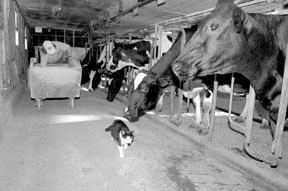
Joe Dutra, 55, still rises with the roosters at 5:30 a.m. with three hours of work ahead of him before he can consider sitting down for his morning cup of coffee. His arms are like tree trunks; his nails are dirty from milking his herd of 110 cows every 12 hours. He doesn’t know what it’s like to ponder what he’ll do today – it’s been decided for him every day for the past 25 years.
Beyond Cash Donations: How New Forms of Giving Are Transforming Not-for-Profit Accounting
Evolving Funding Landscape for Not-for-Profits Not-for-profit organizations are being asked to do more with less,…
Learn More
Dutra is a third-generation dairy farmer, and his way of life is endangered.
Dutra and others like him face an uncertain fate in Rhode Island, as dairy farms in the state have dwindled from 102 in 1977 to 22 today. Ten dairy farms have closed since 1999 alone, according to statistics. The remaining farms milk approximately 1,400 cows and produce about 2.4 million gallons of milk a year. The price that farmers receive for their milk is constantly changing, and is at its lowest since Jimmy Carter was president.
Meanwhile, operating costs continue to rise.
To try to save their livelihood, Dutra and his wife Jessie, owners of Wanton Farm in Jamestown, and other dairy farmers have formed the Rhode Island Dairy Farm Co-op and are working to market and sell a local brand of milk – Proud Cow of Rhode Island.
“Given the poor condition of the dairy industry, one of the beneficial things for farmers is direct marketing – eliminating the middleman and going straight to the consumer,” said Kenneth Ayars, chief of the state Division of Agriculture.
The state gave the farmers a $20,000 farm viability grant a few years ago to start Proud Cow.
“There is a lot of (public) interest, so it wouldn’t be a hard sell,” said Ayars. “In Rhode Island, people jump at the chance to support local farmers. They want local produce and want to see the open space maintained and they see this as a way to do that.”
More than 95 percent of the milk Rhode Islanders drink comes from other states, and for every $3.29 paid for a gallon of milk, dairy farmers receive $1. The store makes more to put the milk on the shelves than the farmer does to produce it.
“We used to mind our own business, fill up our bulk tank and get it sold,” said Joe Dutra. “When you’re working like this for $1 a gallon, it really makes you feel like a fool.”
In the past year, Proud Cow has made leaps and bounds toward becoming an official entity. The group – which currently consists of six other farms (four of them active dairy farms) – is working toward becoming a legal entity, has its own registered trademark, has a board of directors, has drafted bylaws, has a carton design and has a pasteurizer and processor. It’s been a complicated process.
“You think that it would be simple to put milk in a bottle and sell it, but
it’s not,” said Dutra.
Mother Nature hasn’t helped
This year has been especially hard on farmers, with the harsh winter, then wet spring and summer. The Dutras – who own 140 acres of farmland overlooking the Newport Bridge and Narragansett Bay – almost ran out of feed because they were behind in cutting hay due to the rain. Large milk processors have also continued to buy out smaller ones, making it even more difficult for dairy farmers here to have their milk processed locally. Competing with farms out West is impossible.
“They irrigate their alfalfa… use hormones and have 10,000 cows,” Dutra said. “If we can’t find a niche here, all of the milk is going to be from out of state.”
Proud Cow’s goal is to produce 2 percent of the milk consumed by Rhode Islanders, a seemingly small amount, but a percentage that will take a lot of the 22 dairy farms’ milk, Jessie Dutra said. The co-op wants to sell its brand of milk at local markets and convenience stores. Price hasn’t yet been determined, but Dutra said even 25 cents more would help.
“We think that every community with a local farm will want to have our milk,” she said. “Our goal is to have all the dairy farms in the state” taking part.
According to Ayars, the division is also working with Harvest New England – all of the New England departments of agriculture have contributed at least $20,000 to the organization, which will promote local products to larger stores like Shaw’s and Stop & Shop.
One of Proud Cow’s future goals is to preserve the remaining dairy farms, to bring back others that were lost, and bring in new farming families. The group is still working out the kinks, like whether they’ll be an actual business, but Jessie Dutra is hopeful.
“We’ve learned so much about what it takes to start a venture like this,” she said. “If we do this right, we can really help Rhode Island farmers.”
Dairy farmer Louis Escobar, owner of Highland Farm in Portsmouth, said he’s sure that Rhode Islanders would support Proud Cow.
“The general public has realized that there aren’t many (farms) left and they want to know how to help,” he said. “The Rhode Island consuming public is very conscious about supporting local agriculture.
“We’re used to working for a minimal return, but we have to make something,” he added. “This has been 20 months of continuous record-low prices. You can (manage) for a little while, but you can’t do it for long.”
Proud Cow will do more for Rhode Islanders than save the dairy farmers, Jessie Dutra said. Wanton Farm has hosted tours for two inner-city groups and held an open house this summer, something the co-op wants to do more.
“It’s good on so many levels – people want to know more about dairy farms,” she said. “Where are you going to have to go to see that,” if there are no dairy farms here?
Some farmers are using that public curiosity to make a profit where their milk business falls short. Escobar, also the chairman of the co-op, charges people to venture through a corn maze he maintains at his farm, which his father purchased in the 1930s.
Dairy farmers are frustrated that this is what their family history has been reduced to, but paying bills takes precedence.
“Your profit should be made in milk,” said Joe Dutra. “It’s a shame to have
to sell bottled water and have a corn maze to make a profit.”
Environmentally friendly
Farms have their own place in the environment. Dairy farms have nutrient-rich soil that can’t be replaced once the land has covered by subdivisions. Many farmers have surrendered their family farms to developers, just to get out of debt.
“Once it’s developed, you can’t go back,” said Jessie Dutra. “It’s the choice of working hard for nothing or living the easy life.”
“The future of dairy farming in Rhode Island – if it’s not Proud Cow – we’ll need to get something to get into a niche,” said Escobar. “We need to get a little more for our product or we won’t survive.”
Marketing and selling a local brand of milk will hopefully put a little more money into dairy farmers’ pockets, Escobar and the Dutras said. The co-op is betting on the state’s desire to support local commerce – especially an industry in danger of being erased.
“There’s no doubt in my mind” that Proud Cow will be successful, Escobar said. “The public wants to support agriculture. It’s not for everybody, but we need at least 2 percent. Anything above that will be gravy.”
For the complete current issue, visit our subscription Web site, or call (401) 273-2201, ext. 227 or 234.