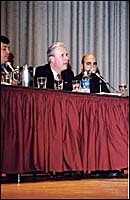
speaks at an ethics panel
at Johnson & Wales.
Johnson & Wales senior Chris Miksis already has seen his fair share of spotty ethical decisions during his brief career in the restaurant business. So while at a panel discussion on business ethics at Bishop McVinney Auditorium March 26, he was angling for some advice.
“What are a few ethical issues you wish somebody had warned you about when you were 22 years old and just starting your career?” Miksis asked the panel of four local business leaders, hand-picked from Johnson & Wales’ fields of expertise: business, technology, hospitality and culinary arts.
Miksis, the food-service-management major, and the rest of the audience of about 200 Johnson & Wales students got plenty of earnest advice.
Seifert Systems Invests in Energy Efficiency to Strengthen Operations
For manufacturers, energy is more than just another operating expense. It plays a critical role…
Learn More
“One, never get intoxicated in front of your boss,” offered panelist John Elkhay, a well-known local chef and co-owner of XO Café and Ten Prime Steak & Sushi. “And No. 2, don’t sleep with your co-workers.”
While the discussion ranged from tongue-in-cheek to thorny, each panelist tried to sort through the slippery issue of business ethics by boiling it down to simple maxims.
Guy Sanchez, a former vice president of GTECH Holdings Corp., said businesspeople should use a quick test when facing ethical decisions by asking themselves: Would you be embarrassed to read about your conduct in the local newspaper?
“If the answer is yes, it’s probably not an ethical decision,” he said.
Robert Schmeck, general manager of the Newport Marriott and chairman of the Rhode Island Hospitality and Tourism Association, showed the audience a thick copy of Marriott’s code of conduct, issued to the hotel chain’s 153,000 employees worldwide.
But Schmeck said he tried to condense it recently for his 9-year-old daughter. “I told her ‘Ethics means don’t lie, don’t cheat and don’t steal,’” he said. “That’s something she understood.”
John Hazen White Jr., president of Cranston manufacturer Taco Inc., said he has whittled down the definition of business ethics to two words: honesty and integrity.
Elkhay suggested using the guilt test: If you’re contemplating something that fosters any pangs of guilt, don’t do it.
He said there are plenty of opportunities for ethical lapses in the restaurant business, citing the time he quit a restaurant job because the owner had been filling top-shelf vodka bottles with the cheap stuff.
“That sort of thing will get you into Chapter 11 faster than anything,” Elkhay said.
While some examples are blatant, others illustrate just how easily situations can slip into ethical gray areas.
Sanchez used a hypothetical example: You’re a manager at a public company, where rumors of pending layoffs are rampant, and a subordinate tells you, “I’m about to buy a house but I’m afraid I might get laid off. Should I buy it?”
“There’s really not a right answer in a situation like that,” Sanchez said. “It’s times like those when you have to use your core value system to make the right decision.”
One student raised the question of accepting gifts from purveyors: Is it ever acceptable, and if so, under what circumstances? Both White of Taco and Schmeck of Marriott said their companies limit employee gifts to values of $50. At Marriott, gifts above that amount should be reported to a supervisor, Schmeck said.
Another workplace issue where the ethical line is becoming increasingly blurred: co-worker relationships. The panelists agreed that because Americans are working longer hours than ever, it is more difficult to forge meaningful relationships outside the workplace – and tougher to resist relationships with co-workers.
Relationships between superiors and subordinates cloud a manager’s ability to make objective performance evaluations and can lead to the perception of favoritism, the panelists said. And while each panelist said dating among employees at any level is generally a recipe for turmoil, there are exceptions.
“I wouldn’t have two kids today if I didn’t date somebody I worked with at the hotel,” said Schmeck, who said he met his wife while they both worked at Marriott.
White said the problem of superior-subordinate friendships can be just as dicey as dating relationships, because they can give rise to the same issues of impropriety.
“I’m closer to employees than my father (Taco’s former president) ever was, and that can bring about real problems,” White said.
But the issue of business ethics rises above the individual employee, as the nation has become keenly aware in the wake of the Enron and Arthur Andersen scandals. Sanchez said employees need to be diligent in sizing up an organization’s core values.
“If a company is unethical to its customers and suppliers, it is very likely that it will be unethical to its employees too,” Sanchez said.
So what did Miksis glean from the 90-minute discussion that might help guide his ethical decisions when he ventures into the Boston restaurant scene after graduating in May?
“I think just using common sense is key,” he said.