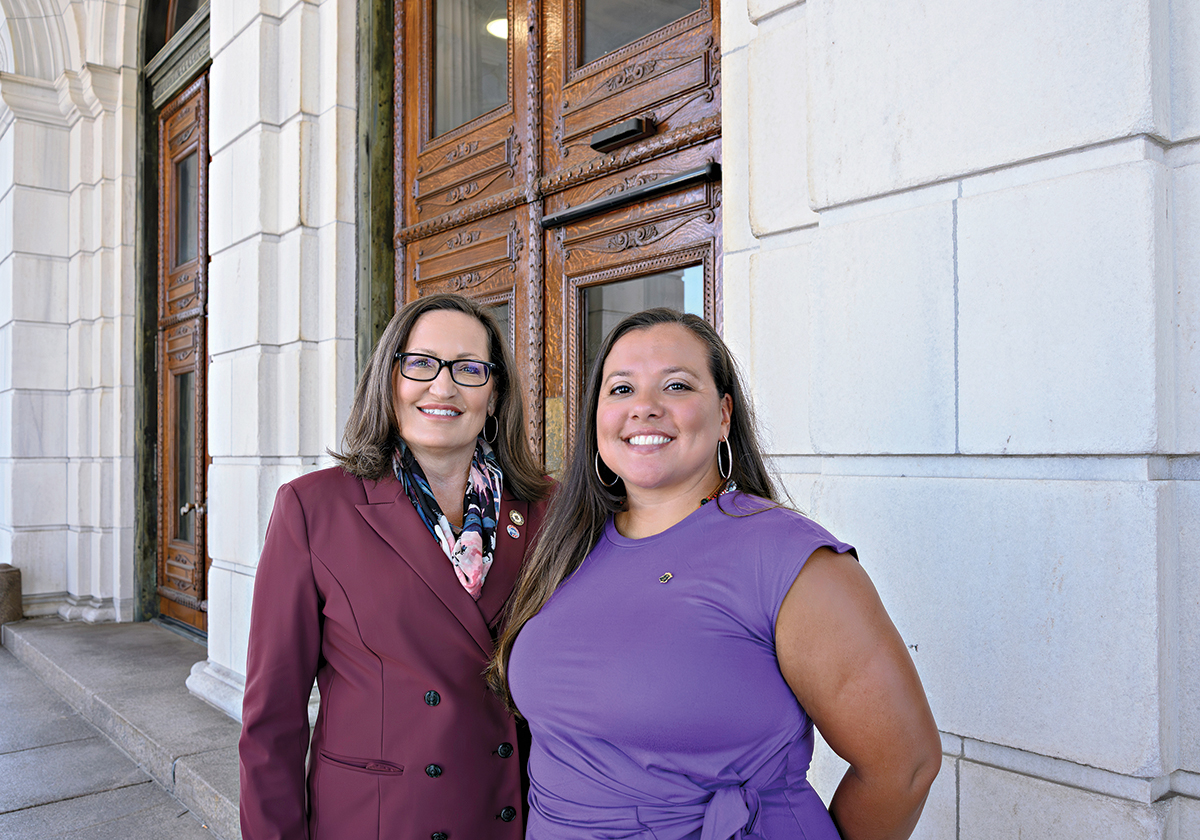
Sitting in front of a microphone, donning bright-pink glasses, Lori Urso proceeded to educate a room of mostly men about a topic most don’t talk about – menopause.
“Now look, this is an awkward conversation,” Urso, a Democrat state senator representing Pawtucket, said before the Senate Committee on Labor at the Statehouse in March. “Menopause has been stigmatized in this country for a long time. But it’s really high time that we normalize this conversation.”
Urso was presenting legislation to change Rhode Island’s Fair Employment Practice law to add menopause-related conditions to the list of medical conditions that employers have to accommodate, alongside pregnancy and childbirth.
Since then, the bill was passed by the General Assembly and signed into law in June, making Rhode Island the first state to mandate workplace protections for women employees going through menopause, a natural biological process that marks the end of a woman’s reproductive years and can bring on symptoms such as hot flashes and sleeping problems.
“We need to start being really more accommodating and understanding of what women are going through,” said Urso, a primary sponsor of the legislation along with Rep. Karen Alzate, D-Pawtucket. “Especially as this transition hits them at a time in their careers when they’ve built up a lot of experience … and all of a sudden they’re facing challenges that, frankly, sometimes you don’t quite know what’s happening to you at first, and you’re confused.”
Every woman faces menopause differently, says Dr. Renee Eger, medical director of the Obstetrics and Gynecology Care Center and the Menopause Program at Women & Infants Hospital.
Menopause is a natural decline in a woman’s reproductive hormones that usually occurs when they are in their 40s or 50s. Many women get hot flashes – a feeling of warmth they can’t escape – and night sweats. Other symptoms include memory loss, mood swings and heart palpitations. All of these can make it difficult for women to do their job, doctors say.
A survey by Society for Women’s Health Research found 25% of women decided not to pursue or considered not going for a leadership position at work because of menopause symptoms. Also, 40% of women considered finding a new job or changed jobs because of their symptoms.
The adverse effects of menopause on women in the workplace cost an estimated $1.8 billion in lost work time annually in the U.S., according to a study by the Mayo Clinic. That rises to $26.6 billion when medical expenses are added.
“The discussion about this is to really try to keep women moving forward in their careers and feeling confident to stay in their job,” Urso said.
The law doesn’t list any specific accommodations employers should offer. Instead, it says employers should “reasonably accommodate” menopause symptoms. And companies don’t have to take actions that are deemed to be an undue hardship, such as a very expensive or difficult accommodation, although employers have the burden of proving the hardship.
Urso says there are no plans to amend the law to include specific accommodations – it will be up to employers and employees to take actions that work best for their particular workplace and symptoms.
Some of these could be working out a different schedule to help women deal with the fatigue from sleep disruptions, time off for medical appointments, a hybrid work model or more remote work, better access to bathrooms, and adjusting uniforms and room temperatures so they’re more comfortable for someone dealing with hot flashes.
These are similar to accommodations that are offered to pregnant women or employees with medical conditions, says Kelly Nevins, CEO of Women’s Fund of Rhode Island.
“This isn’t really a crazy kind of ask of employers,” Nevins said. “It’s something that can help them [women] remain in the workplace, which is good for employers and also good for employees.”
Just 18% of employers said they planned to offer specific resources for women going through menopause in 2025, according to Mercer’s Survey on Health and Benefit Strategies for 2025. That is up from 5% in 2023.
The shifting attitude might be related to the aging workforce. In 2021, women 55 years and older made up 10.8% of the U.S. workforce, up from 5.8% in 1980, according to the U.S. Department of Labor.
And given that the average age of a Rhode Island worker is older than the national average, Urso says, keeping women in the workforce longer might be even more crucial.
Gregory Tumolo, an employment law attorney in the Providence office of Littler Mendelson PC, says the new law shouldn’t create any big burdens for employers. They will likely need to amend their policies and should handle menopause accommodations as they would related to any health condition.
However, Tumolo says, dealing with the changes to the Rhode Island Fair Employment Practice law may be easier for larger companies with the type of office work that is easily done remotely, if need be. Accommodating conditions such as menopause can be more challenging for smaller companies that require in-person work, such as construction or health care. Because the law went into effect less than three months ago, Tumolo recommends that companies unsure about how to comply with the law should consult an attorney.
While the law has gained national attention since it went into effect, Urso says workplace conversations about how to support women going through menopause have already been taking place across the world.
“It’s nothing new,” Urso said. “It may seem new now to people that we’ve passed this law, but this has been an important discussion that’s been going on.”