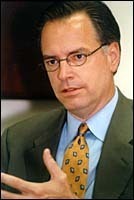
and CEO, Right
Management Consultants.
(Brian McDonald)
Name: John J. Gavin
Position: President and CEO Right Management Consultants, in Philadelphia
Education: Temple, University
Background: 18 years at Anderson Worldwide, five years at Right Management
Consultants
Residence: Philadelphia
Family: Married, three children
Name: Ray Way
Position: Managing Principal Right Management Consultants in Rhode Island
(a subsidiary of the parent, Right Management)
Education: Central Connecticut State University
Residence: Warwick
Family: Married, three children
Beyond Cash Donations: How New Forms of Giving Are Transforming Not-for-Profit Accounting
Evolving Funding Landscape for Not-for-Profits Not-for-profit organizations are being asked to do more with less,…
Learn More
PBN: Tell us about your company?
GAVIN: Right Management is the world’s largest career transition firm. We
are also in the consulting business. We are in 200 offices around the world and
we have been in business since 1980. This is our 20th anniversary as
a firm, as well as our 20th anniversary in Providence.
Define career transition?
GAVIN: When companies are displacing employees, whether it is an individual
for performance issues or whether it is a larger scale reduction in force — they
hire us to help their employees find new work. We aren’t a search firm and we
aren’t a placement business, but we help those people develop the skills and go
through the process to find their next opportunity. We are paid by the sponsoring
organization to provide that service.
What else does your company do?
GAVIN: The other line of business is providing three areas of consulting services
within organizations. We do talent management, leadership development and organizational
performance — three areas of helping develop talent within organizations, not
just those that are leaving.
How does it work?
GAVIN: We both seek out clients and they come to us. We have a reputation
and a brand that we are very conscious of. Our brand is that we are the premier
providers, the high quality provider, so we are very well known in the human resource
community. When there are events around downsizing, or transitioning employees,
we are well known. But we don’t sit back and wait for the phone to ring. It’s
a very strong relationship business. We are always trying to establish relationships
with senior executives, particularly human resources executives in larger organization
in each of the markets that we operate in.
The economy is slowing down, is this a good time for your business?
GAVIN: Yes. We recently released our results for the first quarter and our
revenues were up 34 percent. Profitability was also up substantially.
Are there specific industries you work with?
GAVIN: More of our business is with service intensive business, like banking,
health care, financial services, technology type companies where more people tend
to have more activity. But we are also very strong in the manufacturing sector
and the product sector.
Transitioning employees is a sensitive issue. What are the key elements to making a transition successful?
GAVIN: In terms of a significant downsizing, planning and communicating the
event so that the remaining employees feel as though the situation has been handled
as well as possible. That’s the issue. Companies that are letting people go are
very conscious of the need of the people that are staying to feel as positively
about the company as they possible can under the circumstances. So there are some
very good ways of handling those situations and some very bad ways. Part of doing
it the right way is planning and communicating it to the whole organization, and
the other part is giving outstanding service to those people that leave so that
they feel as though they have been treated well because they constantly talk back
to the people that remain in the organization.
Do displaced workers often have to find work out of their home state, or in other industries?
WAY: Eighty percent of the people that come through our program don’t want
to leave the state, or the industry. Whether you are from Rhode Island or Minnesota,
home is home. In fact, those 80 percent don’t have to move. Of the remaining 20
percent, 10 percent may find another spot outside of the community because they
have the expertise, and the other 10 percent decide that it’s time to retire.
Far and away the larger percent don’t want to move, and don’t have to. If you
are shutting down a plant or a division, we work with the hourly workers to help
them go out in the marketplace and explain what their skills and abilities are
so that they can not only find another job, but usually they can find one that
pays better.
We hear a lot about tech companies downsizing a lot in today’s market — is
this a hot spot for your company?
GAVIN: The whole technology sector and more specifically, the dot-com sector
has obviously gone through some major turmoil. A couple of years ago everyone
was flooding into that business, and now there are a lot of people that are being
let go from that business. What’s interesting is that the services we provide
people in that sector tend to be a little bit different. When people are coming
out of some of these dot-com companies they need to use technology and quicker,
better, faster is the mindset.
Is the need for services like those of your company, in sync with the unemployment rate?
GAVIN: A lot of people think that the unemployment rate would be a barometer
of our business activity, but it really hasn’t been. The unemployment rate has
been 4 percent in America for 10 years and our business has been growing steadily.
Our business revolves around change. So while the unemployment might be in the
4 percent range there is a lot of turn around in the employment. The point is
that while the unemployment rate is low or high, companies are churning people
and that’s where we come in.
Rhode Island and New England have experienced banking mergers over the past few years. How do you get employees to understand the ramifications of these mergers and more specifically, where they fit in?
GAVIN: We have two lines of business, the career transition is the business
that handles people that are redundant and therefore come out of those mergers.
Our consulting line of business is one that helps organizations think about how
they will fit together. To help the employees who are redundant understand who
wants to stay and who wants to try something new, what the strategy is going forward
and how someone fits or doesn’t. So our whole consulting line of business there
is an awful lot of work around the integration in acquisitions and helping to
select and retain the people that are best to keep and help transition out those
that don’t fit.
For what workers is there the most opportunity in downsizing situations?
GAVIN: Globally it’s the middle-market part of companies that is being squeezed.
That’s where the most overlap is. People need the people to do the work, and people
need the people to lead the organization. It’s really the middle management that
is finding it more challenging.
Because Rhode Island companies are so small, does it make for a more challenging market?
GAVIN: One of our competitive advantages is our global network. On the other
hand the other big advantage is strong relationships in the local market.
WAY: We deal with companies that have 25 employees and want to change around. There are a lot of private companies in Rhode Island, a lot of privately owned small companies and they have peculiar problems when it comes to employees. It’s just a different set of perimeters.
When do you begin to establish relationships with potential clients?
GAVIN: We try to establish relationships in advance of events. When there
is a notice in the newspaper about XYZ company having announced a downsizing,
it’s not time for us to be calling – it’s too late. It’s important for us to have
relationships with the kinds of companies that we think we can provide the best
service. We look at the quality of the organization, if it’s a company that has
a reputation for not treating its employees well. Then they are not inclined to
appreciate what we do. Second, we look for multi-national organizations because
one of our competitive advantages is our 200 locations. And third is, those companies
where change appears to be evident, the banking sector, health care sector and
technology sector, go to where the opportunities are going to happen because you
know the industry in which they are operating.
WAY: The answer is the relationships happen all the time. In Rhode Island, last year was our biggest volume ever in terms of business and it was a boom economy. Things are happening on one end and people are being displaced on the other end. We are constantly in front of our clients, whether it’s good times or not. The market in Rhode Island is such that we only have a limited amount of global companies. I think that the average company in this state is 100 employees or less, and those are our clients as well. By being in the marketplace for 20 years you get to know everybody and keep that relationship going.