While the troubled economy drags along in search of a recovery, many family businesses are making the most of enduring relationships and long-term perspective not just to survive but thrive.
A partnership between Kyle Dwyer, 34, and his brother, Bob Dwyer, 38, Dwyer Hardwoods in Narragansett saw a 350 percent annual growth in sales in 2009. (The company would not provide sales figures.)
The brothers began working in construction as teenagers in upstate New York and their experience and family cohesion are paying off.
Their first step toward success was focusing on the specialty hardwoods market, including oak, maple, cherry, birch and walnut for high-end residential work. The company does custom woodworking.
Before the economy took the huge dive, the company got a bank loan, said Kyle Dwyer. He says the company jumped into the competitive market for cedar and other exterior products, providing an avenue for growth.
Dwyer Hardwoods has just four full-time employees, so family makes all the difference.
“Our father is retired and comes for a couple of days from upstate New York,” Dwyer said. “Sometimes he drives a truck. Bob’s wife, Jen, is our part-time bookkeeper. Jen’s father is retired and comes in to help.
“If the floors in the warehouse need to be swept, someone sweeps the floors. Or they answer the phone. Or they work on a quote for customer,” Dwyer said. “We’re getting inexpensive help.”
That all-for-one attitude is a major advantage family businesses have in surviving the recession, says Tom Juenemann, executive director of the Institute for Family-Owned Business in Portland, Maine.
“Family members take cuts in pay, or no pay at all, to keep the business going,” said Juenemann, who recently surveyed 25 family businesses across the country and found them, surprisingly, and almost uniformly, upbeat.
“Endurance and longevity are the primary motivators of family businesses,” Juenemann said. “In a family business, typically, profit is not the primary motivator.”
Ted Clark, director of the Northeastern University Center for Family Business in Boston, said advantages family businesses have over public corporations include investing “their own money, and they have an emotional investment” in the business’ success. At a recent retreat with members of a dozen New England family businesses, Clark heard a repeated message – they understand how to prepare for the future and they’re making tough choices.
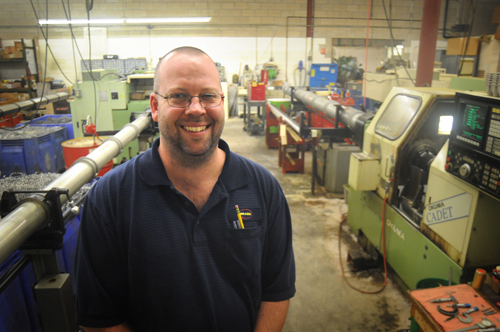
The company had 34 employees in 2008 and had to cut back to 16, says Vice President Mike Hamilton, whose father, Warren Bruce Hamilton, started Brada Manufacturing in 1979.
Mike Hamilton, 38, started helping at the Warwick company when he was 14 years old.
So in January 2008, when Brada Manufacturing invested $400,000 in additional state-of-the-art machinery, it was a difficult, but necessary, decision, Hamilton said. The capital investment was required to meet demands of the shop’s broad customer base, which includes the aerospace, valve and medical industries, he said.
And while the layoffs were a tough choice in a company where some employees have been working for 25 years, valuable relationships endure. Brada Manufacturing has slowly been rehiring former employees and the company is now up to 24.
Long-term relationships with customers make up 70 percent of the business and are also a critical factor in keeping Brada moving solidly forward through the recession.
Experts say long-term perspective is key to the endurance of family businesses.
“Family businesses tend to plan for and hope for longevity across generations,” said Andrew Hier, a member of the Family Firm Institute Inc. in Boston and a partner in the Owner Managed Business Institute in Cambridge.
Since the shareholders are usually all family members, they can adjust their expectations about dividends so that capital is protected for longevity, Hier said. “This is in contrast to publicly held companies, where there is pressure to deliver dividends to shareholders on a regular basis.
“Secondly, publicly traded companies need to satisfy stock analysts’ expectations of profits each quarter,” he said. “This forces many publicly traded companies to make investment and operational decisions based on short-and mid-term goals. Privately held family businesses, on the other hand, can allocate their investments, costs and overhead for the best long-term return.”
While most of its customers are in Rhode Island, Connecticut and Massachusetts, Brada Manufacturing has about 15 percent national and international business – another avenue to keep the company strong during tough economic times.
“We just keep plugging away. It’s not going to be down forever,” Hamilton said. “Most of the industries we serve are starting to pick up.” •