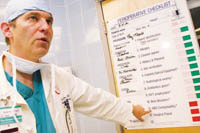
Dr. Harry Sax, chief surgeon at The Miriam Hospital, explains a checklist of items that help prioritize operating room procedures.
Borrowing from flight procedure lowers errors
On his white coat, Dr. Harry C. Sax dons a button that reads “because we’ve always done it that way” crossed out in red. That phrase, says the new chief surgeon at The Miriam Hospital, isn’t an acceptable answer to why things are done in his operating room.
Beyond Cash Donations: How New Forms of Giving Are Transforming Not-for-Profit Accounting
Evolving Funding Landscape for Not-for-Profits Not-for-profit organizations are being asked to do more with less,…
Learn More
Sax has changed protocols since he took over the Providence hospital’s OR last June, using steps he takes during one of his other passions – flying airplanes.
“I think there’s a certain amount of mechanical acumen that you have to have in both areas,” the surgeon and pilot said. “And I think many of us are comfortable with great levels of responsibility.”
Since last year, Sax has trained about 200 clinicians in the Lifespan system – which includes Miriam, Bradley, Newport and Rhode Island hospitals – in what is called “Lessons from the Flight Deck.”
The goal of the course is to improve performance and reduce errors in the operating room, borrowing things from aviation such as checklists, constant communication and voluntary reporting of mistakes.
“The reality is that we all make mistakes,” Sax said. “The best hospitals in the world make mistakes every day.”
Recent estimates place the number of American deaths due to medical mistakes at up to 98,000 per year, costing the health care system as much as $29 billion in litigation and clinical and lost-wage costs, according to a January 2003 entry in the Association of periOperative Registered Nurses Journal.
Yet it’s a challenge to get clinicians to admit failure in the competitive environment of medicine, Sax said. “It’s very, very uncomfortable for people to discuss making mistakes,” he said, “because most of us got here because we didn’t make a lot of mistakes on the tests,” as well as in their clinical training grounds.
The chief surgeon said that many errors in the operating room, as in flying, are due to a series of miscues that lead to a dire outcome. Thus, he and his surgical team run through a checklist of 14 items to verify things as simple as the patient’s name and where to operate.
Sax noted that plane accidents seldom occur, in part due to the pilots’ practice of voluntarily reporting mistakes made in the air. And the Federal Aviation Administration will actually clear pilots of liability in some cases if they report their errors without the agency’s urging.
Actually, the idea to use aviation practices in the surgical process came to Sax in the mid-1990s, around the time that his hospital at the University of Rochester in New York performed knee surgery on a patient – on the wrong leg.
Sax said that the blunder prompted him to develop a course adapted from Crew Resource Management training. FlightSafety International, a subsidiary of Warren Buffet’s Berkshire Hathaway Inc., had been providing the flight training to commercial pilots.
Part of the flight training urged team members of all ranks and specialties to voice their opinions, Sax said, so he decided to train surgeons, anesthesiologists, nurses and technical staff when he started the medical version of the program in 1999.
By the time Sax left the university for Miriam last year, about 500 clinicians had finished the aviation-type training. According to surveys done before, during and after the course, he said, people who took the course were more comfortable sharing ideas and reporting their errors.
The training gives clinicians more than confidence. They can use their course hours toward their continuing-education requirements. Also, he said, some malpractice insurance carriers award doctors a 5-percent discount on their policies for taking the course.
In fact, Sax said, disclosing errors to patients and their families can work to the malpractice insurer’s advantage.
“The malpractice rates don’t go up,” he said, “and in many cases they either go down or they settle for much less money – because people are being honest.”