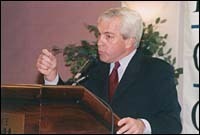
Senate Majority Leader.
Promising to work on several fronts to promote economic
development initiatives, newly elected Senate Majority Leader William V. Irons
outlined his priorities to business leaders and state officials at a Greater Providence
Chamber of Commerce breakfast meeting Thursday (Nov. 16) at the Providence Marriott.
Irons, a Democrat from East Providence, also challenged small business owners
to get to know their senators and representatives and to invite their legislators
to their places of business.
Seifert Systems Invests in Energy Efficiency to Strengthen Operations
For manufacturers, energy is more than just another operating expense. It plays a critical role…
Learn More
“Many of my colleagues do not understand you,” said Irons. “It is rare for
a business person to reach out to a public official. It is critical that each
of you develop a relationship with your senator and representative.”
Irons said he would re-institute a practice of meeting with business leaders
each January to discuss business concerns and what the legislature can do to
help them. But, he said, business people must do their part by educating lawmakers
and making time to visit the State House during the legislative session.
High tech shortcomings ‘unacceptable’
As for issues he considers critical, Irons cited five: high quality government;
a competitive tax policy; 21st Century infrastructure; excellence
in education at all levels; and treating Rhode Island’s high quality of life
as an economic asset.
In discussing the need to establish of high quality government, Irons said;
“Good government is more than honest government. It is an effective and efficient
government that lives within its means during good times, recognizing that the
national economy on which we feed will not always be as strong as it is now.”
He pointed out that studies have ranked Rhode Island among the country’s least
technologically savvy states when it comes to e-government, or use of the Internet.
“That is unacceptable to me,” he said. “We do not want to give business people
the impression that Rhode Island is quaint, that it is backward.”
Irons has appointed a point person to look specifically at Internet issues with
regard to state government.
“I have asked Sen. Daniel DaPonte, (D-Dist. 42) to delve into e-government and
information technology issues,” said Irons.
Irons’ calls for a more competitive tax structure drew applause from the audience.
During the 2000 legislative session, Irons supported a proposal that would have
provided tax benefits for the state’s wealthier business leaders – a proposal
that never made it to a full vote. Tax breaks for the wealthy
is an issue that has traditionally drawn strident opposition from advocates
for the poor.
But proponents counter that by allowing for such benefits, companies are more
likely to remain in Rhode Island and expand — creating new jobs.
“I believe that economic stagnation hurts those at the bottom most,” he said.
“It reduces their opportunities.”
A great deal of Rhode Island, said Irons, competes with Massachusetts and Connecticut.
“We all know that,” said Irons. “I know that making our tax rates competitive
will attract strong opposition from those who are chiefly concerned with income
and equality. And I respect differences of opinion. But there is nothing divinely
ordained about our current tax structure. It is the product of federal and state
actions over several years.”
It is both rational and reasonable, said Irons, to be competitive. Borrowing
from a phrase he heard from a colleague years ago, “the best public policy is
a strong economy,” said Irons.
Irons also called for the state to bring its infrastructure into the 21st
Century. He praised the development of T.F. Green Airport and said that the
state can and should support the development of a container port at Quonset
Point.
“We can have a port, we must have a port that can handle tankers,” he said.
The federal Environmental Protection Agency, said Irons, will tightly control
details such as where dredged materials are sent – how storage containers are
stored.
The bickering about the port, said Irons, “has got to come to an end.”
“Wherever materials are disposed or used, EPA regulations will have to be met,”
said Irons.
The new Senate Majority Leader spoke of the importance of bringing the state’s
education system in line with the times.
“Our educational system was built around a manufacturing economy and a national
economy in which the U.S. faced few serious competitors in the domestic market,”
he said. “These conditions changed in the 1970s. Now we have an information
economy and global competition. Education is the key – and it is a key with
a different shape.”
Irons said our schools are performing much as they did in 1970.
It isn’t that they have gotten worse, he said, but “expectations and needs have
changed.
“The purveyors of negativity will have all of us think that our education system
is dismal and down,” he said. “The reality is that the world has changed at
a pace that no one could have anticipated. You can see that in the IT dearth
that we have throughout the nation.”
Irons called for all to workers together to redirect the educational system,
with business leaders leading the way.
“Business people know first-hand what the economy demands,” he said.
Irons drew a very clear correlation between quality of life and economic development.
“Individuals have quality of life when they have capacity and opportunity… that
is when they can make a choice,” he said. “A degraded environment limits choice.”
Irons used Providence Place as an example of what is possible, chastising those
who criticized its very development as some kind of “corporate welfare.” When
Money magazine recently named Providence the best place to live in the East,
Providence Place was a big part of that, said Irons.
“I challenge anyone to tell me that wasn’t the linchpin that brought everything
together,” said Irons. “That took courage, it took leadership.”
Irons’ inaugural address to the business community as Senate Majority Leader
appeared to play well.
Mark Formica, vice chairman at Citizens Bank, credited the legislator’s record
on business issues, including financial services legislation and health care
reform.
“Bill Irons has been a very strong friend of business,” said Formica. “He has
an ability to balance varied concerns.”
Mark Hayward, director of the Providence office of the U.S. Small Business Administration,
said Irons’ straight-forward approach resonates with both business and labor.
“That’s one thing about Bill Irons — he’ll tell it to you straight,” said Hayward.
“That’s the best thing for this community and for the labor community.”