way at Warwick Center
Technologies imagined by Hanna Barbera in the cartoon The Jetsons might not
be that far off in the future. Although it is not likely that everybody will
live in homes in the sky and use spaceships for transportation any time soon,
the ability to talk to people in far away places and look at them at the same
time is getting more affordable.
Like many aspects of the telecommunications industry, the technology for videoconferencing keeps improving, and thus making equipment easier to manufacture at cheaper costs.
"It’s just like computers," said Peter Cotton, founder and owner of MRI Sales Consultants of Rhode Island and ConferView Videoconferencing Centers in Warwick.
Seifert Systems Invests in Energy Efficiency to Strengthen Operations
For manufacturers, energy is more than just another operating expense. It plays a critical role…
Learn More
"Twenty years ago a 10 megabyte hard drive was a big deal, and the machine (used for videoconferencing) would probably cost you about $40,000," he said. "In the late eighties you could buy a cart system for about $16,000, and now machines cost as low as $3,000. And the quality is constantly getting better."
With over 490 sites across the U.S., and over 100 internationally, ConferView was the first provider of videoconferencing in Rhode Island. Cotton has seen the technology change quite a bit since 1993, when ConferView rose from the executive search agency MRI. He said there is still room for improvement in the medium before the technology can emulate normal television programming though.
"People that watch television at home are very sophisticated viewers," he said. "The broadcast quality has a lot more money behind it. With pans, zooms and tilts the image is constantly moving and changing."
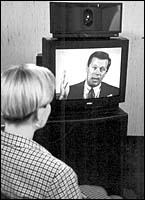
In the ConferView office is a conference room with a cart system, where clients come to hold videoconferences with others across the country and throughout the world. Atop the television sits a box a little bigger than a VCR. In the middle of the table is an area microphone. When somebody speaks the microphone senses the voice, and the camera shifts toward the speaker.
Dennis McCarthy is global link manager at Bryant College in Smithfield, where he helps clients find remote sites for videoconferencing and preps them on how to behave during a videoconference.
"The technology is becoming less expensive and in terms of its visual quality it has improved dramatically in the last five years," he said. "Many folks who have used it in the past five years have had a bad experience with it, but now if they try it again, they’ll find it delivers optimal video communication."
Cotton explained the process of an analog video signal and audio signal being compressed and converted to digital, and being sent anywhere across the globe, and re-converted to an analog signal. He said it is no wonder that there is a minor delay in the transmission.
"But it’s only under a second," he said.
Thomas Rossi, general manager of the Manufacturing Jewelers and Suppliers of America, has had a lot of experience with videoconferencing, and said he is pleased with the way the technology has evolved, but that it could be better.
"There are some shortcomings," he said. "It’s nothing like seeing somebody in person, but to me it’s the next best thing."
Cotton agreed with the place of videoconferencing in personal interaction.
"It really fills the gap between a phone call and a personal visit," he said.
East Providence-based EBS Econotel has within the past year or two shifted its marketing efforts from its phone systems to its videoconferencing units, because there is more of a possibility clients will be interested when they see how the prices have gone down.
"The technology has become more affordable and more accessible," said Barbara Goldberg, chief financial officer EBS. "The infrastructure is becoming more widely available and it’s not exotic to have the connectivity anymore."
Cotton said along with the quality and affordability of videoconferencing improving, the number of uses is increasing. ConferView has played host to clients testifying in court cases all over the world. One client, David Gold, was recently an expert witness in a trial that took place in Aukland, New Zealand, yet he had to travel no further than Warwick.
With ConferView’s parent company MRI, many of the company’s clients will use videoconferencing to interview job candidates in other regions. And Bryant’s program includes videoconference outreach to students in kindergarten through twelfth grade.