For Quentin Sanford, Jr., the fascination started early.
When he was a child, car trips to visit relatives in the Central Falls/Pawtucket area would take his family past the China Star Restaurant, the shiny stainless steel and green diner car originally home to Keenan’s Diner in East Providence.
Beyond Cash Donations: How New Forms of Giving Are Transforming Not-for-Profit Accounting
Evolving Funding Landscape for Not-for-Profits Not-for-profit organizations are being asked to do more with less,…
Learn More
“When we were kids, we’d ride by, especially at nightand it made an impression on our minds,” Sanford said, referring to his brother and himself.
Today, Sanford owns the very diner that sparked his interest all those years ago, and he has plans to reopen it – he hopes–by the end of the year.
The diner opened as Keenan’s Diner in 1951, but it is Chinese food that was served in the building for much of its history, during its incarnation as the China Star Restaurant. China Star operated from 1964 to January 2000.
Sanford has named the structure the Star Diner to honor both periods of the diner’s history.
A couple of years ago, Sanford said, the land was to be sold and the diner donated to the American Diner Museum for its exhibit at the Heritage Harbor Museum and Library. But the deal fell through, and Sanford said he knew the best way to preserve the diner was to buy it.
For Sanford, an antiques and automobile enthusiast, it was a natural step.
“We own an ice-cream place in Westport, Mass. – a seasonal place – and we’ve always wanted to go year-round,” he said.
Since August 2000, Sanford, along with family and friends, has been working on the diner, preparing it for what he hopes will be a winter opening – preferably by the end of this year.
The process, he said, has “taken much more than we thought.” Cleaning 50 years’ worth of cooking grease and nicotine film off of the diner’s surfaces has taken some doing, but the building has been well cared for. The original clock still works and the piping for the music system is still intact. All it needs is a jukebox.
Being faithful to the diner’s history is part of the plan. A sample of the diner’s original upholstery provided a prototype for Alden Manufacturing of Hartford, Conn., to reproduce the originals it had crafted for the structure 50 years ago.
“We’re trying to keep it as original as we can,” Sanford said.
Unique to the nature of diners, which are constructed to be moved from location to location, the Star Diner has sat on the same location since 1951, once serving jockeys from the nearby Narragansett Park race track, Sanford said. Today, East Providence’s Newport Avenue is an active strip with restaurants and retail chains.
“This area has kind of grown up around it,” he said.
Diners steeped in history
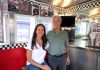
Kim Pelletier has been a waitress at Pawtucket’s Modern Diner – the first diner in the country to be placed on the National Register of Historic Places – for 13 years, where she said that weekends are the busiest times, but that early weekday mornings have their share of crowds too. Pelletier said she enjoys working at such a popular destination.
“There’s a lot of history to the diner,” she said. “A lot of people come here just for thatsome people come here just to look.”
And then there are the regulars.
Jose Depina works close by and comes in five or six times a week, for the people, he said, and “I like the food a lot.”
“I come here as much as I can,” said Willie Williams, a Pawtucket resident who lives close by. “I remember when this building was way downtown (Pawtucket), years ago. I remember when it opened up over here.”
The diner was moved from Times Square in downtown Pawtucket to its current location on East Avenue 16 years ago when owner Nick Demou bought the building.
“When we took it over, diners were not popular,” Demou said. “They just weren’t. We took a real chance on it.”
That has changed, with consumers’ growing interest in everything nostalgic, but Demou said he still feels pres
sure to distinguish himself from his competitors. One way the Modern Diner does that is through an extensive list of breakfast specials on weekends.
“We can’t ever slack,” he said. “We always have to be the best and the fastest. If we don’t, we’ll fail.”
A graduate of the Johnson & Wales College of Culinary Arts, Demou could work in or own another type of restaurant, but for him running a diner is a lifestyle choice.
“I’m home and showered by 3:30 in the afternoon,” he said. “Of course, I do have to be up earlier than most people, but I’ve never not been able to take my son to practice or to swim lessons.”
“Preserving America’s Diners,” a tour led by Daniel A. Zilka, executive director of the American Diner Museum, was offered twice during the recent convention of the National Trust for Historic Preservation held in Providence.
The American Diner Museum is a non-profit organization dedicated to recognizing the historic significance of vintage diners to American culture by publishing a diner directory annually and hosting Diner Rama, a conference and exhibit for diner enthusiasts from all over the country.
The organization will have a permanent home when the Heritage Harbor Museum and Library opens in Providence’s Jewelry District. Found in the most abundance in the Northeast, the diners on the tour drew praise even from those who didn’t grow up with them as a dominant part of their architectural landscape.
So much so, that by the tour’s second stop, one woman proclaimed to no one in particular: “I want a diner.”
Indeed, there seems to be something undeniably appealing about the structures.
“They’re fascinating,” said Kate Carothers, a historic preservation specialist from Covington, Kentucky. “I really wanted to come on this tour.”
“I’m from Oklahoma, and we don’t have any diners. The few that we had are gone,” said Oklahoma State Legislator Russ Roach, who lives in Tulsa. “Things like that that are unique – that involve people and make them express themselves are good.”
Diners have their origins in Providence, Zilka said, inspired by the lunch wagon invented by Walter Scott in 1892. The most famous diner of this type – in this area anyway – is Haven Brothers Diner, still open each night at 5 p.m. to serve late-nighters in Kennedy Plaza until 2 a.m.
Until the lunch wagon, “there was literally no place to eat after 6 p.m.,” he said. “It was the beginning of fast food in America.”
But with a distinct difference.
“Diners tend to reflect a locality,” Zilka said. “You go to McDonald’s, it’s all the same. Diners are inherently the people of the area in terms of clientele, and their staffs as well. They’re more interesting. And, they’re uniquely American.”
That comfortable feeling is precisely what restaurant chains like Denny’s and Johnny Rockets are trying capitalize on with their new, diner-style designs, Zilka said.
“It’s a feeling that you usually don’t share with people when you’re at a Dunkin’ Donuts,” he said. “It’s a real camaraderie.”
Thirty-two companies – many of which also constructed train cars – built the prefabricated dining cars at one time, Zilka said. Diners could be shipped in pieces and assembled on site, moved if a land lease ran out, or traded in for a larger model when business boomed.
At one time, five to six thousand diners dotted particularly the truck routes on the East Coast. Once construction on the Interstate highway system was begun in the 1950s – when drive-ins and later drive-throughs were the rage – production of diners fell off dramatically. Today, less than half that number remain standing, Zilka said, making his work to find, restore and relocate the structures all the more crucial.
Currently, the American Diner Museum is attempting to relocate seven diners.
“There are only so many of the vintage diners that are left,” he said. “When a diner leaves, it leaves a hole.”