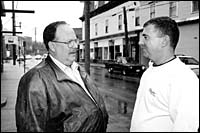
the goal of Gary Turner (left) and
Robert Peloquin.
What Gary Turner sees when he drives the streets of downtown Pascoag is quite different than what is actually there.
Where there is a crumbling stone shell that used to be a mill building, he sees a gleaming new coffee shop. Where there are boards on the windows and falling vinyl siding, he sees a bowling alley. And where there is an empty storefront, he sees a dry cleaner or some other type of service-oriented business.
He jokes that his vision gives him “energy like that of a teenager.”
Rhode Island's Market Has Changed. Developers, Builders, Investors and Sellers Must Change With It.
By Emilio DiSpirito IV License Partner | Engel & Völkers Oceanside Leader | The DiSpirito…
Learn More
But he knows that if he is going to be successful in his new job as the area’s Main Street Coordinator, where his main goal is to make his vision a reality, he is going to need all the energy he can muster.
“Our goal is not to change the community, but instead to make what is there a little better,” he said. “Everybody here wants to bring this area back to life. Now we just need to make it happen.”
In fact, at one time, Pascoag, one of six village communities that in the town of Burrillville, had its own bustling downtown. With life revolving around the local textile mill, the downtown area had a wide mix of businesses, including a general store, a movie theater, a hardware store, and even a bowling alley.
But when the textile industry left the state, taking with it most of the jobs, the village and its business community gradually decayed.
“We absolutely had a thriving community,” Turner said. “And I firmly believe that if the textile industry hadn’t moved we would be a hot spot in the state, but instead today we are strictly a bedroom community.”
For Turner, and the group that hired him, the Downtown Pascoag Association, the time to change is now. In fact, the group has been working with the Northern Rhode Island Chamber of Commerce to change its image and make the downtown area more “visitor friendly.”
“The key is to work together,” said Robert Peloquin, chairman of the Downtown Pascoag Association. “I know that this is going to happen, and when it does happen it’s going to promote new business and bring new life to the area.”
The downtown section, which runs almost in a circle connecting four roadways, currently has fewer than 20 business, including two bars, two pizza places, a florist, a hardware store, a coffee shop, an IGA supermarket, a bank and a tanning salon.
What makes the area unusual is that while half of the area is commercial, the other half is residential.
“We are definitely a mixed-use community. It’s an unusual mix,” Turner said. “But I think it creates a unique opportunity for service type businesses. I also think it’s important that we provide something for the younger residents, especially those under the age of 16, to do.”
Still, the two men are reluctant to say exactly what kind of businesses they would like to see in the downtown area.
“It’s not up to us to determine what type of businesses can come here and succeed,” Turner said. “I would think that smaller service-oriented business would be suitable.”
Turner isn’t concerned about the added competition new business would bring or how that competition might affect the current business owners in the area.
“The business climate handles that,” he said. “It always amazes me. I don’t know how it happens, but it does. It seems like businesses are opening as the town grows. More competition also bring more traffic and more traffic brings more customers, so in the end I think it’s good for local business.”
According to Paul Ouellette, vice president of community development for the Northern Rhode Island Chamber of Commerce, this revitalization is crucial to the future success of businesses already in the area.
“This is an area that has remained virtually unchanged and is a fine example of what a mill village used to be,” he said. “But you can only let something deteriorate for so long. I think that this is something that really needs to be done.”
For Peloquin, the hard part is already over.
“I think the biggest hurdle is behind us,” he said. “Organizing and getting started is the hard part, but right now we have the people in place and a lot more is going to happen.”
Still the area suffered another setback earlier this year when a gas leak contaminated the local water supply forcing both residents and businesses to start buying their water.
“It’s an unfortunate happening,” Turner said. “And, yes, it was a temporary stumbling block. But I think that people will recover and if anything it has brought the town closer together.”
And according to Peloquin there are too many good developments that have already happened to slow the movement. For example, he said, the town recently bought a building for renovation in the downtown area and has expressed an interest in creating a municipal parking lot in the area. In addition, work has already begun on a river walkway and park.
“I think that once people realize what is happening here they will want to get involved,” he said. “There are a lot of positive things going on here.”